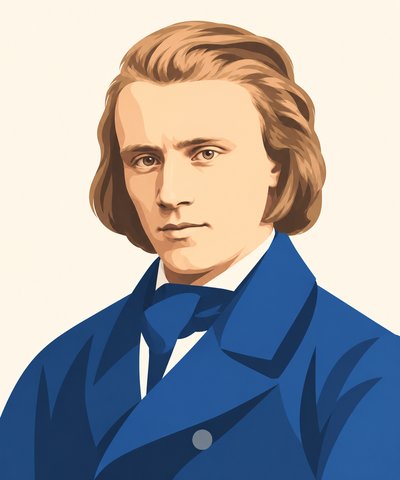
Johannes Brahms was born in 1833 in Hamburg, in northern Germany. His family lived in a poor, crowded old part of the city. His father was a musician who played the double bass in dance halls and small bands. He gave Johannes his first music lessons, and at seven the boy began to study the piano with a piano teacher. But the boy wanted to compose all the time. His teacher complained that he “could be such a good player, but he will not stop his never-ending composing.”
In 1853, at 19, Brahms went on a concert tour with a violinist friend. The violinist came from Hungary, and through him Brahms came to love Hungarian dance music. Years later this led to his Hungarian Dances. On the tour he met the violinist Joseph Joachim, and they became friends for life. In Weimar he visited Liszt, who was 22 years older and the most famous pianist in Europe. It is said that Brahms was too nervous to play for him. So Liszt took Brahms’s handwritten music and played it at sight, although he had never seen it before. Joachim then told Brahms to visit Robert and Clara Schumann in Düsseldorf. When Brahms rang the doorbell, the Schumanns’ eldest daughter ran to open the door. She was 12. She later remembered a very young and very handsome man with long fair hair. Robert asked him to play at once. After only a few bars Robert stopped him and said, “Wait, I must call my wife.” Robert was so impressed that he wrote an article praising him as a brilliant new talent. With Robert’s help, a publisher printed Brahms’s first works, among them Liebestreu (Faithful Love).
In 1854 Robert became mentally ill, and he was taken to a hospital. Brahms stayed in Düsseldorf, and he helped to run Clara’s home. Robert died in the hospital in 1856. During these hard years Brahms and Clara became very close. Their letters show how much they cared for each other. Clara remained one of his closest friends for the rest of her life. In 1858 Brahms became engaged to a young singer. But he felt that he could not marry while he had no steady job, so he ended the engagement. He never married.
In 1859 his First Piano Concerto was performed in Leipzig, and the audience hissed to show that they did not like it. Brahms wrote to Joachim that a failure like this was the best thing for him, because it made him think harder and gave him courage. “All the same,” he added, “the hissing was rather too much.” That same year he started a women’s choir in Hamburg, and he wrote these rules for it. Rule the first: It is hereby declared that the members of the Ladies’ Choir shall be there. Rule the second: It is hereby declared that the members of the Ladies’ Choir shall be there at the appointed time. Rule the third: Any member who is absent or late shall pay a fine, and the said money shall be given to the poor. Of course, he wrote all this as a joke. But that season the practices often had to stop, because the director himself was not there. He had gone to a music festival.
In 1862 Brahms hoped to become the conductor of the orchestra concerts in his home city. But the job went to someone else, and he was deeply hurt. Thirty-two years later Hamburg finally offered him the same job. Brahms said no. He wrote that it should have come at the right time. That autumn of 1862 he visited Vienna for the first time. The people there welcomed him warmly, and he lived there for the rest of his life. In 1865 his mother died, and he began to write A German Requiem. Most requiems pray for the dead. But Brahms chose words from the Bible that comfort the people who are left behind. He said that he would gladly have called it a “human Requiem.” Its first performance in 1868 made him famous.
Years before, one of the singers in his Hamburg choir had come from Vienna. She often sang him a song from her home city. By 1868 she was married, and that year she had her second son. For the baby Brahms wrote a lullaby, and in the piano part he hid the song from Vienna that she used to sing to him. This is his famous Lullaby.
In 1877 Brahms helped the Czech composer Antonín Dvořák, who was eight years younger, to find a publisher, and Dvořák soon became famous. From then on the two were very close friends. Years later, while Dvořák was working in America, Brahms himself checked the printed music of Dvořák’s new works, so that they could be published. When Dvořák came back, Brahms asked him to move to Vienna. Dvořák wanted to stay in Prague, but it is said that Brahms even offered him his own money and property.
Brahms liked to make jokes, often about himself. In 1878 the handsome young man of 1853 grew a long, full beard. It is said that he then introduced himself to a friend as “Music Director Müller,” and the friend did not recognize him. He was a close friend of Johann Strauss II, the “Waltz King” of Vienna. Once he was asked to sign a lady’s fan. He wrote down the first notes of Strauss’s The Blue Danube, and under them he wrote, “Unfortunately not by Johannes Brahms.” In 1896, at a dinner, Joachim began a toast to “the greatest composer.” It is said that Brahms called out at once, “Quite right, here’s to Mozart!” A friend said that his teasing was never unkind.
In May 1896 Clara died. Only a few weeks later Brahms himself became ill, and over the next months he grew slowly weaker. When friends asked how he was, he answered, “Each day a little worse.” In March 1897 he went to hear his Fourth Symphony in Vienna. He was already very weak. After every part of the symphony the audience applauded him, and tears ran down his face. He and the audience both knew that this was goodbye. Soon afterwards he could no longer leave his bed, and he died in Vienna in April 1897, at 63, less than a year after Clara.
Brahms was shy, and his words could be rough. But he loved jokes, especially jokes about himself. He lived simply, he stayed loyal to his old friends, and he was kind to younger composers. In his time Liszt and Wagner believed that music had to find new forms. Brahms loved Bach and Beethoven, and his music joins their strong, careful forms with warm and deep feeling. Even Wagner once said, after hearing Brahms play, “One sees what may still be done in the old forms when someone comes along who knows how to use them.” His four symphonies and his German Requiem proved it. The conductor Hans von Bülow called Bach, Beethoven and Brahms the “three Bs” of music. He meant the three greatest composers, whose names all begin with B. People still use the phrase today. Brahms also wrote about 200 songs, and his Lullaby is probably the best-known lullaby in the world.
演唱 Johannes Brahms 的曲目
这些曲目收录在 Singalong Solfege 中。可以跟随引导人声和钢琴伴奏,用唱名演唱。
| 编号 | 难度 | 曲名 | 年份 | |
|---|---|---|---|---|
| Ex. 11-5 | ④ | Liebe und Frühling I | 1852 | |
| Ex. 12-4 | ③ | Liebestreu | 1852 | |
| Ex. 12-5 | ⑤ | Lied aus dem Gedicht 'Ivan' | 1852 | |
| Ex. 14-9 | ② | Die Mainacht | 1866 | |
| Ex. 3-9 | ③ | Der Gang zum Liebchen | 1868 | |
| Ex. 1-9 | ② | Nachtwandler | 1877 |