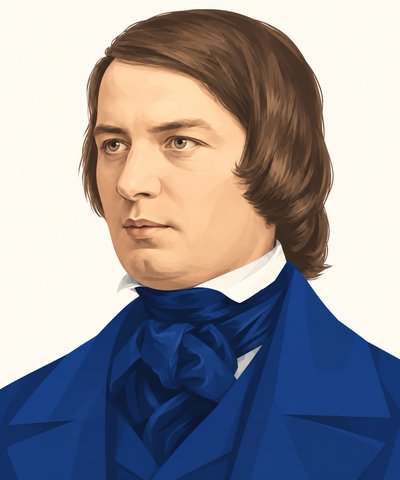
Robert Schumann was born in 1810 in Zwickau, a town in Saxony, Germany, the youngest of five children. His father sold and published books, and he also wrote novels himself. As a boy Robert read all the time, and he wrote poems and plays. A school friend remembered that Robert was sure he would one day be famous. Famous for what, he did not yet know. He also loved music. He found the parts of an overture in his father’s shop, gathered a few school friends with instruments, and conducted them from the piano. His father bought them music stands, and he sat in a corner at their evenings, pretending not to notice.
When Robert was 15, his only sister died. A year later his father died too. His mother wanted a safe life for him, so in 1828, at 17, he went to Leipzig to study law. The next year he moved to the university in Heidelberg. But at Easter 1830 he heard the great violinist Paganini, and that summer, at 20, he wrote to his mother at five in the morning: “Good morning, Mamma! My cigar tastes uncommonly good.” Then he came to the point. His whole life, he wrote, had been a struggle between “Music and Law.” He asked her to let him study music. The piano teacher Friedrich Wieck promised that in three years he would make Robert one of the greatest pianists alive, and Robert moved into Wieck’s house in Leipzig.
But from 1831, at 21, the fingers of his right hand grew weak. He may have hurt them with a machine he used to strengthen his fingers, but nobody knows for sure. He tried every cure, even some very strange ones, and he joked about them in his letters to his mother. Nothing helped, and by 1832 he knew that he would never be a concert pianist. So he turned to composing.
He also began to write about music. In 1831 he wrote about the unknown Chopin: “Hats off, gentlemen, a genius!” In 1834, at 23, he helped to start a music magazine, and for ten years he was its editor. He signed his articles with made-up names. The passionate Florestan and the gentle, dreamy Eusebius were two sides of himself. He used the magazine to help young composers, and many years later he wrote about the young Brahms in the same way.
When Wieck’s daughter Clara was 16, she and Robert fell in love. Her father did not like it at all. He feared that marriage would end her career, and he did not believe that a poor young composer could support her. Once Clara told Robert that he sometimes seemed like a child. Those words gave him the idea for Scenes from Childhood, a set of short piano pieces. One of them is the famous Träumerei (Dreaming). Wieck also told Robert that nobody bought his music. So Robert asked his publisher how many copies had been sold. The publisher checked and found that hundreds of copies had been sold. “Well, it really can’t be so bad after all,” Robert said to himself, and he went cheerfully on his way.
After a long fight in court, Robert and Clara were at last allowed to marry in 1840, when he was 30. That year he wrote nearly 150 songs. In May, while they were still waiting for the court’s decision, he wrote Mondnacht (Moonlit Night), which is now one of the most famous of all German songs. On the evening before the wedding he gave Clara a book of 26 songs called Myrthen (Myrtles). The myrtle is a flower that brides wore in their hair. The book opens with Widmung (Dedication), and near the end comes Aus den östlichen Rosen (From the Eastern Roses). Until then he had written only piano music and songs. But the next January he wrote his First Symphony in four days. “I must confess, my dear husband,” Clara wrote in their diary, “I did not think you were so clever.”
Schumann was famous for being silent. He could sit among friends all evening and hardly say a word. His old teacher knew this well. In 1843 the two of them met at a crowded party, and they had no chance to talk. Later Schumann said sadly, “Oh, we haven’t been able to talk together at all!” His teacher laughed and teased him about his silence: “Then we’ll just be silent together, as much as we like!” Schumann blushed and said, “Oh! Then you’ve not forgotten me?” He was happy that his teacher still knew what he was like. But the quiet man could also become very angry. In 1848, the year after Mendelssohn’s death, Liszt spoke badly of Mendelssohn’s music in Schumann’s home. Schumann, who had loved Mendelssohn, lost his temper and left the room. Liszt later admitted that he had been wrong.
He loved his children. He thought that the pieces children usually learned were “so bad.” So for his eldest daughter Marie’s seventh birthday he wrote some little pieces for her, and they grew into a whole book, the Album for the Young. He also wrote rules for young musicians. One of them says: “Try, even if you have only a small voice, to sing at sight without the help of an instrument; your ear will grow ever sharper.”
In 1850, at 40, he became music director in Düsseldorf, and the town welcomed him warmly. But he was a poor conductor. He was very short-sighted, he spoke softly, and he did not like to talk, so the players often did not understand what he wanted. In the end he gave up the post.
In February 1854, at 43, he began to hear music that was not there. One night he wrote down a melody that, he said, angels had sung to him. He asked to be taken to a hospital, because he no longer trusted his own mind. A few days later he threw himself into the Rhine, but boatmen rescued him. He spent the rest of his life in a hospital near Bonn. That June Clara gave birth to their last son. Robert did not hear the news until September, when Clara wrote to him. He wrote back: “What joyful news you have sent me! The birth of a fine boy!” Clara wanted him to choose the baby’s name. He answered, “You will easily guess my choice, the name of the unforgettable one.” He meant his friend Mendelssohn, who had died seven years before, and the boy was named Felix. For a while Robert wrote letters, and Brahms came to play the piano with him. But for more than two years the doctors did not let Clara see him. In July 1856 she was at last allowed to visit him, and two days later he died, at 46. He never saw his son Felix.
Schumann was shy and silent, but warm, loyal and full of quiet humour. As a boy he had not known what would make him famous. In the end it was his music, and his writing about music too. His songs, written mostly in that one happy year, are among the greatest in German song, and with Schubert he is counted as one of its two great masters. He was also generous to others, and through his magazine many young composers found their audience. That magazine, started in 1834, is still published today.
演唱 Robert Schumann 的曲目
这些曲目收录在 Singalong Solfege 中。可以跟随引导人声和钢琴伴奏,用唱名演唱。
| 编号 | 难度 | 曲名 | 年份 | |
|---|---|---|---|---|
| Ex. 6-6 | ④ | Aus den östlichen Rosen | 1840 | |
| Ex. 9-3 | ① | 免费 | Mondnacht | 1840 |
| Ex. 14-7 | ③ | Widmung | 1840 |