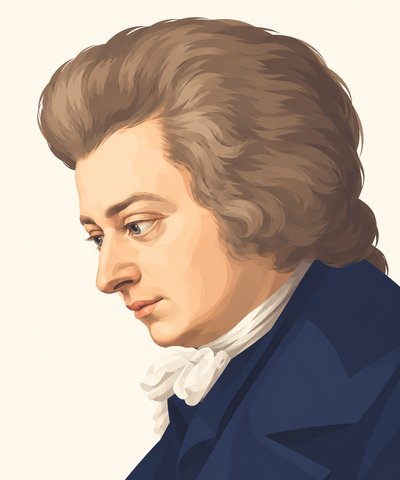
Wolfgang Amadeus Mozart was born in 1756 in Salzburg, a town that is now in Austria. At that time Salzburg was a small state, and its ruler was an archbishop, a high leader of the Church. Mozart’s father, Leopold, was a violinist in the archbishop’s orchestra. He taught Wolfgang and his older sister Nannerl at home, and he was Wolfgang’s first and most important teacher. The boy was writing little pieces at about five.
In 1762, at six, he began to travel across Europe with his family, and he played for emperors and kings. In Vienna he played for the Empress Maria Theresa. His father wrote that afterwards the boy jumped onto the Empress’s lap, put his arms around her neck and kissed her. It is said that at the palace he also slipped and fell on the shiny floor. One of the Empress’s young daughters helped him up. She was Marie Antoinette, who later became Queen of France. It is said that the boy told her, “You are kind. I will marry you.”
Between 1769 and 1773, from 13 to 17, he made three journeys to Italy with his father. In 1770, at 14, he wrote an opera for Milan, and it was a great success. Between the journeys he played in the archbishop’s orchestra in Salzburg. Wie unglücklich bin ich nit (How Unhappy I Am) is from these years. He wrote songs like this one for his friends and for music at home.
But he was unhappy in Salzburg, because the pay was low and there were few chances to write operas. In 1777, at 21, he left his job, and he went with his mother to look for a better one. They stayed for some months in Mannheim, a German city with one of the best orchestras in Europe. There he wrote two French songs for the daughter of a flute player in the orchestra. These were Oiseaux, si tous les ans (Birds, If Every Year) and Dans un bois solitaire (In a Lonely Wood). In Mannheim he also fell in love with Aloysia Weber, a young singer with a beautiful voice. Then they went on to Paris. There his mother became ill, and she died in July 1778. On his way home Mozart saw Aloysia again in Munich, but it is said that she no longer cared for him. In January 1779 he went home to Salzburg.
In 1781, at 25, the archbishop took him to Vienna. There the archbishop treated him like a servant, and he did not let Mozart play for money at other people’s concerts. The two men argued, and Mozart asked to leave his job. He stayed in Vienna for the rest of his life. In 1782, at 26, he married Constanze Weber, Aloysia’s younger sister. They had six children, but only two sons lived to grow up. That same year Gluck, who was 42 years older, praised a new opera by Mozart and invited him to dinner.
In Vienna Mozart also became a close friend of Joseph Haydn, who was 24 years older. In 1785 Haydn told Mozart’s father that his son was the greatest composer he knew. In the same year, at 29, Mozart wrote Das Veilchen (The Violet). It is often called one of the first true German art songs, serious songs for voice and piano.
In 1786, at 30, his opera The Marriage of Figaro was first performed in Vienna. Later it was performed in Prague, and it was a huge success there. In January 1787 he visited Prague, and he wrote to a friend that people there played, sang and whistled nothing but Figaro. After that he wrote a new opera for Prague, Don Giovanni.
Mozart loved jokes and word games. He sometimes signed his letters to his sister “Gnagflow Trazom,” which is his name written backwards. His letters to his family are also full of rhymes, made-up words and rude jokes about the toilet. His parents and his sister wrote the same kind of jokes back to him. He also loved to dance. In 1783 he held a ball in his home, and it went on from six in the evening until seven in the morning.
In 1784 he bought a starling, a small bird that can copy sounds. In his notebook he wrote down a tune that the bird sang. It was almost the same as a tune in his new piano concerto, but the bird sang one note wrong. Next to it Mozart wrote, “That was lovely!” The concerto had not yet been played in public, so perhaps Mozart had whistled the tune in the shop, and the bird had learned it from him. When the bird died three years later, Mozart buried it in the garden. He wrote a funny poem for its grave. In it he called the bird “a dear little fool,” said that it had been a bit naughty but always cheerful, and asked the reader to cry for it.
In September 1791 his opera The Magic Flute was first performed. He had written it for a popular theatre outside the centre of Vienna. Ordinary people came to see it again and again. At the same time he was working on a Requiem, a mass for the dead. That summer someone had ordered it from him without giving his name. In late November Mozart fell ill, and he had to stay in bed. He died in Vienna on 5 December 1791, at 35. Mozart could not finish the Requiem, and one of his pupils completed it later. Haydn was in London when he heard the news. He is said to have written that the world would not see such a talent again for a hundred years.
Mozart was full of jokes and tricks, and he loved to make people laugh. He loved dancing and good company, he wrote long, silly letters to his family, and he even wrote a poem for his pet bird. The people around him probably had a great deal of fun with him. In his short life he wrote more than 600 works in almost every kind of music, and he is seen as one of the greatest composers who ever lived. In a letter about his piano concertos, he wrote that experts would find special things in them, but that ordinary listeners would enjoy them too, without knowing why. In his own time his music pleased both kinds of listeners. Almost every great composer after him, from Beethoven and Schubert to Chopin and Tchaikovsky, loved his music and learned from it. For many of them, Mozart’s music was the model of beauty, clear form and perfect balance.
演唱 Wolfgang Amadeus Mozart 的曲目
这些曲目收录在 Singalong Solfege 中。可以跟随引导人声和钢琴伴奏,用唱名演唱。
| 编号 | 难度 | 曲名 | 年份 | |
|---|---|---|---|---|
| Ex. 2-2 | ③ | Wie unglücklich bin ich nit | 1772 | |
| Ex. 1-2 | ④ | Oiseaux, si tous les ans | 1777 | |
| Ex. 8-3 | ④ | Dans un bois solitaire | 1778 | |
| Ex. 3-2 | ④ | Das Veilchen | 1785 |