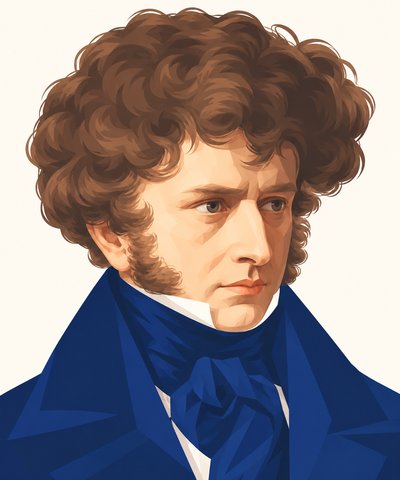
Hector Berlioz was born in 1803 in La Côte-Saint-André, a small town in the south-east of France. His father was a doctor, and he wanted his son to become a doctor too. Hector loved music, but he never learned the piano. The only instruments he played were the flute and the guitar. According to his own story, his father once promised him a fine new flute if he would study the bones of the body seriously. The boy said a weak “yes,” and then he threw himself on his bed in despair.
In 1821 his father sent him to Paris to study medicine. In the book he later wrote about his life, Berlioz said that the first time he saw the room where students cut up dead bodies, he jumped out of the window and ran home. He went back and got used to it. But in the evenings he went to the opera, and he fell in love with the music of Gluck. He copied Gluck’s scores by hand in the library of the music school. Soon he gave up medicine and studied composition, first privately and then at the Paris Conservatoire.
In 1827 an English company played Shakespeare in Paris. Berlioz did not understand English, but he was overwhelmed by the plays and by the Irish actress Harriet Smithson, who played Ophelia and Juliet. He fell madly in love with her. She did not answer his letters. In 1830 he poured his feelings into the Symphonie fantastique, the story of a young artist’s love and wild dreams. It is still one of the most famous symphonies ever written. His friend Liszt later arranged it for piano, and from that piano version Schumann wrote a famous review that made Berlioz known in Germany.
That same year he won the Prix de Rome, France’s top prize for young composers, on his fifth try. He wrote the prize piece during a revolution in Paris, while bullets hit the wall near his window. Later the winning piece was played in public at the prize-giving. But a horn player missed his entry, and the big ending never came. Berlioz was so angry that he threw his score across the orchestra. After this, he decided that he would conduct his own music himself, so that other people could not spoil it.
The prize took him to Rome, where he heard that the young pianist he was engaged to had married another man. Berlioz set off for Paris to kill her, her husband and her mother. According to his own story, he took two pistols, poison and a maid’s dress as a disguise. But he lost the dress on the way, and on the coast road near Nice he calmed down and found that he was hungry. He then spent what he called “the twenty happiest days of my life” in Nice, and there he wrote his overture King Lear.
Back in Paris, in 1833, he married Harriet Smithson at last, and they had one son, Louis. But the marriage was not happy, and after about ten years they separated. When Harriet later became very ill, Berlioz paid for her nursing and visited her almost every day until she died in 1854.
His music was hard for many Parisians to accept, and for 30 years he earned his living by writing about music for a newspaper. He hated the work. In 1838 the great violinist Paganini heard his music. He went down on his knees in front of Berlioz on the stage, and two days later he sent him 20,000 francs. Paganini wrote that Beethoven was dead and only Berlioz could bring him back to life. With the money Berlioz wrote Roméo et Juliette, which he dedicated to Paganini.
In 1840 and 1841 he wrote six songs to poems by his friend Théophile Gautier, Les Nuits d’été (Summer Nights). Absence asks a loved one to come back. In 1843, on a concert tour of Germany, he arranged it for orchestra for the singer Marie Recio, who travelled with him and later became his second wife. It was the first of the songs he arranged in this way. Later he arranged the others too, among them Villanelle.
People in other countries liked his music more than people in France did. He conducted his music all over Germany, in Austria, in Russia and in London. In Leipzig in 1843 he and Mendelssohn exchanged their conductor’s sticks, like two chiefs who exchange weapons as a sign of friendship. Berlioz sent his heavy oak stick with a joking note: “Great chief! … here is my tomahawk.”
His last great work was the opera Les Troyens (The Trojans). In his lifetime only half of it was performed. But the money it earned was as much as his pay from the newspaper. So in 1864, at 60, he stopped writing about music at last. He wrote in the story of his life, “Finally, finally, finally… free!”
In the 1860s he lost one person after another. His second wife died suddenly in 1862. In 1864, at 60, he found his first love again. He had fallen in love with her at twelve, when she was 18. He visited her in Lyon, and she greeted him with “We were two children!” They wrote to each other until he died. In 1867 his only son, Louis, a ship’s captain, died of a fever in Havana. Although he was very ill himself, at 64 Berlioz went on one more concert tour to Russia. “If it kills me,” he wrote, “at least I will know it was worth it.” Back in France he grew weaker, and he died in Paris in 1869, at 65.
Berlioz was passionate, proud and quick to anger, but he could laugh at himself, and he stayed loyal to the people he loved. He was a master of the orchestra. His book on writing for each instrument taught composers for generations, and the bold new sounds of his Symphonie fantastique still amaze listeners today.
Hector Berlioz の曲を歌う
これらの曲は Singalong Solfege に入っています。ガイドの歌声とピアノ伴奏に合わせて、ドレミで歌えます。
| No. | 難易度 | 曲名 | 作曲年 | |
|---|---|---|---|---|
| Ex. 13-4 | ③ | Absence | 1840 | |
| Ex. 7-4 | ⑤ | Villanelle | 1841 |