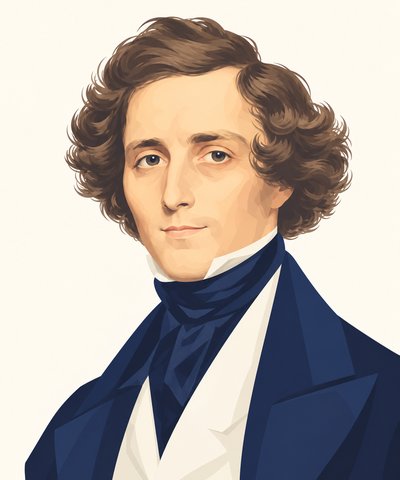
Felix Mendelssohn was born in Hamburg, a port city in northern Germany, in February 1809. His father was a banker. Felix was the second of four children. His sister Fanny, who was three years older, was also a gifted composer, and all his life she was his closest musical friend. At that time Napoleon, the ruler of France, had forbidden all trade with Britain. The family bank had helped to break this rule, and the family feared that the French would punish them. So in 1811 the family left Hamburg in disguise and moved to Berlin.
The four children had a whole team of teachers at home. A composer taught Felix music, and a painter taught the children to draw. In 1821, at 12, his teacher took him to meet Goethe, the great poet, who was then 72. Goethe compared him to the young Mozart. It is said that when Goethe was in a bad mood, he asked the boy to play the piano for him. “I am Saul, and you are my David,” he said. In the Bible, the young David played the harp to make the sad King Saul feel better.
Felix also loved sport, and he swam “with real joy.” In 1826 some young friends started a small swimming club. According to his friend Eduard Devrient, a singer, one friend wrote “swimming songs,” and Felix set them to music. Then the friends tried to sing them while they were swimming.
That summer, at 17, Felix wrote his overture to A Midsummer Night’s Dream, based on the play by Shakespeare. It is said that three years later, in London, a friend left the score in a cab. It was never found, so Felix wrote down the whole score again from memory. Seventeen years later he wrote more music for the play, including the Wedding March, which is now played at weddings all over the world.
In 1829 Bach had been dead for almost 80 years, and his music was known mostly to musicians. Felix wanted to perform Bach’s St Matthew Passion, a large work for choir and orchestra. Devrient helped him to find the singers. In March, at 20, Felix conducted the work in Berlin. It was a great success, and from then on more and more people wanted to hear Bach’s music.
That year Felix travelled to Britain for the first time. In London a carriage knocked him down, and he hurt his knee. He had to stay in bed for about five weeks, so he missed Fanny’s wedding. He had promised to write organ music for it, but it was not ready. So Fanny wrote her own.
From the age of 13, Felix took a sketchbook with him on every journey. In 1830, on a long journey to Italy, he began to paint in colours. He wrote that he could not stop himself from drawing every day, because he wanted to take home memories of his favourite places.
In 1833 Felix became the music director of Düsseldorf, a city in western Germany. There he wrote his song Auf Flügeln des Gesanges (On Wings of Song), and it became one of his most popular songs. In 1835, at 26, he became the leader of the famous Gewandhaus Orchestra in Leipzig. That same year his father died, and Felix was deeply shaken. Leipzig was the city where Bach had worked for the last 27 years of his life. In 1840 Felix gave an organ concert of Bach’s music in Bach’s own church there, to raise money for a monument to Bach. The monument still stands beside the church today. Later, in 1843, he also opened a music school in Leipzig.
In 1836, in Frankfurt, Felix often visited the family of a young woman named Cécile. At first she thought that he came to see her mother, because he talked so much with her mother. The two young people became close while they drew the view from the window together. Felix wanted to be sure that his love would last, so he went alone to the seaside in Holland for a month. Then he came back and asked her to marry him. They married in 1837, and they kept a diary together, full of drawings by both of them. They had five children.
Felix could not sit and do nothing. Devrient wrote that when people only chatted, Felix kept looking at the clock. While he talked, he drew little pictures with a pencil. He once taught Devrient to play chess, and he laughed a lot, because Devrient could not remember any of the moves.
In 1842 Felix visited Queen Victoria and Prince Albert at their palace in London. Before she sang for him, the Queen said that her parrot must be taken out, “or he will scream louder than I can sing.” Felix lifted the big cage and carried it out to the surprised servants. Then the Queen sang a song from his first book of songs. But the song was really by Fanny, and it had been printed under Felix’s name. Felix had to tell the Queen, and he wrote that this was very hard for him.
In 1846, at 37, Felix conducted the first performance of Elijah, a large work for choir and orchestra, in Birmingham, England. The audience wanted to hear eight parts again, so they were repeated at once. O Rest in the Lord was one of them. But by then he was very tired from all his work, and his health was poor.
In May 1847 Fanny died suddenly, at the piano. It is said that when Felix heard the news, he screamed and fell to the ground. Later he wrote to her husband, “I am sure I shall be a better man than I have been, though not such a happy one.” That summer he went to Switzerland with his family. Fanny’s son later wrote that Felix first looked for comfort not in music, but in painting. There he painted 13 large watercolours.
In September he went back to Leipzig. He had never been able to sit still, but now he often sat with his hands in his lap. In October he fell ill, and he grew weaker. He died in Leipzig on 4 November 1847, at 38, less than six months after Fanny. He was buried in Berlin beside her.
Felix Mendelssohn was cheerful and full of energy, and he could not sit still. He was good at almost everything he tried: music, drawing, swimming and chess. He was warm to his friends, and he loved his family. He and Fanny were very close all their lives. He used his gifts for other people’s music as much as for his own, and he brought Bach’s music back to a wide public. His own music is clear and elegant, and it pleased everyone, from Queen Victoria to the families who played his Songs Without Words, short piano pieces with a singing melody, at home. In his lifetime he was one of the most loved musicians in Europe.
Felix Mendelssohn の曲を歌う
これらの曲は Singalong Solfege に入っています。ガイドの歌声とピアノ伴奏に合わせて、ドレミで歌えます。
| No. | 難易度 | 曲名 | 作曲年 | |
|---|---|---|---|---|
| Ex. 14-5 | ④ | Es lauschte das Laub so dunkelgrün | 1826 | |
| Ex. 8-8 | ③ | Auf Flügeln des Gesanges | 1835 | |
| Ex. 1-5 | ③ | O Rest in the lord | 1846 |