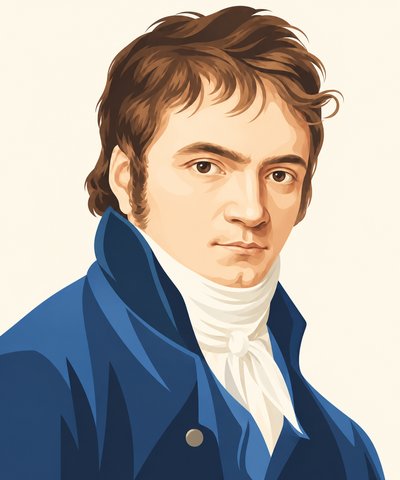
Ludwig van Beethoven was born in Bonn, in western Germany, in December 1770. His grandfather and his father were musicians at the court of the prince who ruled Bonn. At about ten he began to study with Christian Gottlob Neefe, the court organist. Neefe gave him the Well-Tempered Clavier by Johann Sebastian Bach, a large set of pieces for keyboard. In 1783, when Ludwig was 12, Neefe wrote in a music magazine that the boy could play most of these pieces. He added that the boy would “certainly become a second Mozart.” By then he was already playing the harpsichord in the court orchestra, and sometimes the organ in Neefe’s place. He had also published his first piece. Later, as a young man, he played the viola in the court orchestra. In 1787, when he was 16, his mother died. His father had drunk too much for years, and after his wife’s death it became worse. In 1789, at 18, Ludwig asked the prince to pay half of his father’s money to him instead. The prince agreed, and with this money Ludwig looked after his two younger brothers.
In November 1792, at 21, Beethoven moved to Vienna to study with Joseph Haydn. Haydn was 38 years older and the most famous composer in Europe. Mozart had died in Vienna the year before. Before Beethoven left, his supporter in Bonn, Count Ferdinand Waldstein, wrote in his album, “You will receive the spirit of Mozart from the hands of Haydn.” Beethoven never went back to Bonn.
Beethoven soon became famous in Vienna as a brilliant pianist. People admired him above all for his improvising. He never took a post at a court or a church in Vienna. He lived from his music and from the support of nobles who admired him. In Vienna he wrote nine symphonies, 32 piano sonatas, 16 string quartets and one opera, Fidelio. He also wrote many songs. Zärtliche Liebe (Tender Love) is a love song from 1795, his early years in Vienna.
His hearing began to fail in 1798, when he was 27. For a musician this was terrible. In 1802, at 31, he stayed in Heiligenstadt, a village near Vienna. There he wrote a long letter to his brothers, but he never sent it, and it was found only after his death. In it he wrote that he had been so unhappy that he had thought of ending his life. But his music held him back. He felt that he could not die before he had written all the music that was inside him. Bußlied (Song of Repentance) comes from these hard years.
Six years later, in 1808, Napoleon’s younger brother Jérôme, who was then king of a state in Germany, offered Beethoven the post of head of music at his court. The nobles of Vienna did not want to lose him. So in 1809, when he was 38, his pupil Archduke Rudolf and two princes promised to pay him a large sum every year for the rest of his life, if he stayed in Vienna. Beethoven accepted, and he turned down the king’s offer. Der Liebende (The Lover) is a song from that year.
Many people loved Beethoven’s music, but many found the man himself difficult. He was very proud, and he had a fierce temper. But he could also be very kind. In 1800 a music newspaper asked its readers to help the youngest daughter of Bach, who was old and poor. Beethoven offered to give her the money from one of his new works. In 1806 he stayed at the country house of Prince Karl Lichnowsky, who had been his first supporter in Vienna. The prince asked him to play for some French officers. At that time France was Austria’s enemy, and Napoleon’s army had defeated Austria the year before. Beethoven refused, and he left the house in anger during the night. It is said that he then wrote to the prince, “What you are, you are by accident of birth. What I am, I am through myself. There are and will be thousands of princes. There is only one Beethoven.” By “accident of birth” he meant that the prince was a prince only because of his family. In 1812, at 41, he met Goethe, the most famous German poet, who was 21 years older. Goethe wrote that Beethoven’s talent amazed him. But he also wrote that Beethoven’s character was completely wild.
His hearing kept getting worse. From 1818 his visitors had to write their questions in small notebooks. But he wrote some of his greatest music when he was almost totally deaf. In 1822 the Philharmonic Society in London paid him to write a new symphony, his Ninth. It was first performed in Vienna in 1824, when he was 53. It is said that at the end he could not hear the applause. So the singer Caroline Unger turned him around, and he saw the cheering audience. The melody of the last part of the symphony, the “Ode to Joy,” is today the anthem, the official song, of the European Union.
In the autumn of 1826 Beethoven stayed with his brother in the country. In December he went back to Vienna. It is said that he travelled in an open carriage in cold, wet weather, and he fell seriously ill. He never got up again. While he lay ill in bed, a harp maker in London sent him all of Handel’s works. Beethoven had called Handel the greatest composer who ever lived, and he was delighted. But his illness grew worse. For years he had had problems with his liver. Like his father, he had liked to drink, above all wine, and this may have made the illness worse. He died in Vienna in March 1827, at 56. Thousands of people lined the streets for his funeral. Schubert, who admired him deeply, was one of the men who carried torches beside the coffin.
Beethoven was proud, stubborn and quick to anger. But he was also kind to people in need, and he never gave up, even when he lost his hearing. He was the first great composer who lived in Vienna as a free artist, without a post at a court or a church. The people of his time valued him so much that nobles paid him to stay in Vienna, and a society in London asked him for a symphony. He turned music into a way to express his own feelings and struggles, and he opened the way for the Romantic composers of the 19th century.
Ludwig van Beethoven の曲を歌う
これらの曲は Singalong Solfege に入っています。ガイドの歌声とピアノ伴奏に合わせて、ドレミで歌えます。
| No. | 難易度 | 曲名 | 作曲年 | |
|---|---|---|---|---|
| Ex. 3-3 | ③ | Zärtliche Liebe | 1795 | |
| Ex. 10-2 | ④ | Waltz in D flat major | 1800 | |
| Ex. 14-3 | ③ | Bußlied | 1801 | |
| Ex. 9-2 | ③ | Opferlied | 1802 | |
| Ex. 12-2 | ④ | Variation 14 (edited) | 1802 | |
| Ex. 7-2 | ③ | Das Glück der Freundschaft | 1803 | |
| Ex. 5-3 | ④ | Der Liebende | 1809 | |
| Ex. 11-2 | ① | 無料 | Adagio un poco moto (fragment) | 1809 |
| Ex. 13-2 | ⑤ | Adagio cantabile (edited fragment) | 1809 |