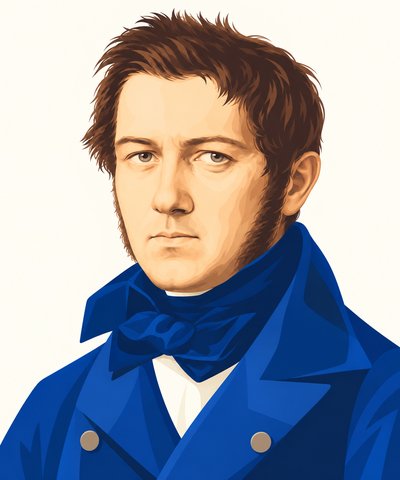
Mikhail Glinka was born in 1804 in the village of Novospasskoye, near Smolensk in western Russia. His family were rich landowners. For his first six years he was raised by his grandmother, who was far too protective. She kept him indoors in overheated rooms and fed him sweets. After she died, he lived near his uncle, who had an orchestra made up of his own serfs, the farm workers who belonged to him. From this orchestra the boy learned the music of Haydn and Mozart, and one of the serf violinists gave him lessons. At about ten he heard a piece for clarinet and strings, and the next day he could think of nothing but that music. According to his own memoirs, he told his teacher, "Music is my soul." At 13 he went to a boarding school in St Petersburg.
As a young man he had an easy job in a government office. He spent his evenings in the salons of St Petersburg, singing his own songs in a pleasant tenor voice. There he became a friend of the poet Pushkin, five years older and already the most famous poet in Russia. In 1830 he went to Italy for three years. He loved the operas of Bellini and Donizetti. But the longer he stayed, the more he missed Russia, and he began to feel that this sweet Italian music was not his own. He decided to do for Russian music what they had done for Italian music. After Italy he studied in Berlin for a few months to learn how to write music properly. In 1836, at 32, his opera A Life for the Tsar was performed in St Petersburg. It was a great success, and it was the first Russian opera that stayed on the stage. Tsar Nicholas I gave him a ring, and Pushkin and his friends wrote a song to celebrate his success. Pushkin agreed to help with the next opera, Ruslan and Lyudmila, based on his own poem. But he was killed in a duel before the work began. Ruslan was finally performed in 1842, when Glinka was 38. The audience did not like it much, and it is said that the imperial family left before the end. Today its overture is one of the most popular pieces in concert halls.
After this disappointment Glinka left Russia and travelled for several years. In Paris he became a friend of Berlioz, one year older and already famous in France. In 1845 Berlioz conducted Glinka's music in Paris, the first time Russian music had been played in France, and he wrote a long newspaper article praising him. In Spain he collected folk dances and wrote orchestral pieces on them. In his memoirs he wrote that he was lazy and always worried about his health, but everyone liked him. In 1847 he returned to Russia, but he still moved around a lot, between St Petersburg, Warsaw and Paris. In 1855, when he was 51 and back in St Petersburg, young composers came to him for advice. One of them was Balakirev, only 18, who later led the group of five Russian composers that included Mussorgsky and Cui. This group used to meet at the flat of Glinka's sister, and they called Glinka the father of Russian music. The next year he went to Berlin once more to study old church music. In early 1857 he caught a cold on the way home from a concert of his music. The cold got worse, and he died in Berlin a few weeks later, at 52. His body was later brought back to St Petersburg. Every Russian composer after him started from his work. Thirty years after his death Tchaikovsky wrote in his diary that all of Russian orchestral music was already there in one short piece by Glinka, just as a whole oak tree is already there in its small seed.
Mikhail Glinka の曲を歌う
これらの曲は Singalong Solfege に入っています。ガイドの歌声とピアノ伴奏に合わせて、ドレミで歌えます。
| No. | 難易度 | 曲名 | 作曲年 | |
|---|---|---|---|---|
| Ex. 1-3 | ③ | Do not tempt me | 1825 |