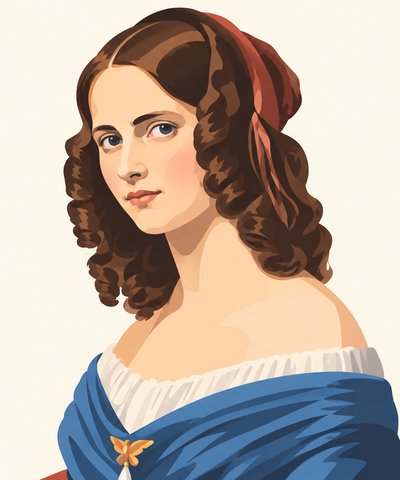
Fanny Mendelssohn was born in 1805 in Hamburg, the eldest of four children, in a family where music was part of everyday life. Her brother Felix, who was three years younger, also became a famous composer. Fanny was a brilliant pianist from childhood. In 1818, at 13, she played all 24 preludes of Bach’s Well-Tempered Clavier from memory, as a birthday surprise for her father. She and Felix studied with the same teachers. All his life Felix showed her his new music, and he often changed it on her advice.
In 1820 her father wrote to her that music would perhaps become Felix’s profession, but for her it “can and must only be an ornament.” In the same letter he said that she might have deserved just as much praise as Felix. He knew that she was as gifted as her brother. He held her back only because she was a woman.
As a teenager she fell in love with the painter Wilhelm Hensel. Her mother did not approve, and while Wilhelm was in Rome for five years, the two were not allowed to write to each other. Instead he sent drawings of the family, and Fanny was always the main person in them. They married in 1829. Felix had hurt his knee in a carriage accident in London, so he could not come, and the organ music he had promised for the wedding was not ready. So Fanny wrote her own. In 1830 their only child was born. They named him Sebastian, after Bach.
From 1831 Fanny ran the family’s Sunday concerts in the garden hall of their house in Berlin. She chose the music, played the piano and conducted the singers, and sometimes hundreds of guests came. In 1844 she wrote to her sister, “We had twenty-two carriages in the court, and Liszt and eight princesses in the room.” Clara Schumann also played there. Women of her class did not usually play in public, but in 1838 she played Felix’s piano concerto at a concert for the poor. She wrote that she “was not the least nervous,” because “my friends were kind enough to undertake that part of the business for me.”
In 1839 Fanny, Wilhelm and their son set off for Italy. In Rome they spent their Sundays with young French artists and musicians, among them the composer Charles Gounod. They asked her to play again and again, and Gounod made her play one piece by Bach at least ten times. “I also compose a great deal now,” she wrote, “for nothing inspires me like praise.” On her last evening in Rome she played Beethoven “to prevent myself beginning to cry,” and Gounod went down on his knees to beg for one more piece. “Such a tour as this is a treasure for life,” she wrote. Her son later called it perhaps the happiest time of her life.
In Rome she named each new piano piece after one of her favourite places there. She wrote that the pieces would help her remember those days, like “a kind of second diary.” Back in Berlin she wrote Das Jahr (The Year), twelve piano pieces, one for each month. She wrote it on coloured paper, and Wilhelm drew a picture for each month. In the same year she wrote the song Nach Süden (To the South), full of longing for the warm south.
Some of her songs had come out under Felix’s name, because it was not thought proper for a woman of her family to publish. In 1842 Felix visited Queen Victoria in London. The Queen chose one of these songs to sing for him, Italien. Felix had to tell the Queen that Fanny had written it. “I found this very hard,” he wrote.
For years Felix did not want her to publish under her own name. In 1837 he wrote to their mother that Fanny did not really want to publish, and that it did not suit her. But in 1846, at 40, she decided to publish anyway, encouraged by Wilhelm. Her first book of songs opened with songs she had written in 1837, among them Warum sind denn die Rosen so blass? (Why Are the Roses So Pale?). This time Felix sent her a warm, joking letter. He welcomed her into the “trade” of composers, as an old workman welcomes a new one. In her diary she wrote, “He is not quite satisfied in his heart of hearts, but I am glad he has said a kind word.”
The spring of 1847 was a happy time. “What have we done to deserve being among the few happy ones in the world?” she wrote in her diary. On 13 May she finished the song Bergeslust (Joy in the Mountains). It was her last. The next day, during a rehearsal for her Sunday concert, she was taken ill at the piano, and she died that night, at 41. Felix wrote to Wilhelm, “You made my sister very happy through her whole life.” Less than six months later Felix died too, and he was buried beside her.
She wrote more than 460 works, most of them songs and piano pieces. For a long time many people knew her music without knowing it was hers. A piano sonata of hers was thought to be by Felix until 2010, when a researcher showed that it was in Fanny’s own handwriting.
Fanny was clever, warm and full of wit, and she was sure of her own music. She loved her family, and the people around her loved her. Her life was short, but it was a happy one. Few women of her time were allowed to be composers, but she left a great body of music, and today it is being printed, played and sung all over the world.
演唱 Fanny Mendelssohn 的曲目
这些曲目收录在 Singalong Solfege 中。可以跟随引导人声和钢琴伴奏,用唱名演唱。
| 编号 | 难度 | 曲名 | 年份 | |
|---|---|---|---|---|
| Ex. 3-4 | ⑤ | Italien | 1825 | |
| Ex. 1-4 | ③ | Warum sind denn die Rosen so blass? | 1837 | |
| Ex. 5-6 | ⑤ | Wanderlied | 1837 | |
| Ex. 6-5 | ③ | Die Mainacht | 1838 | |
| Ex. 4-6 | ④ | Schwanenlied | 1840 | |
| Ex. 7-5 | ④ | Gondellied | 1841 | |
| Ex. 9-4 | ④ | Nach Süden | 1841 | |
| Ex. 3-6 | ④ | Mayenlied | 1842 | |
| Ex. 2-7 | ③ | Nachtwanderer | 1843 | |
| Ex. 6-7 | ④ | Abendbild | 1846 | |
| Ex. 11-4 | ④ | Vorwurf | 1846 | |
| Ex. 7-6 | ⑤ | Bergeslust | 1847 |