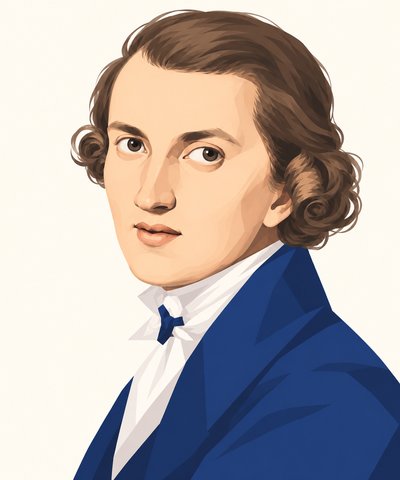
Charles Gounod was born in Paris in 1818. His father was a painter and died when Charles was four. His mother, a trained pianist, gave drawing and piano lessons to children, including her own sons, from six in the morning until six in the evening.
From early childhood he had a very good ear for music. According to his memoirs, when he was about three a musician friend of his mother turned Charles's face to the wall and played chords, changing from one key to another. After each change he asked the boy which key the music was now in. Charles did not make one mistake. At 12 his mother took him to Rossini's opera Otello. He did not sleep that night, and he decided to write an opera himself.
He told his mother that he would be a musician. She knew how hard that life was. She asked the headmaster of his boarding school in Paris to persuade him to give up that dream, and the headmaster promised that he would. He called Charles in and told him that a musician was nothing in the world. Then, to test him, he wrote out a poem and said, "Set this to music." Charles set it in the next break and sang it to him at the piano. The headmaster was deeply moved and said, "Go on, my child, with your music."
At 13 or 14, according to his memoirs, his mother took him to Mozart's Don Giovanni. At the first chords he hid his face on her shoulder and whispered, "Mamma, what music! That is real music!" When he won the Prix de Rome, France's top prize for young composers, in 1839, at 21, the present she gave him was the full score of that opera. That year, when his first Mass was to be performed and they could not pay a copyist, she copied all the orchestral parts by hand.
The prize sent him to Rome for two years. There, in 1840, he met Fanny Hensel, the sister of the composer Felix Mendelssohn, who was visiting with her husband. She played him the German music he did not yet know, and one Bach concerto he asked to hear at least ten times. She wrote in her diary that German music had hit him like a bomb.
He left Rome in 1842 and went home the long way, through Vienna and Germany. In Berlin he visited Fanny again, and she sent him on to her brother Felix in Leipzig. Felix spent four whole days with him. Though the concert season was over, he called the orchestra together to play him his Scottish Symphony, and he played Bach to him for two hours on the organ of the church where Bach had worked.
Back in Paris, at 25, he took a poorly paid job as the organist of a small church. He took it on condition that nobody told him what to play. He played Bach and Palestrina, and the people of the church complained that the services were not cheerful. When the priest asked him to change his style, he refused and resigned on the spot. Half an hour later the priest sent for him and took him back. Little by little, the people who had complained came to love the music he played.
For a time he thought of becoming a priest himself. He went to theology lectures for a whole winter in a priest's black dress. Then he gave it up. He had been wrong about his own nature, he wrote.
At 31 he had still never written an opera. In 1849 the famous singer Pauline Viardot, three years younger, asked him, "But Monsieur Gounod, why do you not write an opera?" She told him to ask a famous playwright to write the words, promised to sing the leading role, and got the Opéra to accept the work. Viardot lent him and his mother her country house, and there he wrote his first opera, Sapho. It was not a success, but Berlioz wrote that parts of it were very beautiful.
In 1852, at 33, he married Anna Zimmerman, the daughter of his old piano professor. They had two children, a son and a daughter.
His most famous piece was born at his father-in-law's house. One evening he improvised a melody over Bach's Prelude in C major. His father-in-law liked it so much that he wrote it down. It was first published in 1853 as a piece for violin and piano. Six years later Gounod set the words of the Ave Maria, the Latin prayer to the Virgin Mary, to the melody. The song became a huge hit and made his name known to the public for the first time. It is still sung all over the world today.
In January 1858, after years of failure, he had his first real success in the theatre, with a comic opera. His mother, who had been blind for two years, died the next day. He wrote: "It was not given to me to bring her this comfort in her last days."
He had begun Faust in 1856, but had to put it aside for two years, because another play on the same story was about to open in Paris. In the meantime he wrote Sérénade, to a song from a play by Victor Hugo. In March 1859, at 40, Faust was finally performed. On the first night two famous publishers said in the corridor that it would not run fifteen times. It did not strike the public much at first, but it grew. Ten years later it entered the Paris Opéra, and in 1888, at 70, he conducted its 500th performance there. The Metropolitan Opera in New York opened with it in 1883 and performed it so often that people joked it should be called the "Faust-house."
Everyone who met him noticed the same thing. In 1868 a friend warned his sister: "Don't be surprised if he kisses you. At the station just now he kissed the father, the mother, the children, the children's teacher and a family friend. He was just about to kiss the station-master too when the train left."
Bizet, twenty years younger, was his pupil. In 1872 Bizet wrote to him: "You were the beginning of my life as an artist. I come from you." In 1875 Bizet died suddenly, at only 36. At the funeral, Gounod stood by his grave to speak, but could say only a few words before his voice broke.
In 1893, at 75, a stroke left him half paralysed. He still walked in his garden near Paris, smoking a clay pipe, and played dominoes with his wife. On Sunday 15 October he went to Mass, played dominoes, and then bent over the Requiem he was writing for his grandson, who had died as a baby. He did not move again. He died three days later, on 18 October 1893. At his state funeral, by his own wish, there was no orchestra, only singing, and the young Gabriel Fauré directed it.
Gounod was a warm man who kissed everyone he met, but he would not give way on music. For half a century Faust was the most popular opera in the world. In his songs, simple melodies are coloured by gentle, surprising changes of harmony, and this sound was handed down to Fauré. Ravel is quoted as calling him the true founder of French art song. Bizet and Massenet also learned from him.
演唱 Charles Gounod 的曲目
这些曲目收录在 Singalong Solfege 中。可以跟随引导人声和钢琴伴奏,用唱名演唱。
| 编号 | 难度 | 曲名 | 年份 | |
|---|---|---|---|---|
| Ex. 4-9 | ④ | O ma belle rebelle | 1851 | |
| Ex. 2-9 | ④ | Sérénade | 1857 |