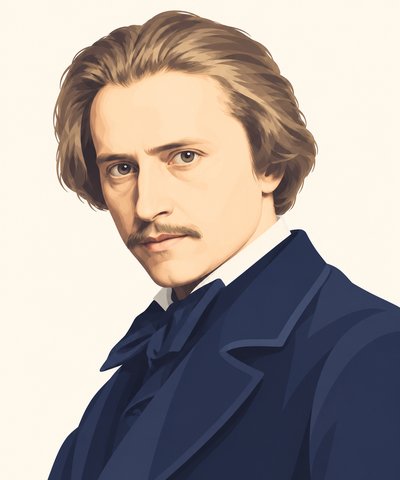
Hugo Wolf was born in 1860 in Windischgraz, a small town that is now Slovenj Gradec in Slovenia. His father made leather for a living, but he loved music and played the violin, the piano and the guitar. He gave Hugo his first lessons, and the family often played music together at home. When Hugo was seven, a fire destroyed much of the family business, and his father never earned as much again. At school Hugo was good only at music. His marks in other subjects were so bad that he had to leave two schools. At the third school his marks were poor too, and he did not get on with the teachers. So at 15 he wrote to his father that he wanted to leave school for music. At first his father warned him how hard a musician’s life was. “Music is food and drink to me,” Hugo answered. In the end his father agreed, and that autumn Hugo began to study at the Vienna Conservatory.
That autumn Hugo heard Wagner’s opera Tannhäuser, and he became a passionate admirer of Wagner. Wagner himself was in Vienna, and Hugo waited for him again and again at his hotel, until at last Wagner agreed to see him. He took some of his own pieces to show to Wagner. Wagner was the most famous composer of the day, but he joked that he could not judge them, because he “understood nothing at all about music.” Then Hugo asked him whether he would ever become a real composer. Wagner answered that when he was Hugo’s age, nobody could tell from his music either whether he had any talent. So it was too early to judge. “Come back when you have written larger works,” he said. Hugo left deeply moved, and he loved Wagner’s music all his life.
In 1877, at 17, he was sent away from the Conservatory. The reason is not quite clear, but he himself said that he had learned very little there. From then on he taught himself. He had no piano, so he took Beethoven’s piano music to a park and studied it there. He earned a little money by giving lessons, and often he had only one meal a day. Kind friends, above all a family of jewellers called Köchert, gave him rooms and meals for many years. In 1879 he even shared a room with Gustav Mahler, whom he knew from the Conservatory, because both of them were poor.
That year, at 18, Wolf took some of his songs to Brahms, whom he then admired. He hoped for praise. But Brahms told him that he should first study counterpoint, the art of combining several melodies at the same time, and he gave him the name of a good teacher. It was good advice. Wolf had left the Conservatory after less than two years, and his training was thin. But to the young man it sounded like a cold refusal. He went to the teacher once, but he would not pay the three florins for a lesson, and from then on he hated Brahms. A few years later he became a music critic for a Vienna magazine, and he attacked Brahms again and again. Brahms, he wrote, was a skilled musician, but “frequently” had “no ideas at all.” Brahms never answered. It is said that in 1894 he even applauded Wolf’s music warmly at a concert in Vienna.
In May 1887 Wolf’s father died. All his life Wolf had wanted to prove to his father that he had been right to choose music, and now it was too late. Two weeks later he wrote Nachtzauber (Night Magic), and then for months he wrote almost nothing. That winter his first songs were printed. His friends paid for the printing. There were two small books, and Wolf dedicated one to his mother and the other to the memory of his father.
Then, in February 1888, at 27, he suddenly began to write song after song. At a friend’s house outside Vienna he wrote 53 songs to poems by Eduard Mörike, most of them in three months, sometimes three in one day. One day he wrote to a friend that his newest song was the best he had ever written. The next day he wrote that the song he had just finished was “a million times better.” To his brother-in-law he wrote that he was working “with a thousand horsepower,” from early morning until night, and that nobody had written such songs since Schubert and Schumann. Only one song gave him trouble: Auf einer Wanderung (On a Walk). He wrote the beginning and the end in one day, but the middle part would not come. It came to him two weeks later.
That autumn he wrote songs to poems by Joseph von Eichendorff. He wrote Verschwiegene Liebe (Secret Love) at a friend’s house in Vienna, in spite of the noise from a factory next door. Then he went to the friend’s country house by a lake, and in one week there he wrote nine more, among them Der Scholar (The Student) and Der Freund (The Friend). After that he wrote 50 songs to poems by Goethe in just over three months.
Wolf wanted honest opinions, not kind words. Once he began to wonder whether his friends praised everything he played. So one evening he played them a song by Schumann that none of them knew, and he praised it highly. They said they did not like it, and soon they were making fun of it. Then Wolf burst out laughing, and he played them his own new songs.
But Wolf could not always compose. After the great years came long silences, when no music came to him at all. In 1891 a friend asked when he would write an opera. “I would be glad if I could write the smallest song,” Wolf answered. But in 1895, at 35, the music suddenly came back, and it was as if the silent years had never happened. In a few months he wrote a whole opera, Der Corregidor (The Magistrate), his biggest work.
The first performance, in Mannheim in 1896, was the biggest night of his life. But Wolf would not play the part of the famous composer. Everyone else came in evening dress; he came in an ordinary summer suit. The theatre had prepared a special box for him; he sat high up in the top gallery, where nobody would notice him. What he cared about was the music. After the second act the woman who had written the words of the opera came up to him, and he embraced her in tears without a word. At the end the audience called for him again and again, but he came out on stage only after his friends had begged him.
That same year, at 36, Wolf moved into the first home of his own. Since he had left his parents’ house at 15, he had always lived in rented rooms or as a guest of friends. Now his friends furnished a flat for him in Vienna. He wrote that only someone who had moved from place to place for half his life could know how happy it made him.
In September 1897, at 37, Wolf became mentally ill. He told his friends that he had been made the head of the Vienna Opera, and they took him to a clinic. After four months he seemed better, and he left. But in October 1898 he tried to drown himself in a lake. The cold water changed his mind, and he swam back to the shore. He then asked to be taken into a hospital, where he lived for the next four years. He died in Vienna in February 1903, at 42. His friends did not let his music die with him. The next year Mahler, who was now the head of the Vienna Opera, conducted Der Corregidor there.
Wolf was small and thin, and people who met him were often surprised that the great composer looked so ordinary. But they remembered his dark eyes, which could flash with anger, laugh or look very sad. All his life he did things his own way. He left his schools, he ignored Brahms’s advice, and he ran away from the honours that people wanted to give him. But with a poem he was different. Before he sang one of his songs, he always read the poem aloud first, and he put the poet’s name, not his own, on the covers of his song books. Like Robert Franz before him, he believed that the music was already inside the poem. But Franz gave each poem one simple tune, sung again for every verse. Wolf followed the poem line by line, and his music changes with the meaning of every word. Often the piano carries the melody, and the voice follows the rhythm of the words above it. His harmony came from Wagner. In Wagner’s long operas the chords keep moving and never seem to settle. Wolf put that same restless sound into songs of three minutes. Wagner never heard them. He died in 1883, five years before the Mörike songs. But Wolf had done what Wagner told the boy in the hotel: he had written larger works, in his own way. That is why he is counted among the greatest masters of German song, after Schubert and Schumann.
演唱 Hugo Wolf 的曲目
这些曲目收录在 Singalong Solfege 中。可以跟随引导人声和钢琴伴奏,用唱名演唱。
| 编号 | 难度 | 曲名 | 年份 | |
|---|---|---|---|---|
| Ex. 13-7 | ④ | Nachtzauber | 1887 | |
| Ex. 1-12 | ③ | Der Scholar | 1888 | |
| Ex. 6-12 | ⑤ | Auf einer Wanderung | 1888 | |
| Ex. 9-9 | ④ | Der Freund | 1888 | |
| Ex. 14-15 | ③ | Verschwiegene Liebe | 1888 |