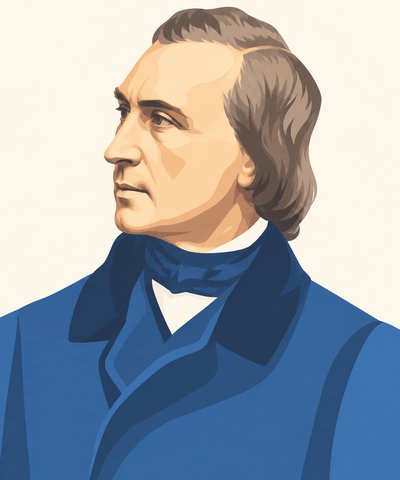
Robert Franz was born in 1815 in Halle, in central Germany, as Robert Knauth. His father carried goods for merchants, and so did his father’s brother. Their business letters were often mixed up, and the two brothers argued about it. So in business his father began to call himself Christoph Franz, and after that the brothers lived in peace. The boy grew up as Robert Franz. People later liked to say that his name joined the first names of Franz Schubert and Robert Schumann, the two great masters of German song. Franz disliked that idea.
Hymns are usually sung slowly, but his father sang them at home so fast that they sounded almost like opera arias. Robert later said that his father’s singing was where his love of music began. At school he could not stop adding a second voice to the hymn tunes, and the teacher punished him for it. His father did not want him to become a musician. But in 1835, when Robert was 20, a pastor heard him play the organ and persuaded his father to let him study music.
He went to study with a well-known composer in the nearby town of Dessau. Franz found the lessons boring, and he left after less than two years. His teacher was sure that he would never become a real musician. But many years later, Franz wrote that everything he knew about writing music had started with those lessons. Back in Halle he studied the music of Bach, Handel, Schubert and Schumann. Their music was so great that for about five years he wrote almost nothing. In 1841, at 26, he became the organist of one of the town’s churches.
Then, in 1843, when he was 27, he suddenly began to write songs, almost one every day. “In the last half year I have become a composer,” he wrote to a friend. His friends told him that his songs were good. He was not sure, but he sent some of them to Schumann. Without telling him, Schumann found a publisher for them, and they were printed. That year his first book of twelve songs came out, ending with In meinem Garten die Nelken (In My Garden the Carnations). Schumann praised it in a long review, and Mendelssohn wrote him a long letter of praise.
Franz spent his whole working life in Halle. For about 25 years he led the town’s choir, and for the first nine years he took no pay. His concerts of Handel’s music, in the town where Handel was born, made Halle famous for music again. In 1846 he met Liszt in Vienna, and they became friends for life.
In 1848, at 32, he married Marie Hinrichs, who had been his pupil and who wrote songs herself. Soon after the wedding, Franz was standing at the railway station when a train whistled right next to him. He said later that it felt as if something tore in his ear. After a few days he could hear again, but the high notes never came back. Over the next twenty years he lost one note after another, from the top down, until he was completely deaf.
In 1867, at 51, illness of his ears and nerves forced him to stop conducting. Now he could give all his time to composing, and he wrote that it went more easily and happily than ever before. That same year a friend in Boston, in America, held a concert of Franz’s songs and sent him the money from it. It was a large sum, and Franz was so surprised that he could hardly find words. The next year he gave up all his posts, and money became short. In 1872 Liszt, the violinist Joseph Joachim and other friends gave concerts all over Germany for him. The money was given to him on his 58th birthday, and it was enough for him to live without worry.
In 1885, at 69, Halle made him an honorary citizen, the town’s highest honour. He was worried about the ceremony, because he could not hear what people said to him. But in the end everything went very well. For his 70th birthday that summer, letters came from all over the world. In 1891 his wife Marie died. The next year Franz died in Halle after a short illness, at 77, and he was buried beside her.
Franz was modest and honest. He wrote about 300 songs, by his own count, and almost nothing else. Many of them are to poems by Heinrich Heine. He believed that every true poem already has a melody hidden inside it, and that a composer only has to find it. In his songs the piano does not just play chords. It often sings its own melodies alongside the voice, a style that grew from his love of Bach. Today his songs are rarely sung. But in his time they won the praise of Schumann and Liszt, and they were sung not only in Germany but also in America.
演唱 Robert Franz 的曲目
这些曲目收录在 Singalong Solfege 中。可以跟随引导人声和钢琴伴奏,用唱名演唱。
| 编号 | 难度 | 曲名 | 年份 | |
|---|---|---|---|---|
| Ex. 4-7 | ③ | In meinem Garten die Nelken | 1843 | |
| Ex. 9-5 | ④ | Der Schnee ist zergangen | 1846 | |
| Ex. 1-6 | ③ | Mutter, o sing’ mich zur Ruh’! | 1850 | |
| Ex. 10-5 | ③ | Stille Sicherheit | 1850 | |
| Ex. 9-6 | ④ | Waldfahrt | 1851 | |
| Ex. 8-13 | ③ | Im wunderschönen Monat Mai | 1856 |