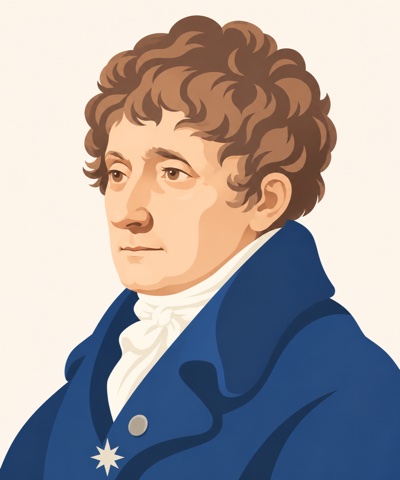
Antonio Salieri was born in 1750 in Legnago, a small town in northern Italy. His father was a merchant, and his elder brother taught him the violin. According to his own story, when he was about ten he walked to a nearby village without permission, to hear his brother play in a church. His father said that next time he would be locked in his room for a week with only bread and water. Antonio thought that bread would be fine with sugar, so he hid some sugar in a cupboard and ran off again. When he was caught, he went to the cupboard, but the sugar was gone. His sister had told their mother, and their mother had told their father. For a long time family friends teased him and asked him how his sugar was.
Both his parents died when he was about 13. A nobleman in Venice, a friend of his father, took him in. In 1766 the composer Florian Gassmann, who worked for the emperor in Vienna, came to Venice and heard about the boy. He took Antonio, then 15, to Vienna, and Antonio lived in his home for eight years. The day after they arrived, Gassmann took him to a church to pray. On the way home he said that he had wanted to begin the boy's musical education with God. Antonio promised to be grateful to him all his life.
In 1770, at 19, Salieri wrote his first opera. Gluck, 36 years older and the most famous opera composer in Vienna, sang through it with him and said that the public would like it. On the morning of the first performance Salieri ran around the city to read his own name on the street posters. After the performance he walked among the people who were leaving, to hear what they said. One man said that he had liked it very much, and Salieri wrote later that he could have kissed him. Another said that it was very boring, and Salieri quickly went down another street.
Gassmann died in 1774, when Salieri was 23, and Emperor Joseph II, who loved music, gave Salieri his job. Gassmann left a wife, a small daughter, and a second daughter who was not yet born. Salieri stayed close to the family for the rest of his life. He taught both girls to sing, and both became singers at the court.
That same year he fell in love with Therese, a girl of about 18. He told her so, and she said that she felt the same. But her father died that week, and her guardian said that a court composer's pay was too small. A friend told the story in front of the emperor, who said only, "Well then, you must have patience." The next morning Salieri's pay was raised from 100 to 300 ducats. They married in 1775, when he was 25.
In 1778, at 27, he was asked to write the opera that opened La Scala, the new opera house in Milan. Gluck had been asked first and had said no. La Scala is now one of the most famous opera houses in the world. In 2004, when it opened again after three years of repairs, it opened with the same opera by Salieri that it had opened with in 1778.
In Vienna he also taught Marianna Auenbrugger, the daughter of a doctor, and a fine pianist. She died in 1782, at 23. After her death her one piano sonata was printed, and with it an ode that Salieri wrote for her. The title page says that the sonata was her first and last work. The third part of the ode is Fra le beate alme felici.
In 1784 Paris asked Gluck, then 69 and weak after a stroke, for a new opera. Gluck gave the work to Salieri and helped him. At first Paris was told that the opera was by Gluck, and then that it was by both of them, so that the critics would judge it fairly. After its success Gluck wrote to a newspaper that all of it was by Salieri. In 1787 Salieri asked Gluck how Christ should sing in a new piece. Gluck said, half joking, that he would soon be able to tell him from the next world in what clef Christ speaks. Four days later Gluck died. In 1788, at 37, Salieri became the head of the emperor's music, and he held that job for 36 years.
Mozart, six years younger, was a real rival. In 1781 he lost a teaching job to Salieri, and he wrote to his father that for the emperor "there is nothing but Salieri." But in 1785 the two wrote a cantata together, for a singer who had been ill. In 1789 Salieri staged Mozart's opera The Marriage of Figaro. On 13 October 1791 Mozart took him to see The Magic Flute. Mozart wrote to his wife that every number, from the beginning to the last chorus, made Salieri call out "bravo." Seven weeks later Mozart died.
Salieri never forgot what Gassmann had done for him. He had promised to give others for nothing what Gassmann had given him for nothing. Three mornings a week, from nine to one, he taught singing and composition without pay, to women and men alike. When rich people paid him, he gave the money to poor musicians. His pupils included Beethoven, Schubert, Liszt and Maria Theresia von Paradis.
Beethoven, 20 years younger, brought him Italian songs to correct, and in 1799 he dedicated three violin sonatas to him. According to Beethoven's pupil Czerny, Salieri once told Beethoven that one of his melodies was not good. The next day Salieri said that he could not get that melody out of his head. Beethoven answered, "Then it cannot have been so bad."
At 54 he felt that people's taste had changed, and he stopped writing operas. That year he wrote a Requiem for his own funeral and put it away. On the title page he called himself "the very smallest." His only son died in 1805, and Therese died in 1807. Three daughters had died before them.
On 16 June 1816, at 65, he celebrated fifty years in Vienna. Early in the morning he went with his four daughters to the same church where Gassmann had taken him. That evening his pupils came to his home, 14 women and 12 men, and each one had written a piece for him. Schubert, 19, wrote a song for him. It ended with the words, "Grandpapa of us all, stay with us a long time yet!" Salieri made a speech in his bad German, and he joked that he had lived in Germany only fifty years, so how could he have learned the language yet?
Gassmann had also started a fund for the widows and orphans of musicians. In 1796, for its 25th year, Salieri wrote a piece for the fund. At the end of the score he wrote a greeting from the next world to whoever would write for its 50th year, because he did not expect to live that long. He did. In 1821, at 70, with failing eyes, he prepared Gassmann's old oratorio, a large work for choir and orchestra, for the 50th year, and he paid all the costs himself.
In autumn 1823, at 73, he went into hospital, and his mind did not recover. People in Vienna began to say that he had confessed to poisoning Mozart. When his former pupil Moscheles visited him, he wept and said, "There is no truth in the absurd report." His two nurses and his doctor signed a statement that he had never said such a thing. It was simply a false rumour.
He died in Vienna on 7 May 1825, at 74. His pupils sang the Requiem he had written for himself.
The rumour did not die with him. A play by Pushkin in 1830, an opera by Rimsky-Korsakov and the film Amadeus in 1984 made that false rumour known all over the world.
Salieri was a small, cheerful man with a quick temper, who told jokes, drank only water and loved cakes and sweets all his life. He could be hard on music he did not like. But above all, he was a grateful man. He spent his life repaying the man who took in an orphan, and giving the same help to others. In his own day he was one of the most successful opera composers in Europe. He taught singers and composers how to write for the voice and to let the words lead the music, and Beethoven, Schubert and Liszt all learned from him.
演唱 Antonio Salieri 的曲目
这些曲目收录在 Singalong Solfege 中。可以跟随引导人声和钢琴伴奏,用唱名演唱。
| 编号 | 难度 | 曲名 | 年份 | |
|---|---|---|---|---|
| Ex. 2-3 | ③ | Fra le beate alme felici | 1782 |