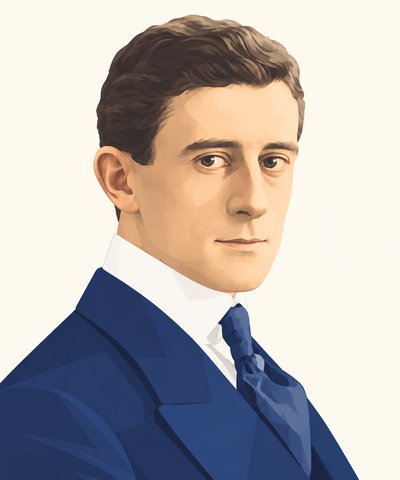
Maurice Ravel was born in 1875 in Ciboure, a small fishing town in the Basque country of southern France, close to the Spanish border. His father was a Swiss-born engineer and inventor who worked on early car engines. His mother was Basque and sang him folk songs. When he was three months old, the family moved to Paris.
His father loved machines and took his two sons to factories to see the newest ones. Ravel loved machines all his life. He started the piano at about seven, and he wrote later that his father knew how to make him love music.
In 1889, at 14, he entered the Paris Conservatoire. At that time, students who did not win a prize within a few years had to leave, and this happened to Ravel twice. Each time he went on studying. From 1897 he studied composition with Gabriel Fauré, who let him find his own way, and even after he had to leave Fauré's class, he kept coming to listen. As a young man he dressed with great care, with long sideburns and bold ties.
In 1899, at 24, while he was still Fauré's student, he wrote a piano piece called Pavane pour une infante défunte (Pavane for a Dead Princess). After a pianist friend played it in 1902, it became very popular.
Ravel and his young friends went to all fourteen first performances of Debussy's opera in 1902, and cheered it. Debussy was twelve years older. Later, critics began to set the two composers against each other, and from about 1905 they stopped seeing each other. But Ravel never stopped admiring Debussy. It is said that years later he heard one of Debussy's orchestral works on the radio and his eyes filled with tears. He said that when he first heard it, he understood what music was.
In 1905, at 30, he tried for the last time to win the Prix de Rome, France's top prize for young composers. He was already known as a composer, but the judges did not even let him into the final round, and all six young men who did get in were pupils of one of the judges. The newspapers called it "the Ravel affair," and soon afterwards Fauré became the head of the Conservatoire. In 1906 he arranged Greek folk songs for a friend's talk, among them Chanson de la mariée, and they came out that year as a set of five.
When the First World War began in 1914, Ravel was 39 and wanted to join the army, but he weighed only 48 kilos. "They don't want me because I'm two kilos short," he wrote to a friend. He wanted to be a pilot, but he was refused again. In 1916 he finally became a lorry driver near Verdun, carrying supplies to the front. He wrote: "I have never been brave, but I am curious about adventure."
In January 1917 his mother died. It was the hardest blow of his life, and years later he wrote that she had been his only reason for living. That year he finished a set of piano pieces, and he dedicated each of them to a friend who had been killed in the war.
In 1921, at 46, he bought a tiny house in Montfort-l'Amaury, a village west of Paris, and filled it with small things he loved. There were music boxes, mechanical toys, and a clockwork nightingale no bigger than a nut, which beat its wings and sang. Many of his ornaments were cheap copies, and he loved to show them to visitors and cry, with a child's delight, "But it's fake!" He kept Siamese cats, and wrote letters to friends in "cat language."
He was a small man, always well dressed, even when he was alone, with his tie matching his handkerchief and his socks. He hardly slept. Late at night he liked to walk through Paris with friends, or sit in cafés and jazz bars.
In 1922 he arranged Mussorgsky's piano suite Pictures at an Exhibition for orchestra. His version is the one usually played today.
In 1928, at 52, he made a four-month tour of North America, playing and conducting his music in about 25 cities. In New York the whole audience stood up when he came on stage, and he said to a friend: "You know, this doesn't happen to me in Paris." There he met George Gershwin, 23 years younger, who asked him for lessons. Ravel refused. If Gershwin studied with him, he said, he would only write bad Ravel, and lose what made his own music good.
The same year he wrote Boléro for the dancer Ida Rubinstein. On holiday by the sea, he played the tune to a friend with one finger and said that he was going to repeat it again and again, without changing it, and only make the orchestra grow louder and fuller. He said the idea came from a factory. Boléro became one of the most famous pieces of music in the world, and it surprised Ravel more than anyone.
In 1932, at 57, he wrote three songs for a film about Don Quixote, among them Chanson à boire. They were his last work. That autumn he was hurt in a taxi accident, and soon afterwards an illness of the brain began, little by little, to take away his ability to write and to speak. He still walked in the woods near his house and listened to music. "I still have so much music in my head," he told a friend. He died on 28 December 1937, at 62.
Ravel was a small, shy, elegant man who loved cats and clever machines, and who kept his feelings to himself. He worked slowly and with great care over every note. He took ideas from the music of many peoples: the Basque and Spanish songs his mother sang, Greek and Jewish folk songs, the music of the Roma of Hungary, and American jazz and blues. He wrote piano music, songs, ballets and concertos, and his music is known for its precision and for his brilliant writing for the orchestra. Boléro made his name known all over the world, but the Pavane, his songs and his version of Pictures at an Exhibition are loved just as much.
演唱 Maurice Ravel 的曲目
这些曲目收录在 Singalong Solfege 中。可以跟随引导人声和钢琴伴奏,用唱名演唱。
| 编号 | 难度 | 曲名 | 年份 | |
|---|---|---|---|---|
| Ex. 3-14 | ② | Pavane pour une infante défunte (edited) | 1899 | |
| Ex. 4-14 | ④ | Chanson de la Mariée | 1906 | |
| Ex. 1-15 | ⑤ | Chanson à boire | 1932 |