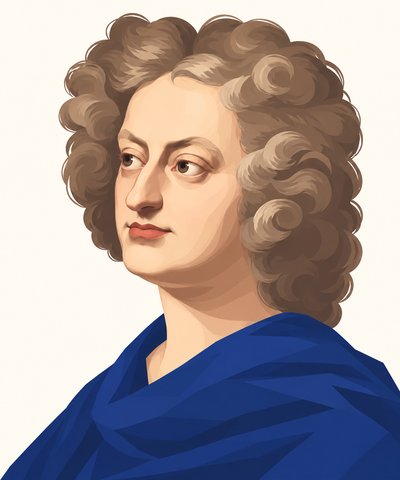
Henry Purcell was born in 1659 in Westminster, London, into a family of musicians. His father, a singer in the king’s choir, died when Henry was not yet six. His uncle, a man of “extraordinary kindness,” brought him up. As a boy Henry sang in the Chapel Royal, the king’s own choir.
In 1673, at 14, his voice broke, and he had to leave the choir. He then became an unpaid helper to the man who looked after the king’s musical instruments. Ten years later he took over the job himself. His title was “keeper, mender, maker, repairer and tuner” of the king’s organs, recorders and other instruments. At the same time he studied composition with John Blow, the organist of Westminster Abbey. In 1679, at only 20, Purcell took over from his teacher as organist of the Abbey, and from 1682 he was also organist of the Chapel Royal.
Around 1680 he married a young woman named Frances. They had six children, but only two of them lived to grow up.
In 1689 William and Mary were crowned king and queen in Westminster Abbey. Purcell charged people money to watch the crowning from beside the organ, high up in the church, where he played. But the Abbey said that the money belonged to the church. He was ordered to hand it over, or he would lose his job and his pay. He paid, and he kept his job.
Purcell wrote songs every year for the birthday of Queen Mary. It is said that once, after his songs had been sung for her, the Queen asked a singer for a simple old Scottish song. Purcell was quite annoyed. In his next birthday music for the Queen, he used the tune of that Scottish song as the lowest part, under the music that the singers sang. He also had a sense of fun with his friends. He wrote more than 50 short rounds, songs that people sing one after another, and many of them are about drinking.
His short opera Dido and Aeneas was performed at a girls’ school in Chelsea, probably in 1689. Its last song, “When I am laid in earth,” which Dido sings before she dies, is still one of the most moving songs in English. From 1690 he wrote music for more than 40 plays in London’s theatres. He was so proud of the music for one of them, Dioclesian, that he printed the whole score at his own expense. Let us dance, let us sing comes from it.
At the end of 1694 Queen Mary died, and Purcell wrote the music for her funeral in Westminster Abbey. Less than a year later he became seriously ill. On 21 November 1695, the day he died, he made his will. In it he left everything to “my loving wife, Frances Purcell.” He was about 36. An old story says that he caught a cold after his wife locked him out late one night, but it is probably not true. The music he had written for the Queen’s funeral was played at his own funeral. He was buried at the foot of the organ in Westminster Abbey, where his wife had chosen. On the wall nearby, words put up by one of his pupils say that he has “gone to that blessed place where only his harmony can be exceeded.”
Purcell lived only about 36 years, but he filled them with music for kings and queens, churches, theatres and friends. He set English words to music more naturally than anyone before him, and he is still seen as one of the greatest English composers. Benjamin Britten built his famous Young Person’s Guide to the Orchestra on a dance from Purcell’s theatre music, and the music from Queen Mary’s funeral opens the film A Clockwork Orange.
演唱 Henry Purcell 的曲目
这些曲目收录在 Singalong Solfege 中。可以跟随引导人声和钢琴伴奏,用唱名演唱。
| 编号 | 难度 | 曲名 | 年份 | |
|---|---|---|---|---|
| Ex. 3-1 | ③ | Let us dance, let us sing | 1691 | |
| Ex. 8-1 | ③ | If Music Be the Food of Love | 1692 |