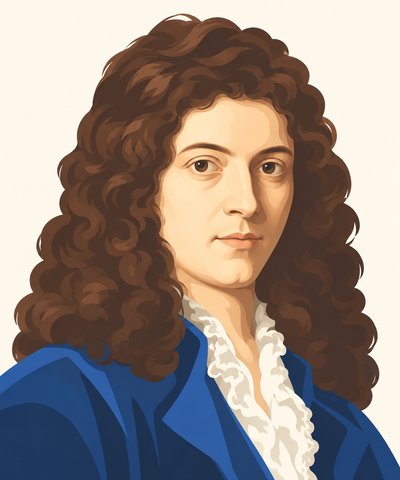
Jean-Baptiste Lully was born in Florence, in Italy, in 1632, into a family of millers, who made flour. His Italian name was Giovanni Battista Lulli. It is said that a monk taught him the guitar and the violin. In 1646, when he was 13, a French nobleman visiting Florence took him to Paris. The king’s rich cousin, a princess, wanted a boy to speak Italian with, and Lully went to live in her house. There he learned the violin, the harpsichord and composition from her musicians. He also became an excellent dancer. In 1652 the princess took the side of nobles who rose up against the king’s government. They lost, and as a punishment she was sent away from Paris to live in the country. Lully did not want to go with her, and she let him go.
The young king, Louis XIV, was six years younger than Lully, and he loved to dance. In 1653 Lully, then 20, danced beside the 14-year-old king in a court ballet that lasted all night. Soon afterwards the king made Lully his composer. In 1661 Lully became a French citizen and the head of the king’s music. The next year, at 29, he married Madeleine Lambert, the daughter of a court singer and composer. Six of their children grew up.
From 1664 he worked with the writer Molière on comedies with songs and dances. The most famous is The Bourgeois Gentleman (1670). Lully also acted and danced in them. It is said that once, playing a man chased by doctors, he jumped right into the harpsichord in the orchestra and broke it. The king, who was usually very serious, could not stop laughing.
In 1672 Lully bought the royal right to put on operas in France. From then on he wrote a new opera almost every year, with words by the poet Philippe Quinault. Italian opera was famous all over Europe, but Lully wanted opera to sound French. It is said that he went to the theatre to hear the great actress La Champmeslé, and wrote his music to follow the way she spoke the words. Le héros que j’attends (The Hero I Am Waiting For) comes from his opera Alceste (1674).
He had a very good ear and a hot temper. It is said that from the back of the stage he could hear a single violin playing a wrong note. Sometimes, when a player played badly, Lully broke the violin over the player’s back. But after the rehearsal he called the player over, paid him three times the price of the violin and took him to dinner. At that time players often added their own notes to decorate the music. Lully did not allow this. Every player had to play exactly what was written, and his orchestra became famous for playing as one.
In January 1687 he conducted a large choral piece to celebrate the king’s recovery from an illness. In those days the leader beat time by hitting a long, heavy stick on the floor. Lully hit his own foot with it. The wound became infected. He refused to let the doctors cut off his toe, and he died in Paris in March 1687, at 54.
Lully was born in Italy, but he gave France an opera of its own. It is said that long after his death, someone praised the new Italian violin music to the old king. The king asked one of his own violinists to play a simple tune from an opera by Lully. Then he said, “That is my taste.”
演唱 Jean-Baptiste Lully 的曲目
这些曲目收录在 Singalong Solfege 中。可以跟随引导人声和钢琴伴奏,用唱名演唱。
| 编号 | 难度 | 曲名 | 年份 | |
|---|---|---|---|---|
| Ex. 1-1 | ③ | Le héros que j'attends | 1673 |