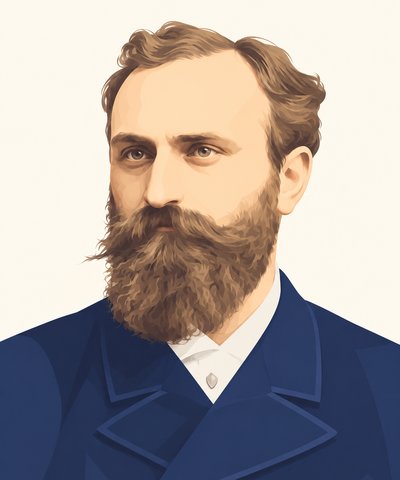
Ernest Chausson was born in Paris in 1855, in a covered shopping passage that his grandfather had built and named after the family. His father was a building contractor who had grown rich as Paris was rebuilt. Ernest's two elder brothers died young, and he grew up as the only child, taught at home by a private tutor and seldom with other children.
He loved books and drawing, and wrote poems and stories. Later he wrote to a friend that, because he was so much alone and read so many gloomy books, he had often felt sad as a boy without any real reason.
At 20 he wrote in his diary: "Whatever other people say, I want to be a musician." But on the same page he asked himself, "After Beethoven and Schumann, is there anything left to say?" To please his father, he first studied law. He qualified as a lawyer in 1877, but he never worked as one.
In 1879, at 24, he went to Munich and heard Wagner's operas for the first time. The same year he began to study at the Paris Conservatoire with Jules Massenet. He left two years later, after failing the first round of the Prix de Rome, and became a private pupil of César Franck, who remained his teacher and friend until Franck's death. His first published songs date from those years, among them Nanny and Le Colibri, which is in five beats to the bar, very rare in songs of that time.
In 1883, at 28, he married Jeanne Escudier, a good pianist, and they spent their honeymoon at Wagner's festival in Bayreuth. They had five children. Their house in Paris was like a museum, full of paintings by Degas and other painters of the day, and composers, poets and painters met there, among them Fauré, Debussy, Albéniz, the poet Mallarmé and the painter Monet.
He was rich, and that made him shy about his own music. A friend wrote that he felt too awkward even to take a score to anyone and ask for it to be played. Instead he worked hard so that other composers' music would be played. From 1886, at 31, he ran a society that held concerts of new French music. He wrote a huge number of letters for it, arranged the concerts, and often paid the costs out of his own pocket.
In 1893 he became a close friend of Debussy, who was seven years younger, poor and still unknown. He had one of Debussy's works performed, helped him with money, and invited him to stay at his summer house. When Chausson was away on holiday, Debussy wrote to him from Paris that he felt lonely, asked for his advice on the opera he was writing, and said that Chausson's return would "fill my heart with joy." But the friendship ended the next year. Debussy broke off his engagement to a singer who was a close friend of the Chausson family, and Chausson never forgave him.
He never believed in his own work. He wrote: "While I only think about a piece, I feel sure of myself. As soon as I pick up my pen, I feel like a little boy." For ten years he worked on an opera about King Arthur. He loved Wagner's music so much that whatever he wrote came out sounding like Wagner, and he fought hard to find a sound of his own. "I must escape from that devil of a man," he wrote.
The poet Camille Mauclair remembered an evening when he brought Chausson a new poem. Chausson sat at the piano and improvised music for it. Then he looked up and asked quietly, "Is that it?" Mauclair told him it was beautiful. Chausson only smiled a little sadly. He never believed, Mauclair wrote, that anything he made was good.
Among his songs are several to French versions of Shakespeare by his friend Maurice Bouchor, who was born the same year. Two of them are Chanson d'amour, written in 1891, and Chanson d'Ophélie, written in 1896.
The violinist Eugène Ysaÿe asked him for a concerto. Chausson answered that a concerto was too big for him, but that he could write a freer, shorter piece. The result was the Poème for violin and orchestra, which Ysaÿe played in Paris in 1897. The audience applauded for a long time, something Chausson had never known before. His friend Albéniz then took it to a publisher in Germany, who did not want it. Albéniz secretly paid the printing costs, and even the fee the publisher paid to Chausson, out of his own pocket, and so the Poème was published. Today it is one of the best-loved pieces for violin and orchestra, played and recorded by violinists all over the world.
In June 1899 the family was at their country house near Mantes, west of Paris. One evening he went out on his bicycle, rode down a slope, lost control and hit a wall. He died of his injuries, at 44. On his desk lay an unfinished string quartet. He had finished his opera about King Arthur four years earlier, but no theatre had taken it. It was staged in Brussels four years after his death.
Chausson was a gentle, generous man who worked for others more than for himself, and who doubted his own music to the end. He learned from Franck and fought hard to free himself from Wagner. In his music he kept looking for new sounds, and his harmonies pointed the way to Debussy and Ravel. And through much of it runs the quiet sadness that he had felt since he was a boy.
演唱 Ernest Chausson 的曲目
这些曲目收录在 Singalong Solfege 中。可以跟随引导人声和钢琴伴奏,用唱名演唱。
| 编号 | 难度 | 曲名 | 年份 | |
|---|---|---|---|---|
| Ex. 9-7 | ④ | Nanny | 1880 | |
| Ex. 10-7 | ④ | Le Colibri | 1882 | |
| Ex. 2-17 | ③ | Chanson d'amour | 1891 | |
| Ex. 3-12 | ③ | Chanson d'Ophélia | 1896 |