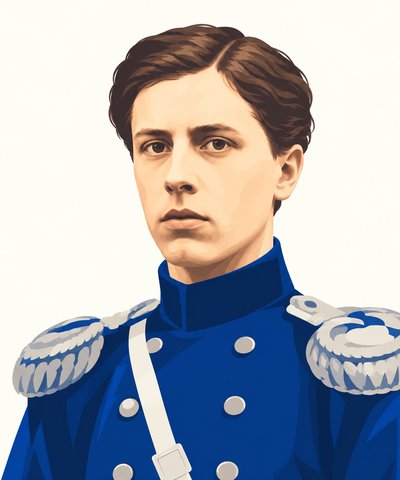
Modest Mussorgsky was born in 1839 on his family's estate in a village in western Russia, about 400 kilometres south of St Petersburg. His family were landowners, but his father's mother had been a serf, one of the farm workers who belonged to the estate. His nurse told him Russian fairy tales, and his mother taught him the piano. At nine he played a concerto for the guests. At 13 he entered the cadet school in St Petersburg. At 17 he became an officer in the Guards, the most elegant part of the Russian army. The composer Borodin, then an army doctor, remembered him at that age as an elegant little officer who spoke French and played opera tunes for the ladies.
That same winter he met Balakirev, who taught him by playing Beethoven's symphonies with him on the piano, four hands. Within two years he left the army for music. He became one of a group of young Russian composers later called the Mighty Handful, with Balakirev, Borodin, Rimsky-Korsakov and Cui. None of them had studied at a conservatory. One was a chemist, one a naval officer, one an army engineer. They wanted a truly Russian music, following Glinka, and they often met at the flat of Glinka's sister. In 1861 the serfs were freed, and his family lost half its land. So he took a job as a clerk in a government office and composed in his free time. For a year he shared a flat with Rimsky-Korsakov. Mussorgsky had the piano until noon, then he went to the office, and Rimsky-Korsakov took over. In that flat he finished his opera Boris Godunov, with words he wrote himself from Pushkin's play. The theatre first refused it, it is said because it had no big female role. He added one, and in 1874 Boris was performed in St Petersburg. The public loved it, and the critics hated it. Even his friend Cui wrote that it was immature. Tchaikovsky, who had heard him sing from it, did not like his music, but he admitted that Mussorgsky "speaks a new language."
In 1874 a painter friend died suddenly. After visiting an exhibition of his pictures, Mussorgsky wrote Pictures at an Exhibition for piano in three weeks. Ravel's orchestral version of 1922 made it one of the most popular pieces in concert halls. In 1867 he wrote Night on Bald Mountain, a wild piece about witches meeting on a mountain. Balakirev called it rubbish and refused to conduct it, and it was never played in Mussorgsky's lifetime. After his death Rimsky-Korsakov arranged it in his own way. Disney used that arrangement at the end of the film Fantasia, and millions of people know it from there. At parties he made everyone laugh. He imitated Italian sopranos in a high falsetto voice, and he could play two tunes at the same time. He wanted his music to sound like real people talking. Most operas of his time were about kings and lovers. Mussorgsky filled his operas with ordinary Russians, such as peasants and beggars, and gave them real voices. In his thirties he began to drink heavily. In 1880 he lost his job, and his friends paid him a monthly allowance so that he could go on composing. In March 1881 they took him to a hospital. There the painter Repin painted him in four sittings, in a green hospital gown, with a red nose and clear eyes. It is one of the most famous portraits of any composer. Mussorgsky died in the hospital a week later, at 42. His friends finished and published the works he left behind. Today Boris Godunov is one of the great operas of the world, and Debussy and Ravel said that his rough, honest music had shown them a new way.
Chanter les morceaux de Modest Mussorgsky
Ces morceaux sont dans Singalong Solfege. Chantez-les en solfège avec une voix guide et un accompagnement de piano.
| N° | Difficulté | Titre | Année | |
|---|---|---|---|---|
| Ex. 7-7 | ③ | Где ты, звёздочка? | 1857 |