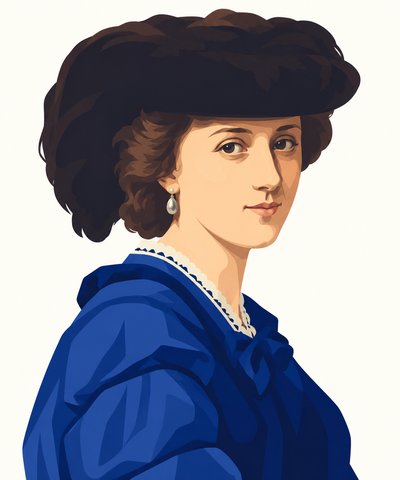
Amelia Lehmann was born in Scotland in 1838. Her father was Robert Chambers, a writer and publisher in Edinburgh. Her mother was very musical, and the house was often full of music. From a young age she sang well and showed a gift for music. It is said that her father thought she was so musical that she did not need lessons. So she began to study music seriously only after her marriage.
In 1861, at 23, she married Rudolf Lehmann, a German-born painter who was twenty years older. They lived in Rome for five years. Liszt was living in Rome too, and he often spent the evening at their home, making music and listening. Their daughter Liza later wrote that Liszt liked to come for bacon and eggs, and that he played the piano for them while the eggs were cooking. In 1866 the family settled in London, and in the end they had four daughters. Many years later, in 1886, Liszt came to London, old and almost blind. When he met Rudolf, he asked to be taken to see Amelia.
Amelia had a lovely voice and perfect pitch. She could sing a song in a different key straight from the printed music. She also drew very well. But she was very shy, and she never believed in her own work. She could hardly ever be persuaded to sing for anyone. She was so hard on herself that she destroyed most of the music she wrote, even many of her best pieces. The few songs that survived, and her arrangements of old songs, were published under her initials, “A. L.” Bouton de Rose was published in 1899.
When Liza was a girl, Amelia taught her singing herself. Later she took Liza to Jenny Lind, the most famous singer of her time. Lind said that Amelia had done so well that she did not want to take Liza away from her mother. She only offered to help. Liza became a famous singer and composer. Amelia called herself “the Brutal truth department,” because she always told singers the plain truth. After a concert where the audience had cheered, Liza sometimes came home to hear her mother say, “Well, if that’s the way you are going to sing, my advice is, give it up!” But singers loved her and came to her for advice. She never took paid pupils, but she helped many young singers to start their careers, and she was very patient when she taught. She also helped a young composer. She took private lessons from Samuel Coleridge-Taylor, who was 37 years younger. He said that she did not really need the lessons. He believed that she took them only to help him earn some money.
She died in 1903, at 65.
Amelia Lehmann was too shy to perform, and too strict with herself to keep much of her own music. Her gifts reached the world through other people: through the old songs she arranged as “A. L.,” and above all through her daughter Liza, whom she trained herself.
Chanter les morceaux de Amelia Lehmann
Ces morceaux sont dans Singalong Solfege. Chantez-les en solfège avec une voix guide et un accompagnement de piano.
| N° | Difficulté | Titre | Année | |
|---|---|---|---|---|
| Ex. 10-11 | ③ | Bouton de Rose | 1899 |