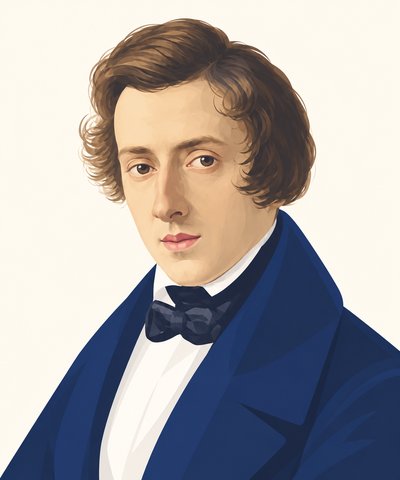
Frédéric Chopin was born in 1810 in Żelazowa Wola, a village near Warsaw, in Poland. His father was a Frenchman who taught French at a school in Warsaw. Frédéric grew up speaking Polish, and all his life he felt Polish. In 1818, at about eight, he played in public for the first time. For the concert his mother had dressed him in a new jacket with a fine white collar. It is said that afterwards she asked him what the audience had liked best. He answered, “Everybody was looking at my collar.” At 14 he spent a summer with a school friend’s family in the country. To make his own family laugh, he wrote his letters home as a pretend newspaper. He copied the style of a real Warsaw newspaper, and he filled it with funny “news” about life in the village. He signed it “Mr Pichon,” which uses the letters of “Chopin” in a different order.
In 1826, at 16, he began to study composition at the Warsaw Conservatory with its director, Józef Elsner. When Chopin finished in 1829, Elsner wrote in his report, “exceptional talent, musical genius.” That same year, at 19, Chopin gave two concerts in Vienna, and both were a success. At the first one he played his own variations on a tune from Mozart’s opera Don Giovanni. In November 1830, at 20, he left Warsaw for Vienna again. A few weeks later, an uprising against Russian rule broke out in Poland. Chopin’s family did not take part in it, but some of his friends did. The uprising failed in 1831. After that Russian rule in Poland became even stricter, and Chopin, like many other Polish people, chose to live abroad. He never went back. In October 1831, at 21, he reached Paris, and he lived there for the rest of his life.
In December 1831 the German composer Robert Schumann, who was born in the same year, wrote about Chopin’s variations on Mozart in a music magazine. He praised Chopin as a genius. In February 1832 Chopin gave his first concert in Paris. Franz Liszt, who was one year younger, was in the audience, and the two became friends. Chopin dedicated his first set of études, piano pieces that train the fingers, to Liszt. In a letter he wrote that he wished he could play them the way Liszt did. Chopin did not like large audiences. In his whole life he gave only about 30 public concerts. He preferred to play for small groups in private homes. He earned his living by teaching the piano. He wanted the piano to sing like a human voice, and his model was the singing in Italian opera. So he told his pupils, “You must sing if you wish to play,” and he sent them to singing lessons and to the opera.
Chopin loved singing, and he also wrote songs himself. He wrote 19 songs to Polish poems, for his family and his Polish friends. Only two of them were printed in his lifetime. Życzenie (The Wish) was written in about 1829, when he was a student in Warsaw. Smutna rzeka (Sad River) was written in 1831, the year he spent far from home. Moja pieszczotka (My Darling) was written in Paris in 1837, to words by Adam Mickiewicz, the national poet of Poland.
Chopin did not want to live under Russian rule, so he did not take a new Russian passport. Without it he could not go home to Poland. Instead, in 1835, at 25, he met his parents in Karlsbad, a town in what is now the Czech Republic. It was the last time he saw them. The next year, at 26, he met the French writer George Sand through Liszt. She was six years older. She had left her husband, and she had a son and a daughter. Two years later Chopin and Sand became a couple. In the winter of 1838, at 28, they went to Majorca, an island in Spain. The weather was cold and wet, and Chopin became very ill. From then on his health was always weak. For several summers he stayed at her country house in central France, and there he wrote much of his best music. In 1847 Sand’s daughter, Solange, who was then 19, married a sculptor, and soon a bitter quarrel broke out between mother and daughter. Chopin took the daughter’s side. Sand was deeply hurt, and in the same year their life together came to an end.
With his friends Chopin was full of fun. He could imitate people so well that friends asked him to do it at parties. It is said that once a Polish musician visiting Paris asked to meet Liszt and another well-known pianist, Pixis. Chopin sat down at the piano and imitated both of them. The next evening at the theatre, the real Pixis sat down next to the visitor. The visitor thought it was Chopin again. He hit Pixis lightly on the shoulder and said, “Stop it, don’t imitate now!” Chopin laughed when he heard what had happened.
But writing music was hard work for him. George Sand later wrote that a melody often came to him suddenly, at the piano. Then he shut himself in his room for days. He cried, walked up and down, and broke his pens. Once he worked for six weeks on a single page. In the end he wrote it down just as he had first played it.
After he parted from Sand, his health became even worse. In 1848, at 38, he travelled to Britain. He played for Queen Victoria, and he gave concerts in London and in Scotland. His last concert, in London, was for Polish people who had lost their homes. The journey made him very tired, and in November he went back to Paris. For many years he had been ill with tuberculosis, a disease of the lungs. In 1849 he became too weak to teach. He died in Paris in October 1849, at 39. At his funeral Mozart’s Requiem, a mass for the dead, was sung. One of the singers was his friend Pauline Viardot, who was 11 years younger. Eight years later his friend Julian Fontana collected his songs and published them.
Chopin did not like large crowds, but with his friends he was warm, funny and full of jokes. When he wrote music, he was very hard on himself. He wrote almost only for the piano, and he made it sing with long, flowing melodies. He also made the mazurka and the polonaise, the dances of his homeland, known all over the world. In Paris he was one of the most admired musicians of his time, and today almost everyone who learns the piano plays his music.
Chanter les morceaux de Frédéric Chopin
Ces morceaux sont dans Singalong Solfege. Chantez-les en solfège avec une voix guide et un accompagnement de piano.
| N° | Difficulté | Titre | Année | |
|---|---|---|---|---|
| Ex. 3-5 | ③ | Życzenie | 1829 | |
| Ex. 7-3 | ④ | Smutna rzeka | 1831 | |
| Ex. 12-3 | ④ | Moja pieszczotka | 1837 |