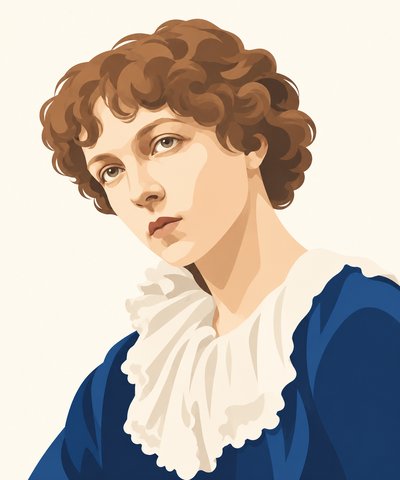
Cécile Chaminade was born in 1857 in Batignolles, then a village just outside Paris. Her father worked for an insurance company and played the violin, and her mother, a good pianist and singer, gave her her first piano lessons. Her parents and their friends often played chamber music late into the night, and when the little girl grew tired she lay down under the piano and fell asleep to the music.
She started composing when she was very small, and she wrote music for everything around her. She wrote later: "My dolls danced to my music. I wrote lullabies for my dogs, and for my cat, whose ways were mysterious, a moonlight serenade."
When she was about twelve, the family's neighbour Georges Bizet asked her to play everything she knew, including her own pieces. Then he said to her father: "She really has the gift. Give her every chance and she will succeed. But above all, don't make music boring for her." A teacher from the Paris Conservatoire also heard her and wanted her in his class, but her father would not let her go. He thought it was not proper for a girl of her family. So teachers from the Conservatoire came to the house instead, and later she studied composition with Benjamin Godard.
She gave her first concert at 18. Ambroise Thomas, the head of the Conservatoire, heard her and said: "She is not a woman who writes music. She is a composer who happens to be a woman." From then on she played only her own music at her concerts.
In 1887, when she was 29, her father died, and the family was short of money. Chaminade now had to earn a living, for herself and her mother. She toured as a pianist, and she signed a contract with her publisher to write twelve new songs a year. Her songs sold very well, and many of them were sung in homes all over the world, among them Madrigal, La Fiancée du soldat and Sur la plage.
She was shy, and so nervous that after every concert she thought it would be her last. But she kept on playing. From 1892 she went to England almost every year, and she played for Queen Victoria. Not long afterwards two men in grand uniforms brought a large parcel, covered in seals, to her house near Paris. She was frightened, and when she heard that it came from the Queen, she almost fainted. Inside, under many layers of paper, was a photograph of the Queen, signed by her own hand. In those days this was a great honour, a sign that the Queen was especially fond of her.
In 1901, at 44, she married the music publisher Louis-Mathieu Carbonel, who was about fifteen years older. He was often ill, and she nursed him until he died a few years later. In 1901 she also recorded some of her piano pieces in London, so we can still hear her play today.
In 1902 the Paris Conservatoire, the school her father had not let her attend, asked her to write a piece for its flute examination. Her Concertino for flute and orchestra is still one of the best-loved pieces for flute, played by flute students all over the world.
Her music was loved most of all in America, where music lovers had formed about two hundred "Chaminade Clubs" to play and sing it. In 1908, at 51, she crossed the Atlantic, which she had been afraid to do for years, and gave concerts in twelve cities. Her first concert at Carnegie Hall in New York was sold out, and in Washington she met President Theodore Roosevelt at the White House. She told an American newspaper that talent has nothing to do with being a man or a woman.
In 1913 she received France's highest honour, the Légion d'honneur, the first woman composer to do so. During the First World War she stopped performing and looked after wounded soldiers.
After the war, music changed, and her songs and piano pieces began to seem old-fashioned. She wrote her last works in 1928, at 71, and later moved to Monte Carlo. Her health was poor.
In 1939, an American music magazine asked its readers to write to her on her 82nd birthday, and thousands did. Three years later she wrote: "Not to be forgotten, to live on in the hearts of people who understand you, is the greatest comfort for an artist." She died in Monte Carlo in 1944, at 86.
Chaminade was shy and easily frightened, but she never gave up. She played concert after concert, crossed the ocean she was afraid of, and earned her living by her music. Her songs and piano pieces are bright, light and full of melody, with the elegance of Paris in her time, and they were played and sung in homes all over the world.
Chanter les morceaux de Cécile Chaminade
Ces morceaux sont dans Singalong Solfege. Chantez-les en solfège avec une voix guide et un accompagnement de piano.
| N° | Difficulté | Titre | Année | |
|---|---|---|---|---|
| Ex. 1-10 | ⑤ | Madrigal | 1886 | |
| Ex. 14-13 | ③ | La Fiancée du soldat | 1887 | |
| Ex. 4-12 | ③ | Sur la plage | 1892 | |
| Ex. 3-15 | ③ | L'allée d'émeraude et d'or | 1900 |