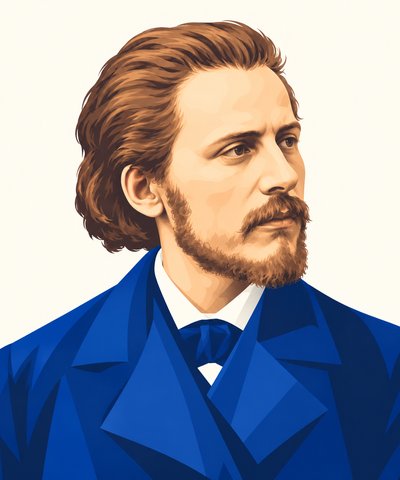
Jules Massenet was born in 1842 in Montaud, now part of the city of Saint-Étienne in central France. He was the youngest of twelve children. His father ran an ironworks, and his mother gave him his first piano lessons. When he was six, his father fell ill and the family moved to Paris, where his mother taught the piano to earn money. He entered the Paris Conservatoire at about eleven. As a student he earned his living by playing the piano in a café and the drums in theatre orchestras. He said later that he felt "as rich as a banker and as happy as a shoemaker," a joke about an old French fable in which the poor shoemaker sings all day and the rich banker cannot sleep. In 1859, at 17, he played the drums in the rehearsals of Gounod's opera Faust, and he watched the composer at work. At 21 he won the Prix de Rome, France's top prize for young composers, which paid for several years of study in Rome. In Rome he met Liszt, who was 53 and the most famous pianist in the world. A young lady from Paris asked Liszt for piano lessons, but he was too busy, so he asked Massenet to teach her. Three years later Massenet married her.
He was 31 when he first became famous, in 1873, with a religious work sung by the famous singer Pauline Viardot. In 1878, at 36, he became a professor at the Conservatoire. In the same year he was elected to the Academy of Fine Arts, a great honour in France, and he was the youngest member ever. In the vote he beat Saint-Saëns, who was seven years older and already well known. After that he wrote one opera after another. Manon (1884), Werther (1892) and Thaïs (1894) are still performed all over the world. The "Méditation" from Thaïs, a piece for solo violin and orchestra, is one of the most played pieces for the violin. His song Élégie became so popular that it has been arranged for almost every instrument. For more than twenty years he was the most popular opera composer in France. Debussy, who was twenty years younger, wrote that young shop girls in Paris woke up in the morning singing tunes from Manon or Werther. Tchaikovsky, two years older, played through that religious work at the piano and was moved to tears, and he wrote, "How much taste these Frenchmen have!" Bizet was his friend. They served together in the National Guard during the war of 1870, when Paris was surrounded by the German army. After one of Massenet's successes, Bizet wrote to him, "You give me a fever, you bandit!" He meant that he was jealous, but in a friendly way.
All his life Massenet got up at four every morning and composed until midday. He hated the excitement of first nights, so he never went to the premieres of his own operas. At one premiere he waited in a café across the street, and a friend ran over to bring him the news that it had gone well. He taught at the Conservatoire for eighteen years, and his pupils included Reynaldo Hahn and Ernest Chausson. They remembered that he drew out their own ideas instead of forcing his on them. When he left the Conservatoire in 1896, Fauré took over his class. He died in Paris in 1912, at 70. His music went out of fashion for a while after his death, but since the 1970s his operas have come back to the stage. When he died, Debussy wrote that people had loved Massenet more truly than any other musician of his time.
Sing Jules Massenet's songs
These songs are in Singalong Solfege. Sing them in solfege with a guide vocal and piano accompaniment.
| No. | Difficulty | Title | Year | |
|---|---|---|---|---|
| Ex. 3-11 | ③ | Élégie | 1872 |