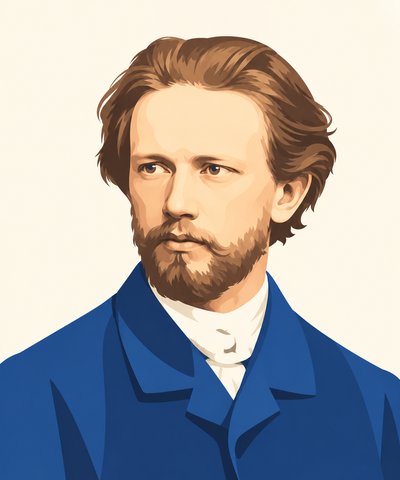
Pyotr Ilyich Tchaikovsky was born in 1840 in Votkinsk, a small town in the Ural region of Russia. His father was a mining engineer, and he was the head of the town’s iron factory. In 1844 a young Frenchwoman, Fanny Dürbach, came to live with the family and teach the children. She later remembered him as “a child of glass,” because small criticisms hurt him deeply.
At that time music was not seen as a real job, so in 1850, at ten, his family sent him to a law school in St Petersburg, 1,300 kilometres from home. Being sent so far from his mother hurt him deeply. In 1854, when he was 14, his mother died of cholera, a disease that spreads through dirty water. He felt this loss for the rest of his life. His first serious piece of music was a waltz in her memory. In 1859, at 19, he became a clerk in the Ministry of Justice. But he kept studying music in his free time. In 1862, at 22, he joined the first class of the new St Petersburg Conservatory. The next year he left the Ministry to give all his time to music.
In 1866, at 25, he moved to Moscow to teach at the new conservatory there. Its director, the pianist Nikolai Rubinstein, became his closest friend in the city. In 1868 Tchaikovsky tried to conduct for the first time. According to a friend, he was so nervous that he held his chin with his left hand while he conducted with his right. He was afraid that otherwise his head would fall off. For almost twenty years after that, he did not like to stand in front of an orchestra.
He was still a poorly paid teacher. In 1869 he wrote to his brother that he was going to write some songs “to earn a little money.” None but the Lonely Heart is one of them, and it became one of his most popular songs.
In 1875 the French composer Camille Saint-Saëns, who was five years older, visited Moscow. Both men loved ballet. It is said that one day, just for fun, the two of them danced a little ballet together on the empty stage of the conservatory. Rubinstein played the piano for them, and there was nobody else to watch. At that time Tchaikovsky was writing his first ballet.
In 1875 the Bolshoi Theatre in Moscow asked him to write a ballet. At that time ballet music was usually simple, and it was there only to keep time for the dancers. But Tchaikovsky wrote rich music, like a symphony. Swan Lake was first performed in 1877. But the dancing and the stage were poor, and critics said that the music was “too symphonic.”
At the end of 1876 a rich widow, Nadezhda von Meck, began to write to him, because she loved his music. Soon she gave him a large sum of money every year, and in 1878 he was able to stop teaching and give all his time to composing. They wrote more than 1,200 letters to each other, but they agreed that they would never meet. Only once, in 1879, did they meet by chance. He was out walking in a forest, and her carriage passed by. He raised his hat, and neither of them said a word. In 1890 she suddenly stopped the money, and she also stopped writing. By then he no longer needed her money, but her silence hurt him deeply.
In 1885, at 44, he rented a house of his own for the first time, in a village near Klin, a town between Moscow and St Petersburg. “What happiness to be in my own home!” he wrote. Every afternoon he went for a long walk in any weather, and he loved to pick mushrooms. Until then he had always stayed with his family or friends, or in hotels.
In 1886 he visited the singer Pauline Viardot in Paris. He was shy with new people, but he wrote that she was so charming that in three hours he kissed her hand about ten times. Viardot owned Mozart’s own handwritten score of the opera Don Giovanni, and she showed it to him. Mozart was his favourite composer, and as a small boy he had first fallen in love with music when he heard a song from Don Giovanni. He wrote that, as he looked at the score, he felt as if he were near something holy.
In 1887, at 46, he had to conduct one of his operas himself, because the conductor could not lead it. He had always been terribly afraid of the stage, but somehow he got through it. The performance went well, and it gave him a little confidence. From then on he conducted his music in many countries, and he met many other composers. In Hamburg in 1889, Brahms stayed an extra day to hear the rehearsal of Tchaikovsky’s Fifth Symphony. At lunch Brahms said openly that he did not like it. Tchaikovsky told Brahms just as openly what he thought of Brahms’s music. Then they drank a lot of wine together, and Tchaikovsky wrote that he liked Brahms more than before.
In 1890 his ballet The Sleeping Beauty was first performed in St Petersburg. The Tsar, the ruler of Russia, came to the final rehearsal, and he said only, “Very nice.” That night Tchaikovsky wrote in his diary, “’Very nice’!!!!! His Majesty treated me as if I were far below him. God be with him.”
In 1891 he conducted at the opening of Carnegie Hall in New York. By then he was more used to the stage, but he was still very nervous. Before one concert he wrote in his diary that he had never been so afraid. But after the concert the newspapers praised him very highly, and he asked in his diary, “Am I really such a good conductor? Or are these Americans exaggerating?!!!”
That year he was writing a new ballet, The Nutcracker. In Paris he had found a new instrument, the celesta, which makes a soft sound like little bells. He asked his publisher to buy one in secret, because he was afraid that other Russian composers would use it first. He used it in the Dance of the Sugar Plum Fairy.
Around the New Year of 1893, at 52, he travelled to a small town in France to visit Fanny Dürbach, his old teacher. She was now about 70, and they had not seen each other for 44 years. She had kept his school exercise books and the letters that he had written as a child. He wrote to his brother that for two days he had felt as if he had gone back to his childhood.
That year he wrote his Sixth Symphony, the Pathétique. He believed that it was the best of his works. On 28 October 1893 he conducted its first performance in St Petersburg. But that autumn there was cholera in the city. It is said that a few days after the concert he drank a glass of water that had not been boiled. The next morning he felt ill. It was the same disease that had killed his mother. For a while he seemed to get better, but then he grew weaker again. He died in St Petersburg on 6 November 1893, at 53, only nine days after the concert. About 60,000 people asked for tickets to his funeral.
Tchaikovsky was a very modest man. He was shy and easily hurt, and even when the whole world praised him, he doubted himself. Yet he never pretended about music. He said what he really thought, even to Brahms. He was afraid of the stage, but he made himself conduct all over Europe and America. With people he was warm, and he travelled far to see his old teacher again.
Above all, he wrote melodies that touch everyone. He was probably the first Russian composer whom the whole world loved while he was still alive. He also made ballet music as rich as a symphony, the very thing that critics had disliked in Swan Lake. After his death Swan Lake became famous all over the world. Today it is danced everywhere with The Sleeping Beauty and The Nutcracker, and even people who never go to concerts know the opening of his Piano Concerto No. 1.
Sing Pyotr Ilyich Tchaikovsky's songs
These songs are in Singalong Solfege. Sing them in solfege with a guide vocal and piano accompaniment.
| No. | Difficulty | Title | Year | |
|---|---|---|---|---|
| Ex. 10-6 | ③ | None but the Lonely Heart | 1869 | |
| Ex. 5-8 | ④ | Amidst a Noisy Ball | 1878 | |
| Ex. 4-11 | ⑤ | Danse de la Fée-Dragée | 1892 |