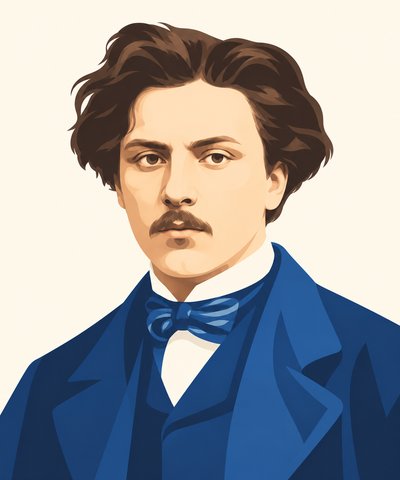
Gabriel Fauré was born in 1845 in Pamiers, a small town in the south of France, the youngest of six children. When he was four, his father became the head of a school for teachers. The school had a little church, and in it was a harmonium, a small organ. Near the end of his life Fauré remembered, “Every time I could get away I ran there. I played very badly, but I do remember that I was happy.” An old blind woman often came to listen, and she told his father about the boy’s gift. So in 1854, at nine, his father took him to a music school in Paris that trained church musicians.
He lived at the school for eleven years. The old church music he studied there gave his own music its special sound. The pupils also had fun. On rainy days they made an “orchestra” of pianos, fire tools, coal buckets and a set of wooden steps. At the big chord they threw everything on the floor, and the dust of many days rose slowly into the air. “The effect was better than we had hoped!” Fauré wrote at 77. On Sundays he and a school friend walked up to the hill of Montmartre and looked over Paris. “I shall have the Madeleine,” said Fauré, naming one of the great churches of the city. “And I, Saint-Augustin,” said his friend. Both wishes came true. From 1877 Fauré led the choir of the Madeleine, and later he became its chief organist.
In 1861 the young composer Camille Saint-Saëns, ten years older, became his piano teacher. At 16, while he was studying with Saint-Saëns, Fauré wrote his first song, Le papillon et la fleur (The Butterfly and the Flower). Saint-Saëns became his closest friend for the next 60 years. In his letters he called his favourite pupil “my fat cat,” and again and again he helped him to find work. They did not always agree, and they argued openly. But the friendship lasted until Saint-Saëns died in 1921.
In 1866, at 20, Fauré became the organist of a church in Rennes, in the west of France. He was bored there. While the priest was speaking to the people, he slipped out to smoke at the church door. One Sunday in 1870 he came to play at the morning service straight from a dance, still in his evening clothes, and he lost his job. He went back to Paris, and that summer war broke out with Prussia. Fauré joined the army and fought in the battles around Paris.
Saint-Saëns took him to the home of the famous singer Pauline Viardot, and Fauré fell in love with her daughter Marianne. In 1877 she agreed to marry him, but less than four months later she broke off the engagement. Fauré was deeply hurt. To cheer him up, Saint-Saëns took him to Germany to meet Liszt. Fauré showed Liszt one of his piano pieces. Liszt, the greatest pianist of the age, quickly read it and gave it back, saying, “It is too difficult.”
In 1883, at 37, he married Marie Fremiet, the daughter of a famous artist who made statues, and they had two sons. Money was always short. He played at church services every day and gave piano lessons from morning to night. His publisher paid him only a small sum for each song. So he could compose only in the summer holidays. Every year from July to October he went to a quiet hotel, often by a lake in Switzerland, and wrote.
For years Fauré had played the organ at funerals. In 1888, when he was 42, his own Requiem was first performed at the Madeleine. Most requiems are full of the fear of death, but Fauré’s is calm and gentle. He said that he saw death as a happy escape to something better, not as a painful thing, and that after so many funerals, “I wanted to write something different.” It is said that the priest told him afterwards, “We don’t need these new things.”
In 1892 Fauré hoped to teach at the Paris Conservatoire, the country’s most important music school. But its director said, “Fauré? Never! If he is appointed, I resign.” Only after the director’s death, in 1896, did Fauré become a professor there. He was a gentle teacher. When a pupil played something dull and empty, he would only ask softly, “Was there nothing else?” Among his pupils were Maurice Ravel and Nadia Boulanger. Once he did not much like a new string quartet by Ravel. A few days later he asked to see it again, saying, “I could have been wrong.” Ravel dedicated the quartet to him.
In 1905 Ravel, then 30 and already well known, tried for the last time to win the Prix de Rome, the most important prize for young French composers. The judges did not even let him reach the final round, and all Paris was angry. The head of the Conservatoire had to retire, and the government chose Fauré, then 60, to take his place. He was gentle, but now he was firm. He made the exams fairer, and some teachers left in anger, because they could no longer give their own private pupils an unfair advantage. Years later he wrote to Ravel that his pupil’s success was “a source of joy and pride for your old professor.”
From about 1903, when he was 58, Fauré slowly went deaf. Worse, high and low notes sounded out of tune to him. But he kept on writing, and some of his finest music comes from these years. In 1922 Paris held a great concert of his music. He could not hear a single note, but those who were there remembered him “grateful and content.” In 1923, at 78, he began a string quartet. “Beethoven made it famous,” he wrote to his wife, “and it makes all those who are not Beethoven terrified of it.” He finished it in September 1924, but he never heard it. He asked his friends to decide whether it was good enough to be published.
That autumn he grew weak. Near the end he is said to have asked what of his music would live, and then to have added, “But that is of little importance.” He died in Paris in November 1924, at 79. France gave him a state funeral at the Madeleine, the church he had dreamed of as a boy, and his own Requiem was sung.
Fauré was gentle, modest and full of quiet humour, and he was a loyal friend. He wrote most of his music in his summer holidays, but he left more than a hundred songs, and many of them, such as Après un rêve (After a Dream), are among the best loved in French music. His music moves into new keys in sudden, surprising ways, so you never quite know where it is going, yet in the end it comes home gracefully. This gave French song a new kind of beauty.
Sing Gabriel Fauré's songs
These songs are in Singalong Solfege. Sing them in solfege with a guide vocal and piano accompaniment.
| No. | Difficulty | Title | Year | |
|---|---|---|---|---|
| Ex. 1-7 | ④ | Le papillon et la fleur | 1861 | |
| Ex. 7-8 | ⑤ | Dans les ruines d'une abbaye | 1866 | |
| Ex. 2-11 | ③ | Lydia | 1870 | |
| Ex. 3-10 | ④ | Hymne | 1870 | |
| Ex. 8-14 | ④ | L'aurore s'allume | 1870 | |
| Ex. 2-12 | ③ | Aubade | 1873 | |
| Ex. 4-10 | ④ | Barcarolle | 1873 | |
| Ex. 9-12 | ④ | Au bord de l'eau | 1875 | |
| Ex. 6-9 | ③ | Après un rêve | 1877 | |
| Ex. 2-13 | ④ | Sylvie | 1878 | |
| Ex. 11-6 | ③ | Rencontre | 1878 | |
| Ex. 12-6 | ④ | Nell | 1878 | |
| Ex. 10-8 | ② | Les berceaux | 1879 | |
| Ex. 2-14 | ④ | Chanson d'amour | 1882 | |
| Ex. 6-11 | ③ | Nocturne | 1886 | |
| Ex. 10-9 | ③ | Clair de Lune | 1887 | |
| Ex. 2-16 | ② | Spleen | 1888 | |
| Ex. 14-14 | ⑤ | Larmes | 1888 | |
| Ex. 3-13 | ④ | Mandoline | 1891 | |
| Ex. 6-13 | ③ | En sourdine | 1891 | |
| Ex. 12-8 | ⑤ | Green | 1891 | |
| Ex. 9-11 | ④ | Le Parfum impérissable | 1897 |