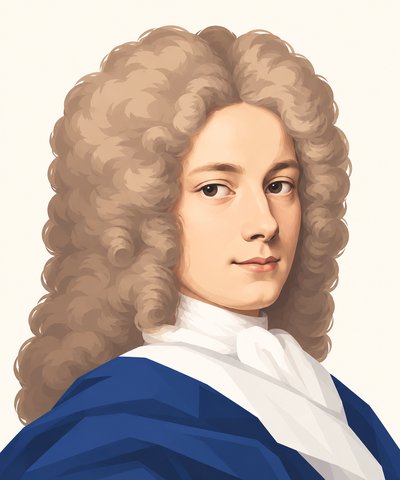
George Frideric Handel was born in 1685 in Halle, a town in central Germany. Johann Sebastian Bach was born in the same year, not far away, but the two never met, although Bach once travelled to Halle to see him. Handel’s father was a surgeon, and he wanted his son to study law, not music. It is said that the boy hid a small keyboard instrument under the roof, and that he played it secretly at night. When he was about seven, his father went to the court of a duke in a nearby town. According to the first book about Handel’s life, the boy ran after the carriage until his father let him come. There the Duke heard him play the organ. He told the father that it would be “a crime” to keep such a talent from the world. So the father let the boy study music.
In 1703, at 18, Handel moved to Hamburg, in northern Germany, and he played in the orchestra of its opera house. There he became friends with a young singer and composer. One evening the two men argued about who should play the harpsichord in an opera. After the performance they fought with swords outside the theatre. According to his friend, his sword hit a large metal button on Handel’s coat, and the sword broke. Soon they were friends again.
In 1706, at 21, Handel went to Italy, because he wanted to learn Italian opera in its home country. The Italians called him “the Saxon,” because he came from Saxony, a region of Germany. It is said that in Venice he once played the harpsichord at a party where all the guests wore masks. The young Italian composer Domenico Scarlatti, who was born in the same year as Handel, heard him. He said that the player could only be “the famous Saxon, or the devil.” Later the two had a contest on the keyboard in Rome. On the harpsichord nobody could say who was better. But on the organ even Scarlatti said that Handel had won.
In 1710, at 25, Handel became head of music at the court of Hanover, in northern Germany. Its ruler, George, allowed him to travel, and Handel went to London. In 1711 his opera Rinaldo was a great success there. One of its arias, or solo songs, is Lascia ch’io pianga (Let Me Weep). Handel went back to Hanover, but the next year he returned to London, and he stayed there for the rest of his life, much longer than George had allowed. But in 1714 George became King George I of Britain. So the man whose court Handel had left was now his king. The king did not punish him. In 1717 he liked Handel’s new Water Music so much that he had it played three times on a boat on the River Thames.
In 1723 a famous Italian singer came to London to sing in his operas. It is said that she refused to sing an aria that he had written for her. Handel told her, “I always knew you were a real devil, but now you will learn that I am the chief of the devils.” Then he lifted her by the waist, and he said that he would throw her out of the window. In the end she sang the aria, and it became one of her greatest successes.
In 1727, at 41, Handel became British. That year he wrote Zadok the Priest for the crowning of King George II. It has been sung at every British crowning since then. The music played before the biggest football matches in Europe, the UEFA Champions League, is based on it.
By then Handel ran his own opera company with his own money. But star singers from Italy were very expensive, and fewer and fewer people came to see Italian operas. His company lost more and more money, and in 1737 it had to close. Handel had lost almost all his money. That same year, at 52, he had a stroke, and his right arm could not move. He got well, and he went back to work. He began to write oratorios instead of operas. These are large works for singers and orchestra on stories from the Bible, sung in English without costumes or acting.
In 1741, at 56, Handel was invited to Dublin, in Ireland. Before he left, he wrote Messiah in about 24 days. The next year the first performance of Messiah in Dublin was a concert for charity. The money helped to set about 142 people free from prison, where they had been kept because of their debts.
Handel loved good food and wine. It is said that at dinners in his home he sometimes cried, “Oh, I have the thought!” and went into the next room. His guests believed that he had an idea for his music. But one guest looked through the hole for the key. He saw Handel drinking a fine French wine, while his guests were drinking a cheaper one.
In 1751, at 66, Handel began a new oratorio. One of its arias is Farewell, ye limpid springs (Goodbye, You Clear Springs), sung by a young woman who says goodbye to the world. But he had to stop, because the sight of his left eye had become weak. By 1753, at 68, he was completely blind. Still he did not stop. He was led to the organ at his concerts, and he played from memory.
On 6 April 1759 Handel went to a performance of Messiah in London. Afterwards he went to bed, and he did not get up again. He told his doctor that he wished to die on Good Friday, the day of Jesus’s death. He died at his home in London on 14 April 1759, the day after Good Friday, at 74. About 3,000 people came when he was buried in Westminster Abbey, the great church where British kings and queens are crowned.
Handel was big, proud and quick to anger, but he did not stay angry for long. He loved good food and wine. He did not give up when he lost almost all his money, had a stroke or became blind. With his oratorios he won his fortune back, and he died a rich man.
Handel was a German who became the great composer of England. Most composers of his time worked for a court or a church, but Handel wrote for the paying public. When the public’s taste changed, he changed from Italian opera to English oratorios, and the people of London loved him for it. Beethoven later called him the greatest composer who ever lived. Today Zadok the Priest is still sung when British kings and queens are crowned, and Messiah is sung every year all over the world.
Lieder von George Frideric Handel singen
Diese Lieder sind in Singalong Solfege enthalten. Singen Sie sie in Solmisation mit Führungsstimme und Klavierbegleitung.
| Nr. | Schwierigkeit | Titel | Jahr | |
|---|---|---|---|---|
| Ex. 2-1 | ② | Lascia ch'io pianga (Aria) | 1731 | |
| Ex. 14-1 | ② | Aria: Farewell, ye limpid springs | 1751 |