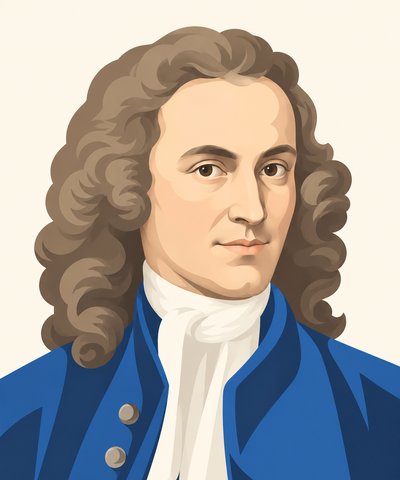
Based on a possible portrait of Bach, attributed to Johann Ernst Rentsch, c. 1715
Johann Sebastian Bach was born in 1685 in Eisenach, a town in central Germany, into a large family of musicians. When the boy was nine, both his parents died within a year. He went to live with his oldest brother, an organist in another town, and he learned the keyboard from him. According to a family story, his brother had a book of music by famous composers, and he would not let the boy use it. But the boy wanted very much to study this music. At night he pulled the book out of a locked cupboard through the gaps in the door. He copied it by the light of the moon. When his brother found out, he took the copy away.
In 1703, at 18, Bach became the organist of a church in Arnstadt, a small town in central Germany. Two years later he asked for four weeks away from work. He wanted to hear Dieterich Buxtehude, the most famous organist and composer in northern Germany, who played in Lübeck, about 400 kilometres away. It is said that Bach walked all the way. He stayed for about four months. When he came back, the church leaders were angry with him. They also complained that he played so many strange notes in the hymns that the people in church could not follow. In 1707 he left Arnstadt for a church in another town.
In 1707, at 22, he married his cousin Maria Barbara Bach. The next year he became the organist at the court of the Duke of Weimar. In 1717, at 32, he accepted a better job at the court of a prince in Köthen. But the Duke did not want to let him go. Bach kept asking to leave, so the Duke had him locked up for almost four weeks. After that the Duke let him go, and Bach moved to Köthen. The prince there loved music, and he did not need much music for church. So Bach wrote mostly music for instruments. The Brandenburg Concertos and the six Cello Suites, pieces for one cello alone, were probably written in these years. In 1720 Bach went on a long journey with the prince. When he came home, he learned that Maria Barbara had died and had already been buried. He had not even known that she was ill. The next year, at 36, he married Anna Magdalena, a 20-year-old singer at the court. Bach had 20 children with his two wives, but only ten of them lived to grow up. Several of his sons became well-known composers.
In Köthen Bach was happy. Years later, in a letter to an old school friend, he wrote that the prince loved and understood music, and that he had hoped to stay there for the rest of his life. But in 1721 the prince married a princess who did not care for music, and he became less interested in music too. Bach also wanted his sons to study at a good school and a university. He gave these reasons in the same letter. So in 1723, at 38, he moved to Leipzig, a large city in eastern Germany. There he became the head of music at St. Thomas Church and its school, a post with the title of Thomaskantor. He was also in charge of the music in the city’s main churches. He stayed there for the rest of his life. In his first years there he wrote a new cantata for almost every Sunday. In 1727, at 42, he wrote his St Matthew Passion, a large work for choir and orchestra about the death of Jesus.
From 1729, at 44, he also led a group of students and town musicians. For more than ten years they gave free concerts at a coffee house in Leipzig. The owner paid the costs with the money from the coffee he sold. Bach’s Coffee Cantata, a short comic piece about a girl who loves coffee more than anything, was probably first heard there.
Bach was also a teacher all his life. In 1722, at 37, still in Köthen, he finished the first book of The Well-Tempered Clavier. It has a prelude, a short opening piece, and a fugue in each of the 24 major and minor keys. A fugue is a piece in which several voices come in one after another with the same melody. Bach wrote that the book was for young musicians who wanted to learn. About twenty years later he put together a second book of the same kind. Several pieces from both books are in this app. In his first year in Leipzig he also wrote his Magnificat, a work for choir and orchestra on the song of Mary from the Bible. The arias Et exultavit and Deposuit, two of its solo songs, come from a later version of it.
Bach’s own home was full of music. In the same letter, written in 1730 when he was 45, he said that his children were all born musicians, and that he could form a group of singers and players from his own family. His wife sang “a good clear soprano,” and his oldest daughter sang too. Bach also had a deep Christian faith. At the end of many of his scores he wrote the letters “S. D. G.,” short for Latin words that mean “to God alone the glory.” He wrote them even on music for the coffee house.
In 1747, at 62, Bach visited King Frederick the Great of Prussia at his palace near Berlin, where his son Carl Philipp Emanuel worked as the king’s keyboard player. It is said that the king stopped his evening concert when Bach arrived, and told his musicians, “Gentlemen, old Bach is here.” The king gave Bach a melody, and Bach improvised a fugue on it at once.
In his last years he worked on The Art of Fugue, a set of fugues all built on one melody. From 1749 his eyesight became very poor. In 1750 a travelling English eye doctor, John Taylor, operated on his eyes twice. Taylor was famous, but even then many people did not trust his skill. The operations did not help, and Bach became very ill. He died in Leipzig in 1750, at 65. The last fugue of The Art of Fugue was never finished. Bach also did not write which instruments should play the work. So musicians still play it in many different ways, on the organ, on the harpsichord or with groups of strings, and many have tried to finish the last fugue.
Bach was a man who never stopped learning, and he did not give up easily. As a boy he copied music by moonlight, as a young man he walked far to hear a great organist, and he kept asking to leave Weimar even when the Duke locked him up. He loved his large family, his home was always full of music, and he wrote all his music, as he said, to the glory of God. Bach wrote almost all of his music for everyday use: for Sunday services, for his pupils and his children, and for the coffee house. In his lifetime he was famous mainly as a great organ player, and very little of his music was printed. But musicians never stopped studying it. Mozart and Beethoven learned from it, and in 1829 Mendelssohn brought the St Matthew Passion back to a large public. His music is polyphonic: it weaves several melodies together, and each one sings on its own. The art of putting melodies together in this way is called counterpoint, and Bach was its greatest master. On this music Bach built the foundation that all later classical music stands on. He is often called the father of Western music, and for many musicians he is still someone very special.
Lieder von Johann Sebastian Bach singen
Diese Lieder sind in Singalong Solfege enthalten. Singen Sie sie in Solmisation mit Führungsstimme und Klavierbegleitung.
| Nr. | Schwierigkeit | Titel | Jahr | |
|---|---|---|---|---|
| Ex. 10-1 | ④ | Prelude | 1722 | |
| Ex. 11-1 | ⑤ | Fugue | 1722 | |
| Ex. 12-1 | ④ | Fugue (edited fragment) | 1722 | |
| Ex. 5-1 | ⑤ | Et Exultavit | 1732 | |
| Ex. 7-1 | ⑤ | Deposuit | 1732 | |
| Ex. 13-1 | ⑤ | Fugue | 1740 |