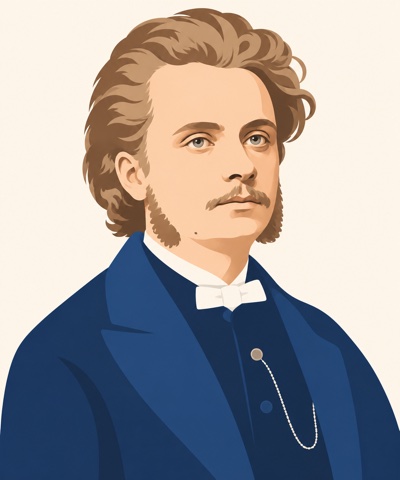
Edvard Grieg was born in 1843 in Bergen, a port on the west coast of Norway. His great-grandfather had come from Scotland, and the family sold fish and lobster to Britain. His father was a merchant. His mother had studied music in Hamburg, and she gave Edvard his first piano lessons. At five he stretched his arms up to the piano to look for sounds. He did not want a tune. He wanted chords. First he found a chord of two notes, then three, then four. At last, using both hands, he found a chord of five notes, and he was filled with joy. Later he called this his first success.
He hated school. According to his own story, he stood in the rain until his clothes were wet through, so that the teacher would send him home to change. One day he took a piece of his own to school, with "Opus 1" written on it. He showed it to a classmate. The teacher saw it, pulled him by the hair, and told him to leave such rubbish at home.
In the summer of 1858, when Edvard was 15, the famous Norwegian violinist Ole Bull came to the family's summer house. He was a friend of the family, and he asked the boy to play. Then he said, "You shall go to Leipzig and become an artist!" His parents agreed at once, and that autumn Edvard entered the Leipzig Conservatory in Germany.
The teaching disappointed him. He wrote later, "I left Leipzig Conservatory just as stupid as I entered it." But students could go to the rehearsals of the famous Leipzig orchestra for free, and he saw Wagner's opera Tannhäuser 14 times. He also heard Clara Schumann, 24 years older, play her husband's piano concerto. Many years later he wrote in his diary that he still remembered every detail of her playing.
In the spring of 1860, at 16, Grieg became seriously ill with a lung disease and almost died. His mother came from Norway and took him home. That autumn he went back to Leipzig, although the doctors told him not to. After this illness his lungs were weak for the rest of his life.
In 1863, at 19, he moved to Copenhagen, in Denmark. There he met Rikard Nordraak, a young Norwegian composer one year older than he was. Until then Grieg had written in the German style he had learned in Leipzig. Nordraak wanted a music that was truly Norwegian. Grieg wrote, "It was as if a mist fell from my eyes, and I knew what I wanted." In March 1866 Nordraak died in Berlin, at 23. Grieg heard the news in Rome, and he wrote a funeral march that same day.
In Copenhagen he also fell in love with his cousin Nina Hagerup, a singer two years younger. For Christmas 1864, at 21, he gave her four songs on poems by Hans Christian Andersen, the Danish writer of fairy tales. One of them was Jeg elsker dig (I Love You). It is said that her mother complained that he had nothing and wrote music that nobody wanted to hear. They married in 1867, when he was 23.
Their only child, Alexandra, was born in April 1868. That summer, at 25, on holiday in a Danish village, he wrote his Piano Concerto, whose first bars are known all over the world. In April 1869 it was played for the first time in Copenhagen, and it was a huge success. He could not be there, because he was working in Norway, but the pianist wrote to tell him that the audience had burst into a storm of applause. The next month Alexandra died, at 13 months, and their happy family life suddenly ended. Grieg found some comfort in composing. He began something new for him, and arranged 25 Norwegian folk songs and dances for the piano.
At the end of 1868 a letter came from Liszt, 32 years older and the most famous pianist in Europe. Grieg had sent him nothing. Liszt had found Grieg's violin sonata by himself, and he wrote to praise it. With this letter Grieg won a grant from the Norwegian government, and in 1870, at 26, he went to Rome to meet Liszt.
Liszt played the sonata at sight, the piano and the violin parts together. Two months later Grieg brought the concerto. Liszt asked, "Will you play?" Grieg had never practised it, and he said, "No, I cannot." Liszt took the handwritten score and said to his guests with a smile, "Very well, I will show you that I cannot play it either." He played it at sight. Near the end he suddenly stopped and left the piano. He walked across the room with his arms up, singing the tune loudly, and he cried, "Splendid!" Then he went back to the piano and finished the concerto. He told Grieg, "Go on. I tell you, you have the talent. And do not let anyone stop you!" Grieg wrote to his parents that he would remember these words when things went badly.
In January 1874, at 30, Grieg received a letter from Henrik Ibsen, Norway's most famous writer of plays. Ibsen asked him to write music for a stage version of Peer Gynt, the story of a young Norwegian who wanders the world. Grieg agreed, and the work took him almost two years. One scene takes place in the hall of the king of the trolls, the monsters of Norwegian folk tales. For this scene Grieg wrote "In the Hall of the Mountain King." He joked to a friend that he could not bear to listen to it, because it sounded like cow dung. Today this piece and "Morning Mood" from the same play are among the best-known tunes in the world.
At New Year 1888, at 44, he and his wife Nina went to a dinner in Leipzig, at the home of a Russian violinist. Two of the most famous composers of the time were there: Brahms, ten years older than Grieg, and Tchaikovsky, three years older. Grieg had never met Tchaikovsky.
At the table Nina was given the seat between Brahms and Tchaikovsky. She jumped up and said that she could not sit between two such great men, because it made her too nervous. Grieg jumped up too and said, "But I have the courage," and he took her seat. Everyone was in a good mood. Brahms took a dish of strawberry jam and said he would have it all for himself. The violinist's wife wrote that it was more like a children's party than a meeting of great composers.
Over more than thirty years, from 1867 to 1901, Grieg published ten books of small piano pieces, the Lyric Pieces. Many of them were simple enough for children, and they sold in huge numbers. They were played in homes all over Europe.
Nina often sang at his concerts, and he played the piano for her. She had little training, but Tchaikovsky heard her sing in Leipzig, and tears came to his eyes. Grieg wrote, "My songs were all written for her."
In 1899, at 56, Grieg was invited to conduct in Paris. At that time a French officer from a Jewish family, Alfred Dreyfus, had been unjustly found guilty of betraying his country. Grieg was angry, and he refused to go. His letter was printed in the newspapers, and he received angry letters every day. One Paris newspaper called him "the Jewish composer." He was not Jewish, but he wrote, "I am proud of it! Hurrah for Mendelssohn!"
In the summer of 1907, at 64, Grieg was preparing to play his concerto at a festival in England. But his health grew worse. He and Nina had already packed their bags when his doctor took him to the hospital. He died there early the next morning, on 4 September. Tens of thousands of people came to his funeral in Bergen. As he had asked, the orchestra played the funeral march he had written for Nordraak 41 years before. His ashes were placed in the rock wall by his house, and 28 years later Nina's ashes were placed beside his.
Grieg was small and frail, and he was warm and childlike with people. But when he thought something was wrong, he did not stay silent. Nina was just as small. They lost their only child, but they stayed together for forty years, and she sang his songs all over Europe.
Grieg was never satisfied with his own music. Almost everything he is loved for is short: songs, piano pieces and music for a play. He is said to have written that Bach and Beethoven built churches and temples on the mountain tops, and that he wanted to build homes where people could feel happy. His chords were new for his time, and they grew from the folk music of Norway. He is also said to have joked that his music had the taste of codfish in it. In his own lifetime his small pieces were played in homes around the world, and through them the music of Norway became known everywhere.
Lieder von Edvard Grieg singen
Diese Lieder sind in Singalong Solfege enthalten. Singen Sie sie in Solmisation mit Führungsstimme und Klavierbegleitung.
| Nr. | Schwierigkeit | Titel | Jahr | |
|---|---|---|---|---|
| Ex. 1-8 | ② | Jeg elsker dig | 1864 |