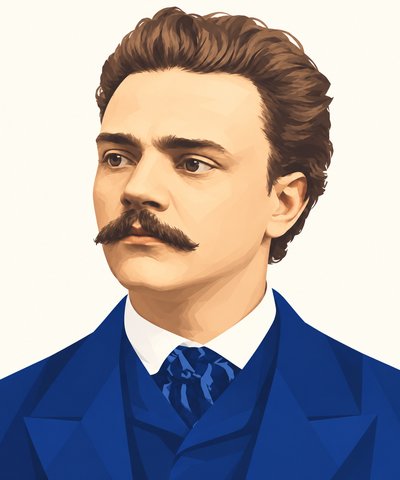
Antonín Dvořák was born in 1841 in Nelahozeves, a village on the river Vltava north of Prague. He was the eldest of nine children. His father was the village butcher and kept the inn, and the family lived above the bar. The village teacher taught Antonín the violin, and he was soon playing for the guests in the inn and in the church. When he was nine, a railway line was built a few steps from the house. He loved trains for the rest of his life.
As the eldest son he was expected to take over the shop, and his father sent him to the fairs to buy animals. He told a friend later that the animals often ran off or dragged him into the pond. Once a bull pulled him into the water, and he cried that he was never going to be a butcher. At 12 he was sent to a small town nearby to learn German. The teacher there had a bad temper, but besides German he taught the boy harmony, piano and organ and let him play at the church services. He and Antonín’s uncle persuaded the father, and at 16 Antonín went to the organ school in Prague.
The lessons there were in German. He later said that everything in the school smelled of mould, even the organ, that his German was bad, and that the other students laughed at him behind his back. He finished second in his class. Then came eleven years of playing the viola for a living, first in a dance band in cafés and at balls, and from 1862 in the orchestra of the new Czech theatre, where Smetana was his conductor. He was poor. He hired a piano by the month and shared a room with friends. Once he could not pay for a ticket to an opera and went away in tears. In that one room he wrote symphonies and quartets that nobody played, and he burnt most of them.
He also gave piano lessons to two sisters. He fell in love with the elder one, Josefina, who was 16, but she did not feel the same. In 1873, at 32, he married her younger sister Anna.
In 1875 he won a grant from the Austrian state for poor young artists. Brahms, eight years older and already famous, was one of the judges. Two years later the Vienna critic Eduard Hanslick wrote to tell him that he had won again, that Brahms admired his music and wanted to help him, and that he should become known beyond his “narrow Czech fatherland.” Within weeks Brahms had recommended him to his own publisher in Berlin. The publisher asked for something like Brahms’s Hungarian Dances, and Dvořák wrote the first Slavonic Dances for a fee of 300 marks. A Berlin newspaper praised them at the end of 1878, and people hurried to the music shops to buy them. At 37 Dvořák became famous. Publishers now wrote to him, and in 1880 a tenor of the Vienna Court Opera asked him for songs. He wrote the Gypsy Songs, among them Songs My Mother Taught Me.
In those same years he lost three children. A daughter died at two days old in 1875, another daughter at eleven months in 1877, and three weeks later his son died of smallpox at three, on Dvořák’s 36th birthday. Out of this he wrote his Stabat Mater, a large work for choir and orchestra on the sorrow of Mary at the cross. When it was sung in London in 1883, the English wanted more. He went to England nine times. On his first visit, in 1884, he conducted the Stabat Mater in the Royal Albert Hall. That autumn, at the Worcester festival, the young Elgar played in the violins. Elgar wrote to a friend, “I wish you could hear Dvořák’s music,” and said that it was wonderful and full of tunes.
Fame did not change him. A Czech fan once wrote to him as if he were a god. Dvořák answered, in 1886, that he was “a simple Czech musician” and would always remain one. In 1891 Cambridge University gave him an honorary degree. He said later that he hated such ceremonies, that everyone looked serious and seemed to speak nothing but Latin, and that he was ashamed because he knew no Latin. But, he added, to compose a Stabat Mater means a lot more than knowing Latin.
With the English money he bought an old barn in the village of Vysoká, south of Prague, and made it his summer home for twenty years. There he got up at four or five, walked to the church in the next village for morning Mass and played the organ, composed until noon, walked in the woods, looked after his garden and his pigeons, and in the evening played cards with the miners at the village inn.
He had loved trains since the railway was built beside his childhood home, and he loved them all his life. In Prague his morning walk went to the railway station, where he knew the engine drivers and asked them about their engines. He wrote on the score of his Seventh Symphony that its first tune came to him as a festival train from Budapest was coming into the station. It is said that he once sent his pupil Josef Suk to note the number of the engine of the Vienna express, and that Suk came back with the number of the coal wagon behind it. He is said to have told a pupil that he would give all his symphonies to have invented the locomotive.
In 1891 a rich New York woman, Jeannette Thurber, asked him to be the head of her new National Conservatory of Music. She offered more than twenty times what Prague paid him. He first refused, because he did not want to be away from home for two years, but then he accepted and went to New York with his family. Among his students in New York was the young Black singer Harry T. Burleigh, who sang the old songs of the slaves to him, and Dvořák told the newspapers that the future music of America must grow from these songs. There he wrote the symphony “From the New World.” At its first performance, in December 1893, the applause went on so long that he had to stand up in his box and bow “like a king.” He wrote to his publisher that he would rather have avoided it.
The summer before, he had taken his whole family, his wife and six children, by train to Spillville, a Czech village in Iowa, the home of his secretary. He played the organ at Mass every morning. In a few days he wrote a string quartet, now called the “American,” and he could not wait for a concert. He made his secretary’s family play it with him at once, without any practice. The secretary remembered that the music was hard, and they could only try to get to the end somehow. It was one of the happiest summers of his life. Then a financial crash ruined the rich people who paid for the school. His salary came months late, and part of it never came. He was homesick, and in April 1895 he went home to Bohemia.
While he was still in New York he had heard that Josefina, Anna’s elder sister, was very ill. He was writing his Cello Concerto, and he put the tune of her favourite among his songs, Lasst mich allein, into its slow movement. She died a few weeks after his return, and he rewrote the end of the concerto so that the song is heard once more.
In 1896 he spent an evening in Vienna with Brahms, who was 62. Brahms urged him to move to Vienna with his family. Brahms had no family of his own to look after, he said, so Dvořák could have his money whenever he needed it. Dvořák was deeply moved, but he could not leave Bohemia. That evening they also talked about religion. Dvořák’s faith was simple and deep, and Brahms had none. On the way back to the hotel Dvořák was silent for a long time, and then he said of Brahms, “Such a man, such a soul, and he believes in nothing!” The next spring he visited Brahms on his deathbed, and he walked in his funeral.
From 1891 he taught composition at the Prague Conservatory, and from 1901 he was its head. His best pupil was Suk, the young man of the engine number, who came to him at 17. In 1898 Suk wrote music for a play, but he was away on a concert tour, so Dvořák went to the rehearsals in his place. He said that it was music from heaven. That November Suk married Dvořák’s daughter Otilie.
In March 1904, at the first night of his last opera, he had to leave the theatre with a sudden pain. The doctors found kidney stones, and then he caught influenza and lay in bed for five weeks. On Sunday 1 May he felt a little better and came to lunch with his family. At the table he suddenly became ill, and he died shortly after midday, at 62. Suk brought lilacs from Nelahozeves, the village where Dvořák was born, and laid them on the coffin. Thousands followed it through Prague to the Vyšehrad cemetery, where the great Czechs are buried.
Dvořák was of middle height, dark, with a thick beard and fierce eyes that frightened children, but he was a gentle and kind man. He was deeply religious, he loved his country, and he stayed the village boy who loved trains and pigeons. He respected the folk songs of other peoples as much as his own. He took the big classical forms of Brahms and filled them with the tunes and dance rhythms of Czech villages. The Slavonic Dances, the “New World” Symphony, the Cello Concerto and the opera Rusalka are played all over the world, and through them the music of a small nation became loved everywhere.
Lieder von Antonín Dvořák singen
Diese Lieder sind in Singalong Solfege enthalten. Singen Sie sie in Solmisation mit Führungsstimme und Klavierbegleitung.
| Nr. | Schwierigkeit | Titel | Jahr | |
|---|---|---|---|---|
| Ex. 11-7 | ② | Songs My Mother Taught Me | 1880 | |
| Ex. 11-11 | ④ | Lasst mich allein | 1888 |