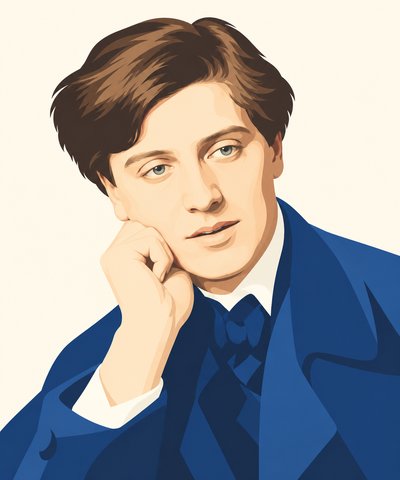
Alban Berg was born in Vienna in 1885, the third of four children. His father was a well-off merchant, but he died when Alban was 15, and the family had less money after that. From the same year Alban suffered from asthma, which stayed with him all his life. He did badly at school. He failed the graduation exams and had to take them again the next year. But he loved music, and as a teenager he taught himself to compose and wrote dozens of songs. After school he worked without pay as a trainee clerk in a government office. In 1904, when he was 19, his family saw a newspaper advertisement. A young composer called Arnold Schoenberg was offering composition lessons. It is said that Alban’s brother took some of his songs to Schoenberg without telling him. Schoenberg, 11 years older and still almost unknown, saw real talent in them. He took the shy young man as a pupil and did not ask him for money, because Berg had none. Years later Schoenberg remembered him as a very tall and extremely shy young man. Another new pupil that year was the composer Anton Webern, two years older, who became Berg’s closest friend for life. In 1906 the family received money from a relative, and he could leave the office and give all his time to music.
In 1906 he also met Helene Nahowski. Her family was against the marriage, but they married in 1911, when he was 26. Schließe mir die Augen beide (Close Both My Eyes) was written for her in 1907. In 1914 he saw a play by Büchner about a poor soldier. Everyone treats him badly, and in the end he kills the woman he loves. He decided at once to make an opera of it. Then the First World War came. Because of his asthma Berg was not sent to the fighting, but he spent three years as a clerk in the War Ministry. Life in the army was hard for him. He felt like a prisoner, and the officers often treated him badly. He wrote to Helene that his own life was now like the life of the soldier in Büchner’s play, and that there was “a bit of me” in that soldier. He finished the opera in 1922 and called it Wozzeck. At first Berg had to publish the score himself. Alma Mahler, the widow of the composer Mahler, gave him the money for the printing. The first performance was in Berlin in December 1925, when Berg was 40. The music was so difficult that the orchestra and singers needed 137 rehearsals. It was a success, and in the next ten years Wozzeck was performed in more than 25 theatres. From then on, the money from performances of his music was enough for Berg and Helene to live on.
In 1930, when he was 45, he bought a car with this money. It was a dark blue Ford, with his initials on it. He loved driving. He wrote to a friend that with its 40 horsepower he could drive up any mountain road easily. In 1932 he also bought a house in the woods by a lake in the south of Austria. After that he spent every summer there, composing. In 1933 the Nazis came to power in Germany. They called his music “degenerate,” meaning sick and harmful, and Wozzeck could no longer be performed there. Germany had been his biggest market, so his income fell sharply. In 1935 the American violinist Louis Krasner offered to pay him to write a violin concerto. Berg needed the money, and he agreed. Soon afterwards, Manon Gropius died of polio at 18. She was the daughter of Alma Mahler. Berg had known her since she was a little girl and loved her like a daughter. He wrote the concerto in her memory. He usually worked slowly, but he finished it in only about four months. On the score he wrote “To the memory of an angel.” He wrote it with the new method of his teacher Schoenberg, a way of writing music without a key. But he also put two old melodies into it: a folk song from the region where his lake house was, and a hymn by Bach. Because of these melodies, many listeners find the concerto warm and sad, not hard to listen to. Later that year an insect stung him on the back. The wound became infected, and the infection spread through his body. He died in Vienna on Christmas Eve 1935, at 50. He never heard the Violin Concerto. Its first performance was four months later, with Krasner as the soloist. He left his second opera, Lulu, unfinished. The last act was not complete. His wife Helene lived for another 41 years, and she never allowed anyone to finish it. It is said that she felt no one else could finish it the way Berg would have wanted. After her death, another composer finished the last act. Today Lulu is performed all over the world.
Berg was very tall and handsome. He was gentle, polite and a little shy. Many people who knew him remembered him with warm feelings for the rest of their lives. Schoenberg and his pupils wrote music without a key, and many listeners found it hard to enjoy. Berg’s greatest gift was to make this new music sound warm and human, with melodies that sing. Because of this, Berg’s music is performed more often than the music of Schoenberg or of his friend Webern.
Lieder von Alban Berg singen
Diese Lieder sind in Singalong Solfege enthalten. Singen Sie sie in Solmisation mit Führungsstimme und Klavierbegleitung.
| Nr. | Schwierigkeit | Titel | Jahr | |
|---|---|---|---|---|
| Ex. 1-13 | ② | Schließe mir die Augen beide | 1907 |