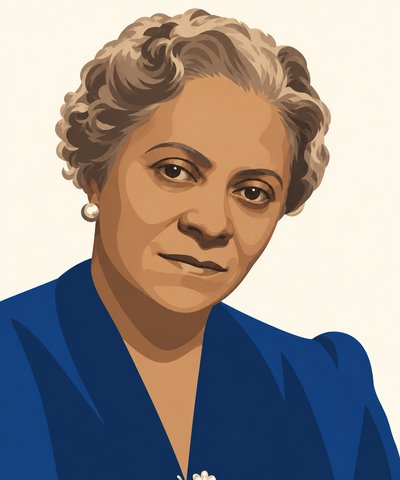
Florence Price was born Florence Beatrice Smith in 1887 in Little Rock, a city in Arkansas, in the south of the United States. Her father was the only Black dentist in the city. Her mother was a music teacher, and she gave Florence her first piano lessons. Florence played in public for the first time at four, and some of her pieces were printed while she was still at school. In 1903, at 16, she went to Boston to study the organ and the piano at the New England Conservatory, a large music school. Her composition teacher encouraged her to use spirituals, the religious songs that slaves had sung in the South, in her own music.
She taught music in Arkansas, and in 1910, at 23, she became the head of music at a university in Atlanta. In 1912, at 25, she married Thomas J. Price, a lawyer, and she left her post to live with him in Little Rock. They had a son, who died as a baby, and two daughters. The music teachers’ society of Arkansas did not let her join, because she was Black. In the 1920s violence against Black people grew in Arkansas. In May 1927 a crowd killed a Black man in Little Rock, near her husband’s office. The family no longer felt safe there. That same year, when Florence was 40, they moved to Chicago.
In 1931, at 43, her marriage ended, and she raised her two daughters alone. At that time films had no sound, and a musician played music in the cinema during the film. To earn money she played the organ for these films, which few women did then. She also wrote songs for radio advertisements. For a time she lived in the home of her pupil Margaret Bonds, a young pianist and composer who was 26 years younger. Bonds later remembered evenings when many Black musicians of Chicago sat around the kitchen table and helped Price copy her music in time for competitions.
Her work and her daughters usually left her little time to compose. But in January 1931 she broke her foot, and for a few days she had to stay at home. She used these quiet days to work on her first symphony. She later wrote to a friend, “But oh, dear me, when shall I ever be so fortunate again as to break a foot?” In this symphony she joined the European form of the symphony with the music of Black Americans. Its third part is a juba, a dance of the slaves, in which the dancers kept the beat by hitting their hands on their bodies. In 1932, at 44, she sent the symphony to a competition for Black composers, and it won first prize.
After the symphony won the competition, the conductor of the Chicago Symphony Orchestra became interested in it. He did not know her, but he chose it for a concert. On 15 June 1933, when Price was 46, the orchestra played the symphony during the World’s Fair in Chicago. It was the first symphony by a Black woman that a major American orchestra had ever played. The audience called her back to the stage again and again.
Price wrote about 100 songs. Travel’s End is one of them. Marian Anderson, one of the most famous Black singers in America, often sang Price’s songs and her arrangements of spirituals. In 1939 Anderson was not allowed to sing in a concert hall in Washington, because she was Black. So on 9 April 1939 she sang outdoors at the Lincoln Memorial, a famous monument in Washington. About 75,000 people came, and the concert was also on the radio. Anderson ended it with Price’s arrangement of the spiritual “My Soul’s Been Anchored in the Lord.”
Price wanted the great orchestras to play her music. In 1943, at 56, she wrote to Serge Koussevitzky, the conductor of the Boston Symphony Orchestra. “To begin with I have two handicaps—those of sex and race,” she wrote, meaning that she was a woman and that she was Black. She asked him to judge her music only by how good it was. He never answered.
She died in Chicago in 1953, at 66, after a stroke. After her death her music was almost forgotten. In 2009 a couple planned to repair an old, empty house near St. Anne, a small town in Illinois. The house had been Price’s summer home. Inside they found boxes of her music and papers. Among them were dozens of works that people had thought were lost, such as her fourth symphony. Since then her music has been performed and recorded all over the world.
Florence Price put the music of Black Americans, the spirituals and dances like the juba, into symphonies and songs in the European style. She did this while she worked at many jobs and raised two daughters alone. In her lifetime her music was cheered in Chicago in 1933, and it was heard by 75,000 people at the Lincoln Memorial.
Lieder von Florence Price singen
Diese Lieder sind in Singalong Solfege enthalten. Singen Sie sie in Solmisation mit Führungsstimme und Klavierbegleitung.
| Nr. | Schwierigkeit | Titel | Jahr | |
|---|---|---|---|---|
| Ex. 11-12 | ④ | Travel's End | 1953 |