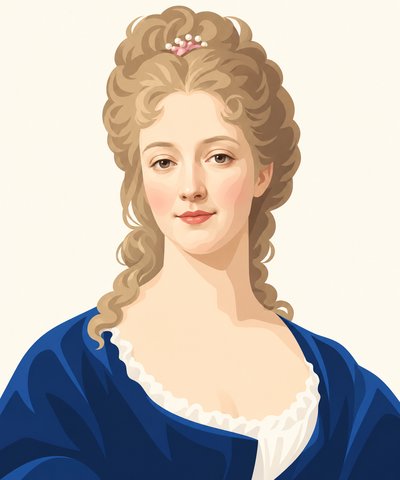
Élisabeth Jacquet de La Guerre was born in Paris in 1665. Her father was the organist of a church, and other people in her family made harpsichords. Her father taught music to all four of his children, the girls as well as the boys, which was unusual at that time.
As a small child she played the harpsichord and sang at the court of King Louis XIV. In 1677 a Paris magazine wrote that for four years “a wonder” had been seen at court. It was a girl who sang difficult music at sight, played the harpsichord in a way nobody could copy, and composed her own pieces. The king liked her playing so much that a powerful lady at court kept her near her for three or four years, to play for her and her guests.
In 1684, at 19, she married Marin de La Guerre, an organist in Paris, and she left the court. In Paris her fame grew. Great musicians came to hear her play. She could improvise at the harpsichord for half an hour without stopping. In 1687 she published her first book of harpsichord pieces. In 1691 a magazine printed a poem in which Lully, who had died four years earlier, writes to her from the land of the dead. He calls her “the first musician in the world.”
In 1694 her opera Céphale et Procris was performed at the Paris Opera. It was the first opera by a woman ever performed in France. Funeste mort (Fatal Death) comes from it. But the opera was not a success. At that time Paris audiences were not kind to new operas, and it closed after five or six nights. She and her husband had one son, who played the harpsichord very well as a child, but he died at ten.
Her husband died in 1704. She kept working, and in the next years she published her most important music. She was one of the first French composers to write sonatas and cantatas, kinds of music that had come from Italy. She died in Paris in 1729, at 64.
In 1732 a book about the greatest French poets and musicians included her among them, next to Lully.
演唱 Élisabeth Jacquet de La Guerre 的曲目
这些曲目收录在 Singalong Solfege 中。可以跟随引导人声和钢琴伴奏,用唱名演唱。
| 编号 | 难度 | 曲名 | 年份 | |
|---|---|---|---|---|
| Ex. 4-3 | ④ | Funeste mort | 1694 |