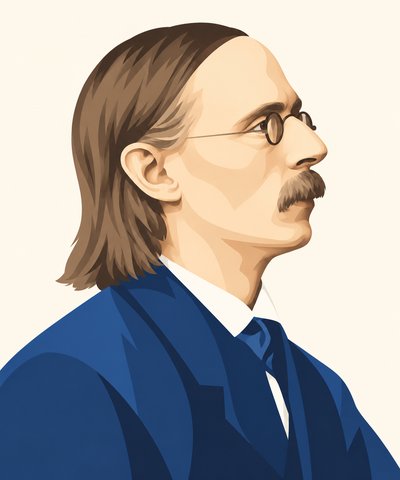
Peter Cornelius was born on Christmas Eve 1824 in Mainz, a city on the river Rhine in western Germany. Both of his parents were actors. A relative of his father was the famous painter Peter von Cornelius, who had the same name. His father trained him to be an actor, and he also gave him music lessons. The boy learned the violin and singing, and he began to compose at about 12. At 18 he became an actor in a nearby town. But he was not a success on the stage, and after a few small roles he gave up acting. In 1844, at 19, he moved to Berlin and lived in the house of his famous relative, the painter. For four years he studied composition there.
In the early 1850s the painter introduced him to Liszt. Liszt was 13 years older, and he was the music director at the court in Weimar. Cornelius worked for Liszt as a secretary. He also translated operas by Berlioz into German, so that they could be sung in Weimar. And he wrote articles for a music magazine in support of the new music of Liszt and his friends. In 1854 he ended one of them with the words “Bach, Beethoven, Berlioz!” This is where the idea of “the three Bs” comes from. Later the conductor Hans von Bülow changed it to Bach, Beethoven and Brahms, and that is the version most people know today. Cornelius also wrote a comic opera, Der Barbier von Bagdad (The Barber of Baghdad), and he wrote its words himself. Its first performance was in Weimar in 1858, when he was 33, and Liszt conducted. Some people in Weimar were against Liszt and the new music he supported. A group of them came to the theatre and made loud noises during the performance. They wanted to attack Liszt more than the opera. After that night the opera was not performed again in Cornelius’s lifetime.
In 1859 Cornelius moved to Vienna, and at first he was poor. In 1861 Wagner came to Vienna. Wagner was 11 years older and already famous. The two became close friends, and Cornelius copied music for Wagner. Wagner later wrote that once he took Cornelius to an Italian opera, to judge whether a tenor was good. Cornelius seemed to be listening quietly. Then suddenly he jumped up and shouted, “Horrible! Horrible!” They both laughed, and they left the theatre in a good mood. In February 1862 Wagner read the words of his new opera, The Mastersingers of Nuremberg, to a few friends in Mainz. Cornelius travelled all the way from Vienna in the middle of winter to hear it. On the way there were floods, and he lost his coat. Wagner wrote that he arrived half frozen, just in time. The next day he went back to Vienna. He had made the long journey only to hear this reading. Auftrag (Request) is from a set of six songs that he wrote in these years in Vienna.
In 1864 the young king of Bavaria, Ludwig II, invited Wagner to Munich. Wagner asked for Cornelius to come too. Cornelius was not sure at first, because he wanted to stay free to do his own work. But at the end of 1864 he moved to Munich, and the king paid him money every year. In 1865, at 40, his second opera, Der Cid, was a success in Weimar. In 1867, at 42, he married Bertha Jung, the daughter of a judge in Mainz. They had three sons and a daughter. One of their sons, Carl Maria, later wrote the story of his father’s life. In the same year Cornelius began to teach at the new music school in Munich. The teaching left him little time to compose, but he worked on a third opera for the rest of his life. He became ill, and the doctors of that time could not treat his illness. He died in Mainz, the city where he was born, in 1874, at 49. The opera was not finished.
Cornelius was modest and quiet. He thought that his own talent was small next to the talents of his famous friends. He had a quiet sense of humour, and he loved stories. People often attacked him in the newspapers, but he did not hate anyone. Both his friends and his opponents respected him.
He was never sure whether he was a poet or a composer, and he called himself a “poet-composer.” He wrote the words of his operas himself, and nearly half of his songs are on his own poems. His Weihnachtslieder (Christmas Songs), on his own poems, became favourites in German homes. One of them, “Die Könige” (The Three Kings), is sung in English by choirs in Britain every Christmas. After his death, The Barber of Baghdad was performed again, and it became a favourite in German opera houses. Cornelius spent many years helping Liszt and Wagner. But his best-loved works, the Christmas Songs and The Barber of Baghdad, are the ones where he wrote both the words and the music.
演唱 Peter Cornelius 的曲目
这些曲目收录在 Singalong Solfege 中。可以跟随引导人声和钢琴伴奏,用唱名演唱。
| 编号 | 难度 | 曲名 | 年份 | |
|---|---|---|---|---|
| Ex. 14-8 | ④ | Auftrag | 1862 |