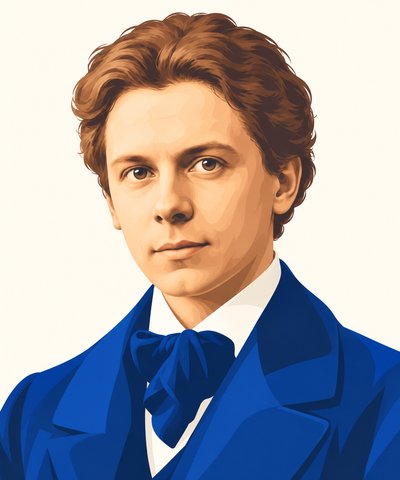
Béla Bartók was born in 1881 in Nagyszentmiklós, a small town in Hungary that is now part of Romania. His father was the headmaster of the local farming school and played the piano and the cello. His mother was a teacher, and she gave him his first piano lesson on his fifth birthday. By then he could already pick out forty folk tunes with one finger. As a baby he got a skin rash that lasted until he was five, and because of it he was kept apart from other children. His mother remembered him as a very serious, quiet child. His father died when Béla was seven, and his mother moved the family from town to town, teaching the piano to support them. While still a schoolboy he gave his first public concert, playing a piece of his own called The Course of the Danube. At 18 he entered the Music Academy in Budapest.
In 1904, when he was 23, he heard a young nanny from Transylvania singing a folk song in a country house. He wrote it down, and from that day he began to collect folk songs. At that time the "Hungarian music" that everyone knew was the music played by gypsy bands in cafés and restaurants. It was very popular, and Liszt and Brahms had used it in their Hungarian Rhapsodies and Hungarian Dances. Everyone believed it was Hungarian folk music. But the songs the peasants sang in the villages were quite different, and much older. The next year he met Kodály, one year younger, who had the same interest. For years the two of them travelled through the villages of Hungary, Romania and Slovakia with an Edison phonograph, recording peasants singing onto wax cylinders. Bartók collected about ten thousand tunes in his life, and he later went as far as Algeria and Turkey to record more. One of his most popular pieces came straight from these travels. The Romanian Folk Dances of 1915 are six short dances based on tunes he had heard village violin and flute players playing in Transylvania. These songs became the root of his own music. From 1907, at 26, he taught the piano at the Budapest Academy for 27 years. He never taught composition, because he is said to have believed that it could not be taught.
His second son Péter was born in 1924. When Péter was nine he begged for piano lessons, and Bartók decided to teach him himself. He had already begun a set of short piano pieces for beginners, and now he finished it for Péter: the Mikrokosmos, 153 pieces that go from the very first steps to concert level. These are not ordinary children's pieces. Many of them use the scales of folk music instead of major and minor, and in some the right hand and the left hand play in different keys. Bartók himself played pieces from the Mikrokosmos in his concerts, and so, many years later, did the jazz pianist Chick Corea. No. 127, New Hungarian Folk Song, is one of them.
Bartók was a quiet, reserved man who hated publicity, and some people mistook this for coldness. He was extremely honest and precise. He loved nature, and he collected plants, minerals and above all beetles. He was also brave. When the Nazis came to power in Germany in 1933, he refused to play there again. In 1938 he and Kodály refused to fill in a form about their racial origin. In his will he wrote that no street or square should be named after him as long as Budapest had squares named after Hitler and Mussolini. In 1940, at 59, he left Hungary for the United States with his wife Ditta, a pianist. The years in New York were hard. He had little money and was often ill. In 1943 he was in hospital when the conductor Koussevitzky visited him and asked him for a new orchestral work. It is said that Koussevitzky left a cheque on the bedside table and insisted that the money was Bartók's whether he finished the piece or not. Bartók got up from his bed and wrote the Concerto for Orchestra in two months. It was a great success in Boston in 1944, and it is now his most popular work. In 1943 the violinist Yehudi Menuhin, 27 and famous since boyhood, played Bartók's violin sonata for him. Bartók is said to have told him that a composer usually had to be dead for a long time before his music was played like that. He had not expected to hear it while he was still alive. In 1944 the doctors found that he had leukaemia, a cancer of the blood. It is said that he told his doctor, "What I regret most is that I have to go with a full suitcase," meaning that he still had so much music in him. He died in New York in September 1945, at 64. Only ten people came to the funeral. In 1988 his sons brought his remains home to Budapest, and he was given a state funeral.
演唱 Bartók Béla 的曲目
这些曲目收录在 Singalong Solfege 中。可以跟随引导人声和钢琴伴奏,用唱名演唱。
| 编号 | 难度 | 曲名 | 年份 | |
|---|---|---|---|---|
| Ex. 5-14 | ④ | 127. New Hungarian Folk Song | 1926 |