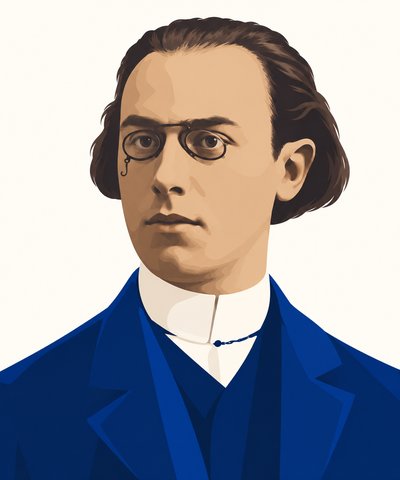
Erik Satie was born in 1866 in Honfleur, a port town in Normandy, in the north of France. His mother had been born in London to a Scottish family. When Erik was about four, the family moved to Paris. In 1872 his mother died. Erik, then six, and his younger brother were sent back to Honfleur to live with their father's parents. There the organist of the local church gave him his first music lessons. From him Erik learned to love the very old music of the church.
In 1878 his grandmother died, and Erik went back to his father in Paris. His father married again. His new wife was a piano teacher, and she wanted the boy to become a musician. In 1879, at 13, he entered the Paris Conservatoire, the national music school. He hated it. One of his piano teachers called him "the laziest student in the Conservatoire." He was sent away after three years, and later he was taken back. Many years later he described the building as "a sort of prison."
In 1886, at 20, he joined the army to get away from the Conservatoire. But he hated the army even more. It is said that he went outside on a winter night without a shirt, so that he would become ill. He became seriously ill, and a few months later the army let him go.
In 1887, at 21, Satie left his father's home and moved to Montmartre, the artists' district of Paris. There he played the piano in a cabaret, a place where people drank and watched singers and comic shows. He let his hair grow long, and he wore a long coat and a tall hat. In early 1888 he wrote the three Gymnopédies, calm and slow pieces for piano. Today they are his best-known music.
In about 1891, at 25, Satie met Claude Debussy in a Montmartre café. Debussy was four years older. Like Satie, he was poor and almost unknown. Satie wrote later that from the first moment he wanted to be at Debussy's side all the time. In 1892 Debussy gave him a book of his own songs. Inside he wrote: "For Erik Satie, a gentle musician from the Middle Ages who has lost his way in this century." The two became the closest of friends. In 1896 Debussy arranged two of the Gymnopédies for orchestra. They were played at a concert in Paris the next year, and from then on more people came to know them.
In 1893, at 27, Satie started his own church, half seriously and half as a joke. He was its leader, and also its only member. He wrote letters to music critics he did not like. They had never been members of his church, but in the letters he told them that he was throwing them out of it.
In 1895, at 29, Satie received a small sum of money. He bought seven suits of velvet, a soft and thick cloth, all exactly the same, and for about ten years he wore nothing else. People called him "the Velvet Gentleman." A painter friend remembered inviting him to the theatre one evening. Satie asked for time to go home and change. He came back in a suit exactly like the one he had taken off, only a little less worn.
The money was soon gone. In 1898, at 32, Satie moved to a single room in Arcueil, a poor suburb south of Paris. It had no running water and no heating. He never moved again, and he never let anyone in. Almost every day he walked about ten kilometres into Paris. He spent the day in cafés, writing music and meeting friends, and he often walked home late at night. To earn money, he played the piano in cabarets and wrote popular songs for their singers. He did not like this work, but he did it for many years.
In 1905, at 39, Satie surprised his friends. He went back to school. Debussy advised him not to, but he went anyway. At the Schola Cantorum, a music school in Paris, he studied the old rules of writing music. Experts often said that he did not know enough, and he believed they were right. After three years of hard work, in 1908, at 42, he received a diploma with the mark "very good." He went on studying there until 1912.
From about 1906, at 40, Satie always carried an umbrella. It is said that when it rained, he kept his umbrella dry under his coat, so that it would stay new.
In Arcueil, Satie worked with a local club for children. He gave them music lessons, and he took them on trips and paid for them with his own money. In 1909 the government gave him a small award for this work. He liked children, and they liked him.
In 1911, at 44, Satie suddenly became famous. Maurice Ravel was nine years younger than Satie and already well known. The two had known each other since Ravel was a student. In January 1911 Ravel played three of Satie's early piano pieces at a concert in Paris, among them the third Gymnopédie. The programme, probably written by Ravel, said that these pieces were about 25 years old, but that they already sounded like the new music of 1911. After that, the young composers of Paris admired him. Satie wrote to his brother that he could not understand it at all. Publishers asked him for new pieces, and he was able to stop working in the cabarets. He had become famous for music that he had written in his twenties.
His humour went into his music too. Above the notes, composers usually write words such as "slowly" or "softly." Satie wrote instructions such as "Open your head" and "Like a nightingale with a toothache." In 1913, at 47, he wrote three short piano pieces about sea animals. The first is about a sea cucumber, a soft animal that lives on the sea floor. Above the music Satie wrote that it purrs like a cat and does not like light. Under the notes he told the story of its day. In the morning it goes out in the rain. It purrs a little, and there are the words "What a pretty rock!" In the evening it comes home: "The sun has gone. I hope it never comes back." Near the end Satie wrote: "I have no tobacco. Luckily I don't smoke." The last piece of the set ends with the same loud chord, played again and again for almost a page. Above it Satie wrote: "Required ending (by the Author)."
In another set from the same year, a strong man carries a stone on his back. The stone is a hundred times bigger than he is, and small children are amazed at his strength. Then Satie added that it is a pumice stone, a stone so light that it floats on water. Under the notes the man walks slowly, "with great difficulty," "dragging his legs." "He feels the stone slipping." Then, on one loud chord: "There it goes: it falls." In 1914 Satie also printed a warning: nobody was allowed to read his words aloud while the music was being played. They were not words for singing. They were a secret between him and the pianist.
In 1916 Jean Cocteau, a young writer, heard Satie's music and wanted to make a ballet with Satie. The painter Pablo Picasso designed the stage and the costumes. The Russian Ballet, the most famous ballet company of the time, danced it. Parade opened in Paris on 18 May 1917, when Satie was 51. Among the instruments in the orchestra were a typewriter, a ship's whistle and a siren. Part of the audience shouted angrily, and others cheered. From then on, everyone in Paris knew his name.
By then Debussy was very ill. During the rehearsals of Parade he made fun of Satie's music. Satie ended their friendship for ever, in a letter to Debussy's wife. Debussy died in March 1918, at 55, and Satie did not go to the funeral. Two years later, Satie wrote a song in Debussy's memory. He dedicated it to their friendship of almost thirty years. In a private notebook he wrote that, in the end, Debussy had been worth more than all the other musicians together.
Young French composers gathered around Satie, and he encouraged them. But he was easily hurt, and he had arguments with many of them, and with old friends too. One of the young composers, Darius Milhaud, 26 years younger, stayed his friend to the end. Milhaud's wife said that she had never met anyone so polite. But she also said that he could get very angry.
Early in 1925, at 58, Satie became seriously ill. A rich friend paid for a room for him in a hospital in Paris. Milhaud and his wife looked after him, and other friends came to see him. Satie stayed in the hospital for more than four months. He died there on 1 July 1925, at 59.
After his death, his brother and a few friends opened the door of his room in Arcueil. Nobody had been inside for 27 years. They found two pianos. Inside one of them were letters and parcels that he had never opened. There were many new umbrellas, shirts and collars, and more of the velvet suits. There was also music that he had believed was lost. A writer who studied his life explains that whenever Satie had a little money, he bought new things for the poor times, so that he could always look neat in public.
Satie did things that no other composer did. He started a church with himself as its only member. He wore the same kind of suit every day for ten years. He wrote funny stories in his music, for the pianist alone. He did all this half seriously and half as a joke. He was polite, proud and easily hurt. He was often poor, but he never let anyone see it. He argued with many friends, but he was kind to children, and he encouraged young composers.
Much of the music of his time was long, grand and serious. Satie's music was short and quiet, a little strange and a little elegant, and often funny. In his own time he played for the cabaret audiences of Paris for many years, and he showed young French composers a different way to write. Today his music is heard in many films and advertisements. In 1911, Ravel's concert programme said that his old pieces already sounded new. More than a hundred years later, many people still feel the same.
Erik Satie şarkılarını söyleyin
Bu şarkılar Singalong Solfege'de bulunur. Rehber vokal ve piyano eşliğiyle solfej ile söyleyin.
| No. | Zorluk | Başlık | Yıl | |
|---|---|---|---|---|
| Ex. 1-11 | ① | Ücretsiz | Gymnopédie No. 1 | 1888 |
| Ex. 6-16 | ③ | Spleen | 1923 |