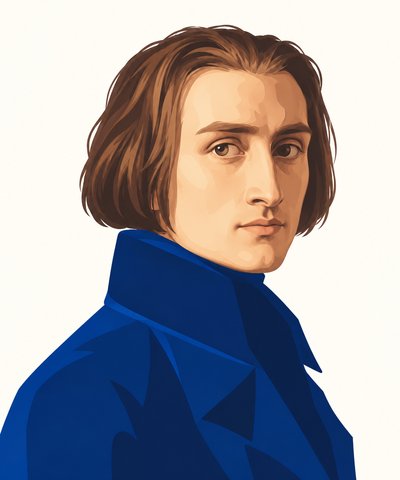
Franz Liszt was born in 1811 in Doborján, a village in the Hungarian part of the Austrian Empire. Today it is Raiding, in Austria. He was an only child. His father, Adam, worked on the estates of the Esterházy princes, the same family that had employed Haydn. As a young man Adam had sometimes played the cello in the prince's orchestra, and he gave Franz his first piano lessons.
At nine Franz gave his first concerts, and a local newspaper wrote that everyone admired him. Six rich Hungarian lords then agreed to pay for his studies for six years. In 1822 the family moved to Vienna. The famous piano teacher Carl Czerny remembered a pale, thin boy who moved from side to side on the piano seat as if he were drunk. His playing was messy, but Czerny was amazed at his talent. He taught him for a year and a half, and he would not take any money. The court composer Salieri taught him too.
At the end of 1823 the family moved to Paris. The Paris Conservatoire, the city's music school, did not accept foreigners, so Franz could not study there. But he soon became famous in Paris as a boy pianist, and he toured England, where he played for King George IV.
In 1827, when Franz was 15, his father died. From then on Franz supported his mother by teaching the piano from morning till night. The next year he fell in love with one of his pupils, the daughter of a government minister, but her father ended it. Franz became ill and very unhappy, and he thought of becoming a priest. He hardly appeared in public, and a Paris newspaper even reported that he had died. In 1830 a revolution broke out in Paris, and the excitement brought him back to life. His mother said, "It was the guns that cured him."
In 1832, at 20, Liszt heard the great violinist Paganini, and it was a shock to him. He wrote to a friend, "What a man, what a violin, what an artist!" He decided to do on the piano what Paganini did on the violin. He began to practise exercises four or five hours a day. Later he turned some of Paganini's violin music into piano pieces. One of them, La campanella (The Little Bell), is still one of his most famous works, and one of the hardest pieces ever written for the piano. In the same years Chopin and Berlioz became his close friends in Paris.
In 1835 Liszt fell in love with Countess Marie d'Agoult. She left her husband for him, and they went to live in Geneva, in Switzerland. They had three children, Blandine, Cosima and Daniel.
From 1839 to 1847 Liszt travelled all over Europe, from Lisbon to Moscow and Constantinople, and he gave more than a thousand concerts. He was one of the first pianists to give whole concerts alone, without any other musicians. He joked in a letter, "The concert is – myself." In London in 1840 his concerts were called "recitals," and the word has been used ever since.
Liszt was something like a pop star of today. His audiences went wild, and the poet Heinrich Heine called it "Lisztomania." In St Petersburg the stage stood in the middle of the hall. There were two pianos, one facing each way, and he moved from one to the other so that everyone could see him. It is said that after his concerts women fought over the gloves and handkerchiefs that he had left on the stage.
He gave much of his money away. In 1838, when a flood hit Pest in Hungary, he gave concerts in Vienna for the people who had lost their homes. People in Bonn, Beethoven's home town, wanted to put up a statue of Beethoven, but they did not have enough money. In 1839 Liszt offered to pay the rest himself, and the statue was put up in 1845.
In 1844 Liszt and Marie parted. The children grew up with his mother in Paris.
In 1847, in Kiev, Liszt met Princess Carolyne zu Sayn-Wittgenstein, a Polish princess who was married to a Russian prince. It is said that she paid a very high price for a ticket to one of his concerts for the poor, and that he went to her house to thank her. In September of that year, at 35, Liszt gave his last concert for money. After that he never played for a fee again.
In 1848 he settled in Weimar, in central Germany, as the court's music director, and Carolyne came to live with him there. In Weimar he put on new operas by living composers. In 1849 Wagner took part in a revolution, and the police wanted to arrest him. Liszt hid him and gave him money so that he could escape to Switzerland. The next year he conducted the first performance of Wagner's opera Lohengrin, which Wagner himself could not attend. Wagner wrote that when he watched Liszt conduct his music, he saw "my second self." Liszt also helped the young Peter Cornelius, who worked for him in Weimar.
In Weimar Liszt wrote many of his own great works. He gave the name "symphonic poem" to a new kind of piece for orchestra that tells a story or describes a picture, and he wrote twelve of them there.
For years Carolyne had tried to end her first marriage. In 1860 she went to Rome to ask the Pope herself, and he finally allowed it. They planned to marry in Rome on 22 October 1861, Liszt's 50th birthday, and Liszt left Weimar and came to Rome for the wedding. On the evening before, a messenger came from the Vatican and stopped the wedding, because her family had objected again. They never married, even after her husband died in 1864. But they stayed close for the rest of his life.
Liszt stayed in Rome. He had already lost his son Daniel, who had died in Berlin in 1859, at 20. In 1862 his daughter Blandine died at 26, a few weeks after her son was born. Liszt wrote, "Blandine has her place in my heart beside Daniel." In 1863 he went to live in a monastery just outside the city. In 1865, at 53, Liszt took the first small steps toward becoming a Catholic priest. He never became a full priest, but from then on he wore a long black priest's coat, and people called him "Abbé Liszt," using the French word for a man of the Church.
It is said that in the winter of 1863–64 the Russian poet Aleksey Tolstoy and his wife lived in Rome, and that Liszt often came to their home and played for them. In 1866 Liszt wrote a song to one of Tolstoy's poems, Не брани меня, мой друг (Do Not Reproach Me, My Friend). It is his only song in Russian.
His daughter Cosima had married his pupil, the pianist and conductor Hans von Bülow. In the 1860s she left him for Wagner, and in 1870 she married Wagner. Liszt learned of the wedding from the newspapers, and for two years he did not see them. They made peace in 1872.
From 1869 Liszt divided each year between Rome, Weimar and Budapest. In 1875, in Budapest, he became the first president of the new Academy of Music. He wrote that living in three homes made his life very tiring. In Weimar he taught a class of young pianists in the afternoons, in a small house that the Grand Duke had given him, and he took no money for it.
In 1873 an American pupil, Amy Fay, described Liszt in her letters home. Liszt was tall and thin, with long grey hair, and he wore a priest's coat that reached nearly to his feet. Amy Fay wrote that he was the kindest man she had ever known.
Liszt was the most famous musician in Europe, but he was always looking for talent in others, often when nobody had asked him. In 1853 Brahms, who was 20 and still unknown, visited him in Weimar. It is said that Brahms was too nervous to play, so Liszt picked up the young man's handwritten music and played it himself, at sight. When Robert Franz lost his hearing and could no longer work, Liszt and other friends gave concerts for him. In 1868 Liszt found Grieg's violin sonata by himself and wrote to praise it, and with this letter Grieg won money from the Norwegian government to travel. In 1870 Grieg visited him in Rome, and Liszt played through Grieg's piano concerto at sight. When he had finished, he gave the music back to Grieg and told him, "Keep going. You have the talent. Do not let anyone make you afraid." In 1877 the Russian composer Borodin, a chemist who wrote music in his free time, came to see him in Weimar. Some people wanted Borodin to change his first symphony. Liszt told him not to change anything, because "the same advice was given to Beethoven and Mozart."
In December 1882 Liszt stayed with Wagner and Cosima in Venice. There Liszt wrote a dark piano piece about a gondola carrying a coffin on the canals. Six weeks later Wagner died in Venice. Liszt later wrote that it was as if he had known that Wagner would die.
In April 1886, at 74, Liszt travelled to London, where his music was performed, and he played for Queen Victoria. In July he went to Bayreuth, in southern Germany, for the festival of Wagner's operas that Cosima now ran. He was already ill when he arrived, and there he caught pneumonia.
He died in Bayreuth on 31 July 1886, at 74.
Liszt loved to be admired, and on the stage he loved to put on a show. But all his life he was also kind and generous. As a boy he had been taught for nothing, and in his later years he taught for nothing too. He was the greatest pianist of his time and one of the first to give whole concerts alone. He gave the symphonic poem its name. Above all, he helped more composers than almost anyone else, from Wagner and Berlioz to Grieg and many young musicians whose talent he found himself.
Franz Liszt şarkılarını söyleyin
Bu şarkılar Singalong Solfege'de bulunur. Rehber vokal ve piyano eşliğiyle solfej ile söyleyin.
| No. | Zorluk | Başlık | Yıl | |
|---|---|---|---|---|
| Ex. 8-12 | ⑤ | Не брани меня, мой друг | 1866 |