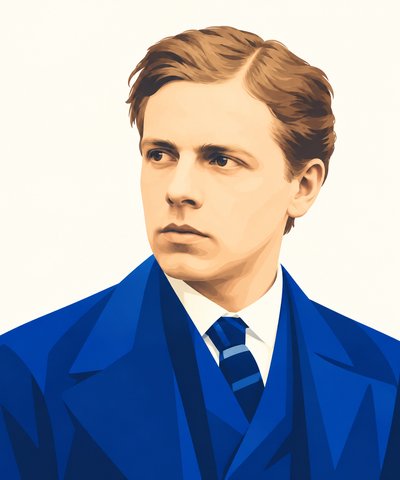
Edward Elgar was born in 1857 in a village near Worcester, in the west of England. His father tuned pianos and kept a music shop in the town. The boy never went to a music college. He taught himself from the books and scores in his father's shop. He played the violin, and at 22 he led the band at the local mental hospital and wrote dance music for the patients. In 1884 he played in the orchestra when Dvořák came to Worcester to conduct his own music. In 1889 he married Alice Roberts, one of his pupils. She was eight years older than he was, and the daughter of a general. Her family objected to the piano tuner's son. It is said that they never forgave her, and that she lost her share of the family money. But she believed in him completely, and she managed his career for the rest of her life. The couple moved to London, hoping that his music would be performed there, but nobody wanted it. After two years they came back to the hills near Worcester, and he went on teaching the violin. In 1898 a music festival asked him for a new piece. He was too busy, and he sent a postcard to one of its organisers: "I wish, wish, wish you would ask Coleridge-Taylor to do it." Samuel Coleridge-Taylor was then 22, eighteen years younger, and almost unknown. The festival asked him, and the piece was his first big success.
He was already 42 when he became famous. In 1899 he wrote the Enigma Variations. Each of its fourteen variations is a musical picture of one of his friends, and the title of each is that friend's initials or nickname. The ninth, "Nimrod," is still played in Britain every year on the day that remembers the dead of the wars. Elgar said that the piece hid a secret, and nobody has found it to this day. In 1901 he wrote the march Pomp and Circumstance No. 1. He told a friend, "I've got a tune that will knock them flat," meaning that it would amaze everyone. The next year a poet wrote words for the big tune, and the song "Land of Hope and Glory" was born. For the English it is almost a second national anthem. In America the march is played at almost every school and university graduation. Some people dislike the proud words of the song, which ask for the British Empire to grow "wider still and wider." When the First World War began in 1914, Elgar himself felt that such words no longer fitted the times, and he asked for new ones. In 1900 he wrote The Dream of Gerontius, a big work for choir and orchestra about the soul of a dying man. Its first performance in Birmingham failed, because the choir had not learned it properly. Two years later it was a huge success in Germany. At the dinner afterwards Richard Strauss raised his glass to "the first English progressive musician, Meister Elgar," and the two remained friends. In 1904 he received the title of knight from the king, and from then on he was Sir Edward Elgar.
Away from music he was a man of hobbies. He rode his bicycle, which he named Mr Phoebus, all over the Malvern hills. He had a chemistry laboratory in his garden shed, and he invented a machine for making a bad-smelling gas, which he tried to patent. He loved horse racing, and he was a fan of the football club Wolverhampton Wanderers. In 1898 he set a line from a match report to music, "He banged the leather for goal," and some people call it the first football chant. He also loved puzzles and codes. He once sent a young friend a letter in code, and no one has ever been able to read it. He also loved dogs. At the end of a radio broadcast for his 70th birthday, he is said to have said goodnight to his dog by name. After his wife Alice died in 1920, when he was 62, he wrote almost nothing more. He was one of the first composers to record his own music. In 1932, at 75, he made a recording of his violin concerto with Yehudi Menuhin, a 16-year-old boy who was already a famous violinist and later became one of the greatest of the century. The recording is still famous. He died in Worcester in 1934, at 76. He was the first English composer since Purcell, two hundred years before him, to be famous across Europe, and for many people his music is the sound of England itself.
Edward Elgar şarkılarını söyleyin
Bu şarkılar Singalong Solfege'de bulunur. Rehber vokal ve piyano eşliğiyle solfej ile söyleyin.
| No. | Zorluk | Başlık | Yıl | |
|---|---|---|---|---|
| Ex. 8-16 | ④ | After | 1895 |