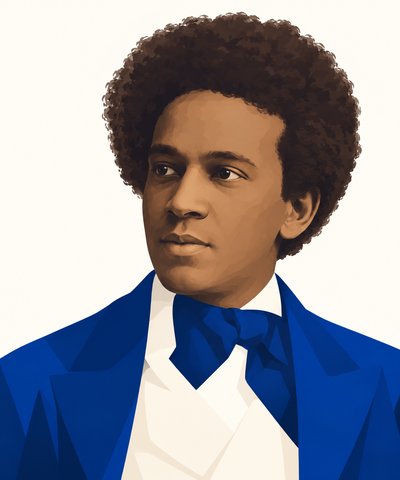
Samuel Coleridge-Taylor was born in London in 1875. His mother, Alice, was a young Englishwoman. His father was a doctor from Sierra Leone, in West Africa, who had studied medicine in London. The two were not married. His father went back to Africa before he knew that Alice was expecting a child, so the boy never knew him. When Samuel was one, he and his mother moved to Croydon, a town just south of London. They lived with her father, who put iron shoes on horses for a living.
When Samuel was about five, his grandfather bought him a small violin and gave him his first lessons. It is said that one day a theatre conductor in Croydon, Joseph Beckwith, was giving a lesson in a house. Through the window he saw a small boy playing marbles in the street, with a tiny violin in his other hand. Beckwith asked him to come in, and he put some music in front of him. The boy played it well, in time and in tune. Beckwith taught him for the next seven years. Many years later, Coleridge-Taylor taught Beckwith's son, and he made him the first violinist of his orchestra.
A local choir leader, Herbert Walters, heard the boy's clear voice and took him into his church choir. Soon Samuel became the solo singer, and Walters looked after him almost like a father. In 1890, at 15, Samuel entered the Royal College of Music in London. Walters was not a rich man, but he paid for the studies himself.
At the college Samuel was so shy that he hid in corners, so that he would not meet the other students. From 1892 he studied composition with Charles Villiers Stanford, one of the leading composers in Britain. Samuel wrote very fast. When Stanford did not like a piece, Samuel threw it in the fire. In 1895 one of his pieces was played at the college, and the audience called for the composer. He had run upstairs and hidden in the organ room. The head of the college went up himself and brought him down to take a bow.
After college, Coleridge-Taylor taught the violin in Croydon and conducted a string orchestra there. When a player made a mistake, he stopped the music. He gave the correction with his eyes on the ceiling, so that the player would not feel blamed in front of the others. He also gave private lessons. One of his pupils was the composer Amelia Lehmann, who was 37 years older. He said that she did not really need the lessons. He believed that she took them only to help him earn some money.
He loved children. It is said that one day a man played a street organ outside his window while he was composing. A street organ is a music box on wheels, played by turning a handle. Coleridge-Taylor asked the man to go away, and a neighbour came out, angry. Later he learned why. The neighbour was paying the man to play for a sick child in the house. After that, Coleridge-Taylor asked the organ man when he would come, and he did his composing at other times. He also stopped playing his piano at night, so that he would not wake the child.
In 1898 a music festival in the west of England asked Edward Elgar, 18 years older, for a new piece. Elgar was too busy. He sent a postcard to the cathedral organist who was helping to run the festival. On it he wrote: "I wish, wish, wish you would ask Coleridge-Taylor to do it." He added that Coleridge-Taylor was the cleverest of all the young composers. So the festival asked him. In September 1898, at 23, he conducted his new piece for orchestra there. Many people in the audience did not know that he was Black, and there was a moment of surprise when he walked on. Then they applauded so loudly that they called him back three times.
Two months later his cantata Hiawatha's Wedding Feast was first performed at the Royal College of Music. Its words come from a long poem by the American poet Longfellow about a Native American hero named Hiawatha. Stanford conducted. At the end, the audience called the composer back again and again. But he was afraid of his own success. A student saw him on her way home, hiding in doorways from the people leaving the concert. The next morning he was famous.
The publisher did not expect the work to sell. It offered him about 15 pounds to buy the music for ever. Coleridge-Taylor was young, and he was afraid that otherwise it would never be printed, so he agreed. Hiawatha's Wedding Feast went on to sell hundreds of thousands of copies. All that money went to the publisher, and later he received only a gift of 25 pounds. After his death, many musicians were shocked by his story. It was one of the reasons why British composers founded a society in 1914 that collects money for composers each time their music is performed.
At the college he had met Jessie Walmisley, a fellow student. Her family strongly objected to the marriage because of his colour, and for a time she stopped seeing him. When she came to see him again, he had filled every vase in his room with red roses, her favourite flower. He had picked them himself in the garden. They married on 30 December 1899, when he was 24. In the end her parents came to the wedding. In 1912 he told a friend that all his life he had been very happy, first with his mother, and then in his marriage.
He then wrote two more parts of Hiawatha. In 1900 all three were performed together at the Royal Albert Hall in London, by about a thousand singers and players. The audience applauded for five minutes, until he was found and brought back to the stage. For many years choirs all over Britain sang Hiawatha, and they loved it almost as much as Handel's Messiah.
Their son was born in 1900, and they named him Hiawatha. Their daughter, born in 1903, later became a composer and conductor herself. On Sunday evenings friends came to the house. Coleridge-Taylor stood in front of the fire and told stories, and one friend said that he was the best storyteller he had ever known.
In America, Black singers in Washington heard about the Black composer of Hiawatha. In 1901 they started a choir of about two hundred singers, named it after him, and began to learn his work. In 1904 he wrote music for six poems by the English poet Christina Rossetti, and the second of them is When I am dead, my dearest. He called the set Six Sorrow Songs. The title may have come from a book by his friend W. E. B. Du Bois, an African American writer. The last chapter of the book is called "The Sorrow Songs," and it is about the songs of the slaves.
Before his first trip to America in 1904, his friends worried that people there would insult him because of his colour. He wrote to one of them that he was very proud of his race, and that he did not want to be protected. In November 1904, at 29, he conducted Hiawatha in Washington, with the choir that had been named after him. One of the soloists was Harry T. Burleigh, a Black singer and composer nine years older. A few days later President Theodore Roosevelt invited Coleridge-Taylor to the White House for a long talk. He was still shy. Once a church announced, without asking him, that he would speak at its evening service. He locked himself in his room for the whole evening.
In England he taught at three colleges, conducted several choirs and orchestras, and judged music competitions. As a judge he was kind. Once he added money of his own to the prize of a 16-year-old girl, and he spoke to her so kindly that she never forgot it.
He was kind to his players too. At a concert in 1912, the trombone players' music was missing. He gave them his own full score, and he conducted the rest of the work from memory. After the concert, the first thing he did was to praise the trombone players for playing so well from the full score.
By 1912 he was working harder than ever. Sometimes he had nine rehearsals in a week. He got up at six and went to bed at midnight. That year he also finished a violin concerto for an American violinist.
On 28 August 1912, after lunch, he went out and bought his wife, Jessie, a bunch of large yellow flowers. Later that day he collapsed at a railway station in Croydon. He went home and lay down, and he grew worse over the next four days. Once he cried, "I am too young to die. I am only thirty-seven!" Then he became calm. On 1 September, it is said, he imagined that an orchestra was in front of him. Lying in bed, he moved both arms as if he were conducting his violin concerto, and he smiled. He died that evening, at 37. At his funeral a singer sang When I am dead, my dearest.
He left very little money. A concert in his memory at the Royal Albert Hall raised money for his family, and the King gave Jessie a sum of money every year. From 1924 until the Second World War, Hiawatha was performed every summer at the Royal Albert Hall, with costumes, scenery and hundreds of singers and dancers.
Coleridge-Taylor was a very shy man, but he was proud of his African roots, and he said so openly. He worked without rest, and he was kind to the people around him, from the sick child in his street to the players in his orchestras.
His music is full of beautiful melodies, and his writing for the orchestra is bright and full of life. In his own time he gave British choirs one of their favourite works, and he gave Black Americans a hero who showed what a Black composer could do. He also used African and African American melodies in his music, as Dvořák had used the folk music of Bohemia. He wanted to show that these melodies were as beautiful as the great music of Europe. Today his music is again played and recorded.
Samuel Coleridge-Taylor şarkılarını söyleyin
Bu şarkılar Singalong Solfege'de bulunur. Rehber vokal ve piyano eşliğiyle solfej ile söyleyin.
| No. | Zorluk | Başlık | Yıl | |
|---|---|---|---|---|
| Ex. 3-16 | ③ | When I am dead, my dearest | 1904 |