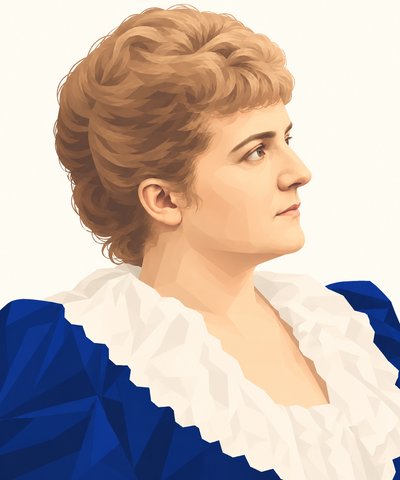
Augusta Holmès was born in Paris in 1847. Her Irish parents had been married for twenty years, and she was their only child. She grew up in Versailles, near the palace gardens. Her mother was a painter and a poet, but she hated music. While she was alive, there was no piano in the house.
Even as a small child Augusta loved music, and her mother tried hard to stop it. When her mother died, Augusta was ten, and now there was no one to stop her. Her father, who adored her, let her take lessons at once. Within two years she was known all over Versailles as a pianist. It is said that at eleven she conducted a march of her own, played by an army band. She studied with the organist of Versailles cathedral, but she taught herself most of what she knew.
As a young woman she was famous for her golden hair and her voice, and her home in Versailles was full of young painters, poets and musicians. One of them, the composer Camille Saint-Saëns, twelve years older, said many years later: "We were all in love with her. Any one of us would have been proud to make her his wife." It is said that he asked her to marry him. She answered that two artists in the same art could not live together without quarrels, and that they should stay good friends. They did, for the rest of her life.
She was engaged once, at about 20. A story told in Versailles says that one day her future mother-in-law shut herself in a room with her lawyer, probably to discuss the money side of the marriage, and told the servants to let no one in. Augusta locked them in and walked off with the key. That was the end of the engagement.
In 1869, at 21, she went with her father to visit Wagner, whom she worshipped. After he heard her music, he told her not to admire him so much: "Take my advice. Belong to no school, least of all mine." The same year she came to know Liszt, who later wrote to her that she had an extraordinary talent.
Her father died at the end of that year and left her enough money to live as she liked. For the next seventeen years she was the partner of the poet Catulle Mendès, and they had five children. During the war with Prussia in 1870 she nursed wounded soldiers in Paris and wrote songs for the fighting men.
In her late twenties she became a pupil of César Franck, and she always called him her real teacher. In 1879 she became a French citizen. She spelled her name Holmès, with an accent, so that French people would say it the French way.
She wrote the words of almost all her music herself. "The words sing in my head, and I write down the tune," she told a friend. In 1883 and 1884 she published a set of five serenades, one for each season and one "for always," among them Sérénade printanière and Sérénade d'hiver.
She wanted to write big works, not only songs for the home. In 1881 a large piece of hers for choir and orchestra lost a prize of the City of Paris by two votes. A conductor performed it anyway, and it was a great success. That same year the city made her a member of the prize jury, the first woman ever chosen.
In 1889 France celebrated the 100th anniversary of the Revolution, and she was asked to write the music for it. Her Ode, with her own words, was performed in a huge hall on the Champs-Élysées by about 1,200 singers and players, in front of an enormous crowd.
In 1895, at 47, her opera was staged at the Paris Opéra. Only two women had had an opera performed there before her. But it was not a success, and it closed after thirteen performances.
By then her money was gone, and she lived by giving piano and singing lessons. She did not complain. She used to say: "Lessons are my bread. Songs are the meat." Her best-loved song, a Christmas carol that is still sung in France, she had sold to a publisher for 250 francs.
In about 1899 the English composer Ethel Smyth, eleven years younger, whose first opera had just been staged in Germany, came to thank her, "one to whom all women owe a great debt." Holmès lived in a small flat. The walls were hung with old, faded wreaths that she had been given at concerts in her great years. She came in wearing a red dressing gown, warm and friendly, without a trace of bitterness. Smyth realised, half hurt and half amused, that Holmès had no idea who she was.
In 1902 Smyth came again, this time to plan a concert of Holmès's music in London. She brought an old friend who had adored Holmès when he was young. The two of them talked only of old times, and Smyth never got a word in about the concert. Holmès had been seriously ill a few years before. She died suddenly of a heart attack at her home in Paris on 28 January 1903, at 55. Saint-Saëns played the organ at the service.
Augusta Holmès was bold and warm. After her great successes, her life slowly faded, but she never became bitter and never gave up. At a time when women were expected to write only small songs, she wrote songs and also large works for choir and orchestra, almost always to her own words.
Пойте произведения: Augusta Holmes
Эти произведения есть в Singalong Solfege. Пойте их сольфеджио с ведущим голосом и фортепианным аккомпанементом.
| № | Сложность | Название | Год | |
|---|---|---|---|---|
| Ex. 11-9 | ④ | Sérénade Printanière | 1883 | |
| Ex. 12-7 | ④ | Sérénade d'hiver | 1884 |