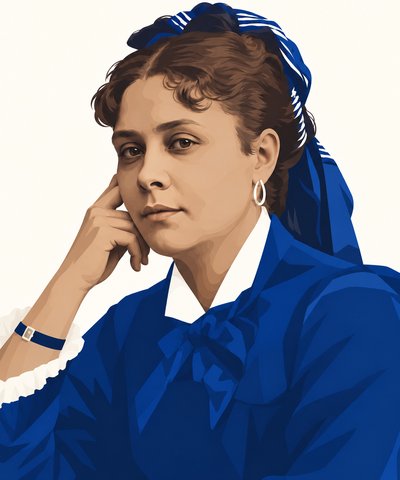
Chiquinha Gonzaga was born in Rio de Janeiro, Brazil, in 1847. Her father was an army officer from an important family. Her mother, Rosa, was the daughter of a slave, and Rosa herself had been freed. Chiquinha was brought up to be a fine lady, and she had piano lessons from a young age. As a child she was already full of energy and very determined. At 11 she wrote her first piece, for a family Christmas party, and her uncle played the flute.
In 1863, at 16, she married a man her father had chosen. Her husband did not like music, and he saw the piano as his rival. He told her to choose between music and him. It is said that she answered, “My husband, I cannot understand life without harmony.” She left her husband. She could take only her oldest son with her, and her husband kept the two younger children. Her father was so angry that he treated her as if she were dead. Nobody in his house was allowed to say her name. Now she was poor. It is said that she made her own dresses. She could not buy the fashionable hats of the time, so she covered her head with a piece of silk instead.
In 1877, when she was about 30, she began to earn her living as a pianist and a piano teacher. At that time many ladies in Rio played the piano at home. But no woman had ever earned money by playing dance music in public. She played the piano in the group of the flute player Joaquim Callado, who is called the father of choro, a kind of popular music from Rio. She was the first woman in his group. That same year, at a gathering of musicians, she improvised a polka, a quick dance, at the piano. It was printed and became a hit. But the upper class of Rio did not think that dance music was respectable, so this success made them look down on her even more. Still, she did not stop. She did not think that any kind of music was below her, so she used all the music she heard in Rio. She wrote polkas, tangos and waltzes, and she also put Afro-Brazilian dances into her music.
In January 1885, at 37, her first operetta, a light opera with spoken scenes, opened at a theatre in Rio. She conducted it herself. She is often called the first woman conductor in Brazil. The newspapers did not know what to call her. In Portuguese the word “maestro” had no form for a woman, so they made up a new word, “maestrina.” At that time there were no records, and people in Rio heard new music mostly in the theatre. They whistled her tunes in the streets. Two years later, in 1887, she wrote A sereia (The Mermaid). It is a gentle song on words by a well-known Brazilian novelist, and it is quite different from the dance music she was famous for.
In those years there was still slavery in Brazil, and she worked to end it. She went from door to door selling her printed music, to raise money for the movement against slavery. With money from her music she also bought the freedom of a musician who was a slave, José Flauta. Slavery in Brazil ended in 1888.
In 1899, at 52, she wrote “Ó abre alas” for a Carnival group in Rio. Carnival is the huge festival of Rio, with music and dancing in the streets. “Ó abre alas” is thought to be the first song written for Carnival, and people still sing it at Carnival every year. That same year she met João Batista Lage, a young Portuguese musician. He stayed with her for the rest of her life. He kept her papers safe, and thanks to him much of what she wrote has survived.
Theatres and publishers often used her music without paying her. So in 1917 she founded a society that collected money for writers and composers whenever their works were performed. It was the first society of this kind in Brazil. In January 1935 she celebrated 50 years as a conductor. She died in Rio de Janeiro on 28 February 1935, at 87. It was the day before Carnival began.
Chiquinha Gonzaga was the first woman in Brazil to make her living from music, as a pianist, composer and conductor. She mixed the dances of Europe with the music of the streets of Rio, and for fifty years the city danced to her music. Today her birthday, 17 October, is the National Day of Popular Music in Brazil.
Пойте произведения: Chiquinha Gonzaga
Эти произведения есть в Singalong Solfege. Пойте их сольфеджио с ведущим голосом и фортепианным аккомпанементом.
| № | Сложность | Название | Год | |
|---|---|---|---|---|
| Ex. 2-15 | ④ | A sereia | 1887 |