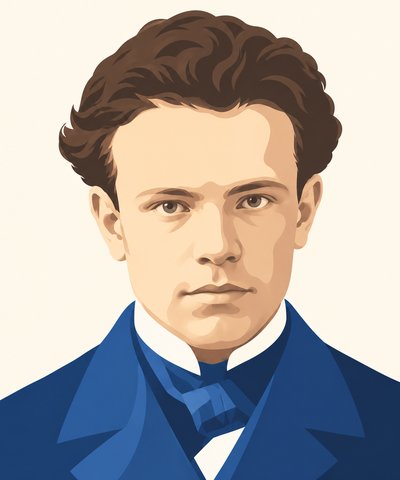
Ottorino Respighi was born in 1879 in Bologna, in northern Italy, the youngest of three children. His father worked at the post office. He was also a trained pianist, and he taught the piano at home. It is said that Ottorino learned the piano by listening to the lessons his father gave to other children. His sister remembered him as a lively boy with a very good memory. She also said that he could not tell a lie, and that he felt other people’s pain very strongly. At 12 he entered the music school in Bologna. There he studied the violin and the viola, and later composition. At 21 he went to St Petersburg in Russia. An Italian opera company was performing there for the winter, and he played the viola in its orchestra. In St Petersburg he took lessons for five months from the Russian composer Rimsky-Korsakov, who was 35 years older. Rimsky-Korsakov was famous for using the instruments of the orchestra to paint colours and pictures in sound. In his Flight of the Bumblebee, for example, the violins sound just like a buzzing bee. It is said that Respighi later called the lessons with Rimsky-Korsakov the most useful lessons of his life. He went back to Russia for a second winter, and he learned to speak Russian well. For the next ten years he earned his living as a viola player, and he composed in his spare time. Nebbie (Mists) comes from these years.
In 1913, at 33, he became a professor of composition at the music school in Rome. He lived in Rome for the rest of his life. In 1916 he finished The Fountains of Rome. It has four parts, and each part is a picture in sound of one fountain of the city at a different time of day. The first performance was in Rome in 1917. The audience did not like it much, and Respighi was so disappointed that he put the score away in a drawer. The next year Toscanini, already the most famous conductor in Italy, conducted it in Milan. It was a great success, and from then on Respighi was famous. In 1924 he wrote The Pines of Rome. In one quiet part a bird called a nightingale sings at night. Respighi wanted the sound of a real bird. So the score asks for a gramophone record of a nightingale to be played with the orchestra. It is said to be the first time a recording was used in a piece for orchestra. At the end, an ancient Roman army marches towards the city, and the music grows louder and louder. He also loved old music. He took pieces written for the lute, an old instrument like a guitar, and arranged them for orchestra as Ancient Airs and Dances.
In 1919, at 39, he married Elsa Olivieri-Sangiacomo. She was his pupil, a singer and composer, and 15 years younger. It is said that his friends had not believed he would ever marry, because the idea of marriage frightened him. After they married, Elsa sang his songs, with Respighi at the piano, in more than 300 concerts in Europe and America. She always told him honestly what she thought of his new pieces. He often answered, “You were right, Elsa.”
Respighi was shy, modest and good-natured, and he lost confidence easily. He could read eleven languages, but he never talked about it. But a friend remembered that he was very proud of something else. He could work as a carpenter, a blacksmith and an electrician. It was hard to get him to play his own music. He made excellent coffee for his guests and told them many funny stories. Then he found a good reason why he could not open the piano that day. He also loved trees. One spring day he and Elsa were out in the car near Rome, and he saw a park full of pine trees. He said, “Here is where I would like to live!” Elsa stopped the car and asked if the place was for sale. It was, and in 1930 they moved into the house there. They called it “I Pini,” the Pines.
In 1932 he joined the Royal Academy of Italy, which Mussolini, the Fascist leader of Italy, had founded. He also signed a public letter with other composers against new music without a key, like the music of Schoenberg. Some people say that he tried to please Mussolini’s government, and the government liked his pieces about Rome. Others point out that he never joined the Fascist party. In January 1936 he fell ill with an infection of the heart, and at that time there was no cure for it. He died at his house, I Pini, in April 1936, at 56. Elsa lived for another 60 years. She finished his last opera, wrote a book about his life and worked to make his music known. She died in 1996, at 101.
Most Italian composers of his time became famous for their operas. Respighi became famous for his music for orchestra. He learned from Rimsky-Korsakov how to paint pictures with the orchestra, and he made the fountains and the pines of Rome into music.
Ottorino Respighi の曲を歌う
これらの曲は Singalong Solfege に入っています。ガイドの歌声とピアノ伴奏に合わせて、ドレミで歌えます。
| No. | 難易度 | 曲名 | 作曲年 | |
|---|---|---|---|---|
| Ex. 7-12 | ③ | Nebbie | 1906 |