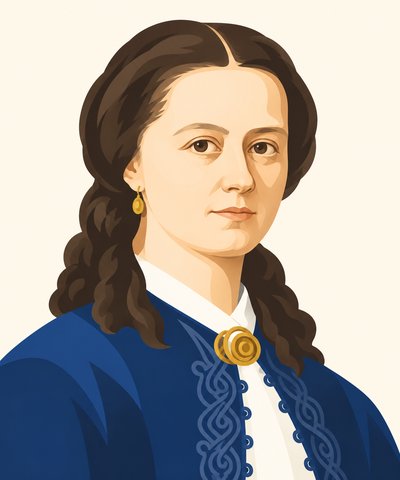
Laura Netzel was born in 1839 in eastern Finland, into a noble family that spoke Swedish. Her family name was Pistolekors. Her mother died less than two weeks after Laura was born. The next year her father married again. Her stepmother, Antoinette, was rich and independent, and Laura later called her the only mother she ever had. As a small child Laura moved with her stepmother to Sweden, near Stockholm. Her father stayed mostly in Finland with his older children. Antoinette saw that Laura had a gift for music, and she paid for her lessons. Laura later said that her stepmother never told her to practise. “The more I played, the more I wanted to play,” she said. She sat at the piano for hours every day. She became a fine pianist and gave her first concert at about 17. At that time a young lady from a noble family did not perform under her own name, so the newspaper called her only “Miss P.” In 1866, at 27, she married Wilhelm Netzel, a doctor who later became a professor of medicine in Stockholm. They had four children.
She began to compose in her thirties. For years she did not want to publish her music. Her friends kept asking her, and in 1884, at 45, she finally agreed. At that time, people thought it was not proper for a lady from a noble family to earn money. She did not want anyone to think that she composed for money. So she gave all the money from her music to a night shelter for homeless women. She published her music under a different name, “Lago,” and later “N. Lago.” She wanted her music to be judged in the same way as the music of men, not as the music of a woman. Soon many people knew who Lago was, but she kept the name all her life. Slumra, slumra, bölja blå (Sleep, Sleep, Blue Wave) was published in 1888.
Her closest friend from her youth was Elfrida Andrée, who became the first woman organist in Sweden. Laura asked her to check her music before it was printed. “Correct the mistakes,” she wrote, “but do not change the harmonies.” She always said what she thought, and she did not try to please people. Once a singer sang her light, quick song “The Butterfly” very heavily. Laura wrote to a friend that the singer had made the butterfly sound like a big, heavy fly. King Oscar II of Sweden loved to sing, and she often sang with him at music evenings in friends’ homes. Once she sent him the music of a new duet for soprano and tenor, so that they could sing it together. The King wrote back that the tenor part was too high for him. So he asked another tenor to learn it, because he did not want to miss hearing it.
In her fifties she went to Paris to study composition with the French organist and composer Charles-Marie Widor, who was five years younger than she was. She later said that she wrote her best music in Paris. In 1891 one of her songs was performed by the leading chamber music society in Paris. Before her, the only composer from the Nordic countries heard there had been Grieg.
In 1892, at 53, she started concerts for working people in Stockholm. They took place every Saturday evening in the winter, and workers paid only a very small price for a ticket. The best singers of the Royal Opera sang at them. Rich people were not allowed in. The halls soon became too small, and the concerts moved to bigger ones. She ran them for 16 years. In 1908, when she was nearly 70, she had to stop. The concerts had become too expensive to run, and fewer workers came, because many now went to the cinema instead. Later she called these concerts the most important work of her life. On her 86th birthday she still played her own music from memory. She died in Stockholm in 1927, at 87.
Laura Netzel did not write music for money or for fame. She hid her name, and she gave away what her music earned. She wanted good music to reach everyone, and her Saturday concerts brought the best singers in Stockholm to working people.
Laura Netzel の曲を歌う
これらの曲は Singalong Solfege に入っています。ガイドの歌声とピアノ伴奏に合わせて、ドレミで歌えます。
| No. | 難易度 | 曲名 | 作曲年 | |
|---|---|---|---|---|
| Ex. 13-6 | ③ | Slumra, slumra bölja blå | 1888 |