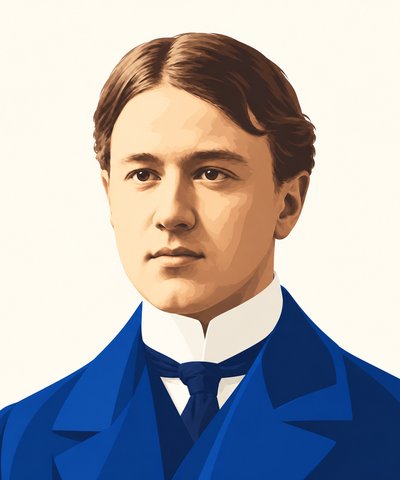
Charles Ives was born in 1874 in Danbury, a small town in Connecticut, in the north-east of the United States. His father George had been the youngest bandleader in the Northern army in the American Civil War, and he was now the town's music teacher and bandmaster. George loved experiments with sound. He made his sons sing a tune in one key while he played the piano in another, and it is said that he once had two bands march towards each other playing different tunes. Charles played the drums in his father's band as a boy. At 14 he became the organist of a church in Danbury, said to be the youngest paid church organist in the state. At 20 he entered Yale University, and a few weeks later his father died suddenly. At Yale he studied music, but he also found time to play on the football team. His composition teacher, Horatio Parker, was a strict musician trained in Germany, and he did not like Ives's experiments with clashing keys. Ives handed in polite pieces for class and kept his bold ideas to himself. Songs My Mother Taught Me is one of those polite pieces from his student years.
After Yale he did not try to make a living from music. He later wrote, "If he has a nice wife and some nice children, how can he let them starve on his dissonances?" Instead he went into life insurance in New York. In 1907 he started his own agency with a partner, and it grew into the largest in the country. He composed in the evenings, at weekends and on holidays. In 1908, at 33, he married Harmony Twichell, a nurse, whose father was a minister and a close friend of Mark Twain. In these years he wrote almost all his music: four symphonies, the Concord Sonata for piano, Three Places in New England, The Unanswered Question and about 150 songs. Almost none of it was performed. In 1918, at 43, he had a heart attack, and after that he composed very little.
Instead he began to print his music himself and give it away. In 1922 he had 114 of his songs printed in a thick book and mailed it free to friends, musicians and hundreds of strangers. Slowly a few younger musicians discovered him. Henry Cowell, a composer 23 years younger, ran a small publishing series for new music, and he printed Ives's scores in it. In return Ives paid most of the printing costs of the whole series, so that other young composers could be published too. In 1939, when Ives was 64, the pianist John Kirkpatrick played the whole Concord Sonata from memory in New York, and a critic called it the greatest music composed by an American. In 1947, at 72, Ives won the Pulitzer Prize for his Third Symphony, written forty years earlier. He said, "Prizes are for boys, and I'm all grown up," meaning that prizes should go to young people. He gave the money to younger composers, half of it to Lou Harrison, who had conducted the first performance. In 1951 the young conductor Leonard Bernstein gave the first performance of his Second Symphony. For about fifty years the piece had existed only on paper and in Ives's head. Ives, now 76, had no radio, so he listened at a neighbour's house. It was the first time he had ever heard his symphony, and the audience in Carnegie Hall cheered it for a long time. The Austrian composer Schoenberg had fled from the Nazis and was living in Los Angeles. After he died in 1951, a note was found among his papers: "There is a great man living in this country – a composer. He has solved the problem how to preserve one's self and to learn. He responds to negligence by contempt. He is not forced to accept praise or blame. His name is Ives." In other words, Ives had found a way to earn his living and still write his own music, without needing anyone's approval.
He died in New York in 1954, at 79. His Fourth Symphony was first performed eleven years after his death, and it needed three conductors at once. Today he is often called the first great American composer, and many ideas of modern music appear in his work years before anyone in Europe tried them.
Charles Ives の曲を歌う
これらの曲は Singalong Solfege に入っています。ガイドの歌声とピアノ伴奏に合わせて、ドレミで歌えます。
| No. | 難易度 | 曲名 | 作曲年 | |
|---|---|---|---|---|
| Ex. 6-15 | ② | Songs My Mother Taught Me | 1922 |