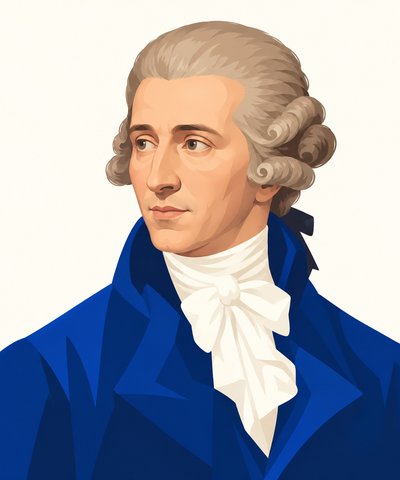
Joseph Haydn was born in 1732 in Rohrau, a village in eastern Austria. His father was a wheelwright, a maker of wooden wheels for carts. At eight he was taken to Vienna to sing as a choirboy at St Stephen's Cathedral. When his voice broke he was dismissed. For some years he lived by teaching and playing, and taught himself to compose. In 1761 he entered the service of the Esterházy princes, one of the richest families in Hungary. For nearly thirty years he directed their orchestra and opera at Eisenstadt and at the palace of Eszterháza. He said later: "I was cut off from the world, and so I was forced to become unique." In Vienna he became a close friend of Mozart, who was 24 years younger, and Mozart dedicated six string quartets to him. After hearing them, Haydn told Mozart's father that his son was "the greatest composer known to me."
In 1791 and again in 1794 he visited London. His twelve "London" symphonies made him the most celebrated composer in Europe, and Oxford University gave him an honorary doctorate. In London he heard Handel's great choral works, and they inspired his own The Creation (1798). The hymn he wrote for the Austrian emperor in 1797 is today the melody of the German national anthem. Between the two trips, the young Beethoven came to Vienna to study with him. The proud young man complained that his teacher paid him too little attention, and Haydn, amused, called him "the Great Mogul." The lessons ended after little more than a year, when Haydn left for London again, and for some years the two kept their distance. Yet Beethoven dedicated his first three piano sonatas to Haydn. In 1808, when the old man was carried into a concert of The Creation, Beethoven is said to have knelt and kissed his hands. He died in Vienna in 1809, at 77. He is called the father of the symphony and the string quartet. He wrote more than a hundred symphonies, and Mozart and Beethoven built on the forms he had shaped.
Chanter les morceaux de Joseph Haydn
Ces morceaux sont dans Singalong Solfege. Chantez-les en solfège avec une voix guide et un accompagnement de piano.
| N° | Difficulté | Titre | Année | |
|---|---|---|---|---|
| Ex. 4-4 | ③ | The Wanderer | 1794 |