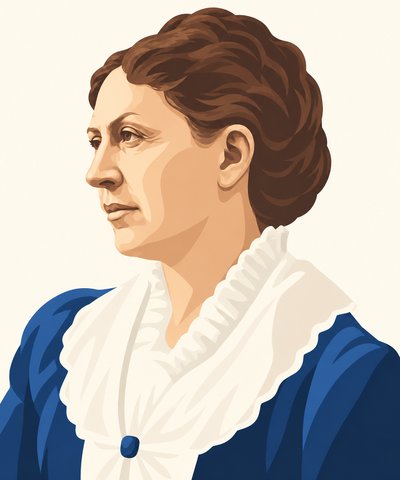
Clémence de Grandval was born in 1828 on her family’s country estate in north-western France, the youngest of four children. Her father was a nobleman and an army officer, and her mother wrote novels. She began music lessons at six, and at twelve she began to compose with a German composer who was a friend of the family. She also took piano lessons from Chopin, and singing lessons from a famous opera singer.
In 1850, when she was 22, Berlioz heard her music at her father’s house and praised it in a Paris music magazine. He ended with a warning: she had only one more thing to learn, and that was not to become proud when people praised her too much. The next year Berlioz conducted part of her symphony at one of his concerts. Two weeks after that concert, at 23, she married the Vicomte de Grandval, an army officer. They had a daughter.
Because she was a rich noblewoman, many people saw her only as an amateur. So she decided to start her studies again from the beginning. For two years she took lessons in composition from the young Saint-Saëns, a French composer who was seven years younger than her. They stayed close friends all their lives, and Saint-Saëns dedicated his Christmas Oratorio to her. Chanson (Song) comes from a set of six songs published in 1857. Her mother wrote the words of the first song in the set.
For her first works for the stage she hid her name. In 1860 a comic opera of hers was performed under the name “Caroline Blangy.” A critic hinted in his review that he knew who the real composer was, and soon the newspapers printed her name. Her house in Paris became a meeting place for musicians. Bizet wrote to a friend that he would see her “on Tuesday at Mme de Grandval’s,” and Gounod dedicated a song to her. In 1869 her opera Piccolino was a great success. Her Stabat Mater (1870) was sung by choirs all over France. In 1880 she won the first Rossini Prize, a prize paid for with money that Rossini had left in his will.
Her husband died in 1886, when she was 58. In a letter to a friend she wrote that her daughter was adorable, but that a child could not take the place of her old companion. “Yes, I am trying to get back to work,” she wrote. Six years later, at 64, her new opera Mazeppa was a great success in Bordeaux. She died in Paris in 1907, at 78.
All her life people told Grandval that she was only an amateur, and she worked like a professional for more than fifty years. In 1890 Saint-Saëns named her, beside Berlioz, Gounod, Massenet and Bizet, as a French composer whose music should not be forgotten.
Chanter les morceaux de Clémence de Grandval
Ces morceaux sont dans Singalong Solfege. Chantez-les en solfège avec une voix guide et un accompagnement de piano.
| N° | Difficulté | Titre | Année | |
|---|---|---|---|---|
| Ex. 3-8 | ⑤ | Chanson | 1857 |