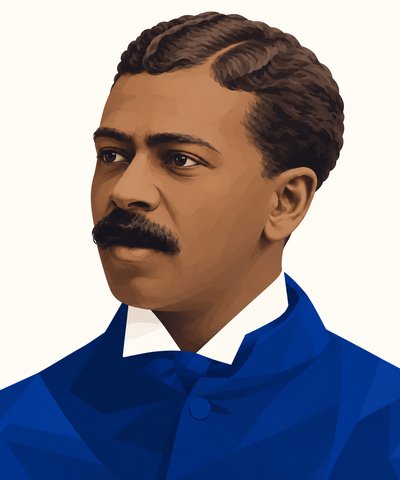
Harry T. Burleigh was born in 1866 in Erie, a town on Lake Erie in Pennsylvania, in the north-east of the United States. Slavery in the United States had ended only the year before. His mother had studied at a college, but she worked as a servant in the homes of rich families. His father died when Harry was about six. His grandfather, Hamilton Waters, had been a slave in Maryland, and in 1832 he bought his own freedom and his mother’s. He later lived in Erie. He was almost blind, and his job there was to light the street lamps every evening. The boy often walked with him as he lit the lamps. His grandfather taught him the spirituals, the religious songs that slaves had sung in the South.
As a young man Harry did many jobs, and he sang in the churches of Erie. His mother worked for a rich family, the Russells, who held concerts in their home. According to his own story, one winter evening a famous pianist played at the Russells’ house. Harry could not go in, so he stood for hours in deep snow outside the window to listen. He became ill. When Mrs Russell heard about it, she gave him a job opening the door at her concerts. From then on he could hear the great musicians who played there.
In 1892, at 25, he went to New York to try for a place at the National Conservatory of Music. He failed the entrance test, because he had had very little training. But the woman who ran the school office knew about him from the Russells. She helped him get a scholarship, and he was one of four students chosen from about 200. He also worked at the school, cleaning the halls.
That same year the Czech composer Antonín Dvořák, who was 25 years older and famous all over Europe, became the director of the school. Burleigh did not study with him. But it is said that Dvořák heard him singing spirituals while he was cleaning the halls. Burleigh often went to Dvořák’s home for dinner, and there he sang the old songs for him. He later remembered that Dvořák asked him hundreds of questions about the lives of the slaves. According to Burleigh, Dvořák told him that he should make the spirituals known to the whole world.
In 1894, at 27, Burleigh tried for the post of main singer at St. George’s Church, a large church in New York. About sixty singers tried for it, and he was the only Black one. Some members of the church did not want a Black singer. But the priest supported him. The church leaders voted, and the vote of the famous banker J. P. Morgan decided the result. He got the post, and he sang at St. George’s for 52 years.
In 1898, at 31, he married the poet Louise Alston, and they had a son the next year. In 1904 the English composer Samuel Coleridge-Taylor, who was nine years younger, made his first tour of America. Burleigh sang one of the solo parts at its first concert, in Washington, and he sang with him again on his second tour in 1906. Coleridge-Taylor is said to have called him “my true friend and greatest singer of my songs.”
Before 1916, concert singers almost never sang spirituals with piano. In 1916 Burleigh arranged the spiritual Deep River for solo voice and piano, in the same way as a classical song. It was a great success, and many famous singers began to sing his arrangements. Soon many singers ended their concerts with a group of spirituals. Go Down, Moses followed in 1917. At that time, in some popular shows, white performers sang Black songs in a comic way to make fun of Black people. In a note printed with these songs, Burleigh asked singers not to make the songs funny, and to sing them with respect. Burleigh did not like making records. His only record for sale is Go Down, Moses, which he made in 1919. He also helped young Black singers, such as Roland Hayes, Marian Anderson and Paul Robeson, who later became famous all over the world.
In 1946, at 79, he stopped singing at St. George’s because of poor health. He died near New York in 1949, at 82. More than 2,000 people came to his funeral at St. George’s.
Because of Burleigh’s arrangements, the spirituals moved from the churches of Black Americans into the concert hall, and classical singers all over the world began to sing them. He had done what Dvořák asked of him as a young man.
Chanter les morceaux de Harry T. Burleigh
Ces morceaux sont dans Singalong Solfege. Chantez-les en solfège avec une voix guide et un accompagnement de piano.
| N° | Difficulté | Titre | Année | |
|---|---|---|---|---|
| Ex. 5-13 | ① | Gratuit | Go Down, Moses | 1917 |