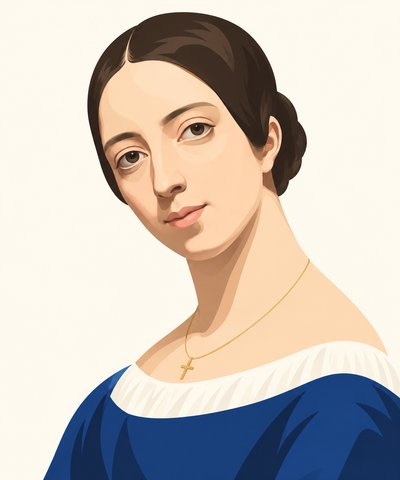
Pauline Viardot was born Pauline García in Paris in 1821, into a family of Spanish singers. Her father, Manuel García, was a famous tenor, singing teacher and composer. Her sister, Maria Malibran, was 13 years older and became one of the most famous opera singers in Europe. Pauline later said that she could not remember when she learned music. As a girl she studied the piano with Liszt, who was 10 years older. At first she wanted to be a pianist. But her mother decided that she should become a singer.
In 1839, at 17, she sang her first opera role, in London. The next year, at 18, she married Louis Viardot, a writer who ran the Italian opera house in Paris. He was about 21 years older. He gave up his job so that he could manage her career. In 1849, at 27, she sang the main woman’s role in Le prophète (The Prophet), a new opera by Giacomo Meyerbeer, in Paris. Meyerbeer had written that role for her. The opera was a huge success.
In the 1840s she became a close friend of Chopin, who was 11 years older. With his approval, she arranged 12 of his mazurkas, Polish dances for the piano, as songs. In 1849 she met Gounod again, ten years after they had first met in Rome. He was three years older and still unknown. She asked him why he had not written an opera. He answered that he had no words for one. She told him to ask a writer she knew, and she promised to sing the main role. She also told the Paris Opéra that she would sing there only if they performed his opera. Gounod’s first opera was performed there in 1851, with Pauline in the main role. It was not a success. But it was Gounod’s first step as an opera composer, and eight years later his opera Faust made him famous all over the world.
In about 1840 the young Wagner, who was still unknown, had shown her some of his songs. He later wrote that she was very kind and praised them, but she did not want to sing them. Twenty years later, in 1860, she sang part of his new opera Tristan und Isolde with him at her house in Paris. At that time Wagner and Berlioz were no longer friendly. Wagner wrote that she had invited Berlioz as the only other guest, on purpose, to make the two men friends again.
By the early 1860s her voice had become weaker. She later told the French composer Camille Saint-Saëns, who was 14 years younger and often played the piano for her, “I wanted to sing everything, and I ruined my voice.” So in 1863, at 41, she stopped singing in opera. In the same year the family left Paris. Her husband was against the French emperor, Napoleon III, and life in Paris had become difficult for them. They moved to Baden-Baden, a town in south-west Germany. There they built a house with a concert hall, and she taught many pupils. Clara Schumann, who was two years older, had been her friend since they were teenagers, and she had a summer house nearby. Clara was serious, and Pauline was lively and carefree. Clara wrote to Brahms that Pauline was the most brilliant woman she had ever met. In 1870, at 48, Pauline sang the first public performance of Brahms’s Alto Rhapsody, a work for solo voice, choir and orchestra. That same year a war started between France and Germany. The Viardots were French, so they left Germany, and in 1871 they went back to Paris.
In Paris young composers came to her home every Thursday, and she encouraged them. Fauré, who was 24 years younger, dedicated his song Barcarolle to her. In 1873 she sang in a religious work by Massenet, who was then 31, and it made him famous. In 1886, when she was 64, Tchaikovsky visited her. He was 19 years younger. A storm started, so she made him stay for lunch. She owned the score of Mozart’s opera Don Giovanni, written in Mozart’s own hand, and she showed it to him. Tchaikovsky wrote that he felt as if he had shaken hands with Mozart himself.
Unlike most composers, she hid her own music. Saint-Saëns wrote that she once sang a wild Spanish song, and the Russian pianist Anton Rubinstein loved it. Several years later she told him that she had written it herself. Her husband did not like new music, and according to Saint-Saëns he even found Beethoven too modern. One day a guest came who also liked only old music. Pauline sang the two men a song in the old style, and they praised it very highly. She had written it herself for that day.
She taught singing for the rest of her life, and she wrote many of her songs for her pupils. Haï luli! was published in 1880 in a set of seven of her songs. She died in Paris in 1910, at 88.
Pauline Viardot was a great singer, a fine pianist and a gifted composer. She was also warm and good with people, and she could not stop helping others, even when nobody had asked her. People loved her for it. She found Gounod a writer and a theatre for his first opera. She tried to make Wagner and Berlioz friends again. Every Thursday she opened her home to young composers. Chopin, Clara Schumann, Brahms, Saint-Saëns, Fauré and Tchaikovsky were among her friends. She was probably the composer with the most friends among other composers, and through her, many of them came to know each other.
Lieder von Pauline Viardot singen
Diese Lieder sind in Singalong Solfege enthalten. Singen Sie sie in Solmisation mit Führungsstimme und Klavierbegleitung.
| Nr. | Schwierigkeit | Titel | Jahr | |
|---|---|---|---|---|
| Ex. 14-10 | ④ | Hai Luli! | 1880 |