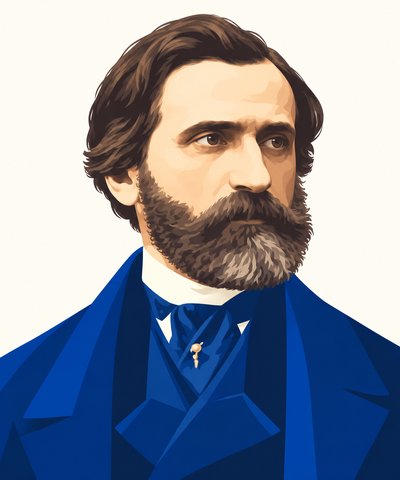
Giuseppe Verdi was born in 1813 in Le Roncole, a village near Busseto in northern Italy. His father kept a small inn and a shop in the village. A merchant in Busseto, Antonio Barezzi, saw his talent and paid for his music lessons. At 18 he applied to the Milan Conservatory and was refused. He was over the age limit, and the examiners did not like the way he held his hands at the piano. So he studied privately in Milan instead. In 1836, at 22, he married Margherita, the daughter of Barezzi, the merchant who had been the first to recognize his talent. Then came three terrible years. Between 1838 and 1840 his two small children died, and then his wife died too. He nearly gave up composing. In 1842 his opera Nabucco was a huge success at La Scala in Milan. Its chorus "Va, pensiero," sung by captives longing for their homeland, became almost a second national anthem for Italians. From then on he was famous.
In the early 1850s he wrote three operas that are still among the most performed in the world. They are Rigoletto, Il trovatore and La traviata. In those same years Italy was still divided into many small states, and the Italians were fighting to become one country. Verdi became the musical symbol of that fight. Crowds shouted "Viva Verdi!" in the streets. The shout had a hidden meaning. The patriots wanted Vittorio Emanuele, the king of Piedmont, to become king of a united Italy. "Verdi" was also short for "Vittorio Emanuele, Re d'Italia," which means "Vittorio Emanuele, King of Italy." When Italy finally became one country in 1861, Verdi himself was elected to its first parliament. Aida followed in 1871.
By then he had bought a farm near the village where he was born. He lived there for the rest of his life, and he liked to call himself a farmer rather than a composer. Wagner was born in the same year, 1813, and he was the other giant of opera, in Germany. The two never met. But when Wagner died in 1883, Verdi wrote to his publisher, "Sad, sad, sad! A great name has gone from the history of art." At 79 he wrote his last opera, Falstaff, a comedy based on Shakespeare. With his own money he built a rest home in Milan for old musicians who were poor. He called it the finest work of his life. In January 1901 he fell ill in a hotel in Milan. The city spread straw on the street outside the hotel so that the noise of the carriages would not disturb him. He died there a few days later, at 87. A month later his coffin was moved to the rest home he had built. Some 300,000 people filled the streets of Milan, and they sang "Va, pensiero" as he passed. Today he is the most performed opera composer in the world. Many of his melodies are known even to people who have never been to an opera.
Lieder von Giuseppe Verdi singen
Diese Lieder sind in Singalong Solfege enthalten. Singen Sie sie in Solmisation mit Führungsstimme und Klavierbegleitung.
| Nr. | Schwierigkeit | Titel | Jahr | |
|---|---|---|---|---|
| Ex. 8-9 | ④ | In solitaria stanza | 1838 |