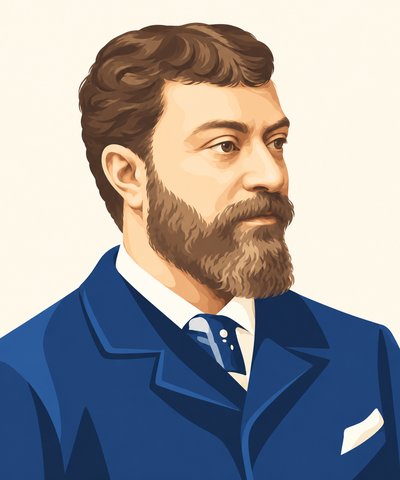
Francesco Paolo Tosti was born in 1846 in Ortona, a small town on the Adriatic coast of central Italy. His father was a grain merchant. In 1858, at 12, the boy got a free place at the Naples Conservatory. There he studied the violin and composition. One of his teachers was the old opera composer Saverio Mercadante, the director of the school. While he was still a student, he also worked at the school as an assistant teacher. Tosti had a pleasant tenor voice, and people in Naples already liked to hear him sing. In 1866, at 20, he finished his violin studies. Later he worked too hard and became seriously ill. He had to stay in bed for about seven months at his family’s home in Ortona. He used the time to write songs. But the publishers he sent them to did not want them.
In late 1870, at 24, he moved to Rome. There he met the pianist and composer Giovanni Sgambati, who was five years older. Tosti could sing and play the piano for himself at the same time, and he did both very well. Sgambati was impressed, and he introduced Tosti to rich families and arranged concerts for him. At one of these concerts Princess Margherita of Savoy heard him sing. She later became Queen of Italy. She chose Tosti as her singing teacher, and from 1872 he went to the royal palace twice a week to give her lessons.
In 1875, at 29, Tosti visited London for the first time. London was a rich city, and many families there wanted Italian singing teachers. After that he spent some months in London every year, and in 1880, at 34, he settled there. That same year he began to teach singing to the British royal family. His pupils included the children of Queen Victoria. He also began to write songs with English words, such as Good-bye! (1880). They were great successes, and by 1885 he was the most popular song composer in England.
In the summers Tosti often went back to the seaside near Ortona. A painter friend had a studio there, and writers and artists met at his house. One of them was the young poet Gabriele D’Annunzio, who was 17 years younger and later became the most famous Italian writer of his time. Over the years Tosti wrote about 35 songs on D’Annunzio’s words. Another poet in the group was Carmelo Errico, a lawyer who wrote poems in his free time. Tosti set one of Errico’s poems to music, and Ideale (Ideal) was published in 1882, when Tosti was 36. It became one of his best-known songs. In 1889, at 43, he married Berthe de Verrue, a singer from Brussels.
The Australian soprano Nellie Melba, one of the most famous opera singers of the time, was his close friend. In a book about her life, she called him “a little man with a great personality, full of funny stories.” She also wrote that at times he behaved like a naughty child. Once she and the famous tenor Enrico Caruso were singing Puccini’s opera La bohème in London. Tosti sat in the front row. During the second act he tied a white handkerchief over his mouth, so that it looked like a huge moustache. Then he filled his cheeks with air and stared at the singers with wide eyes. Melba and Caruso could hardly stop themselves from laughing on the stage.
In 1877 Verdi, the most famous Italian composer, wrote in a letter that Tosti was an excellent singing teacher. Six years later, in 1883, Tosti met Verdi, who was 33 years older, in Milan. Melba later studied the role of Desdemona, the young wife in Verdi’s opera Otello, with Tosti. Then she sang it for Verdi. According to her book, Verdi asked her who had taught her. When she answered, “Tosti,” Verdi said, “Ah! Dear Tosti! He is the only man who would have taught you to sing my opera like that.” In 1890 Tosti met Puccini, who was 12 years younger, and the two became close friends. Puccini valued Tosti’s help and his many friends in London. In 1897 the French composer Gabriel Fauré dedicated one of his songs to Tosti.
At that time almost every Italian composer wanted to write operas. People often asked Tosti to write one, but he never did. In 1906, at 60, he became a British citizen. Two years later, in 1908, his friend King Edward VII gave him the title “Sir,” and from then on he was Sir Paolo Tosti. In his last years he returned to Rome. He died there of heart disease in 1916, at 70.
Tosti wrote more than 400 songs, in Italian, French, English and the language of Naples. Kings and queens took singing lessons from him, and the greatest singers of his time sang his songs. His songs were also sung in ordinary homes all over Britain. In 1925, nine years after his death, Melba wrote that people everywhere still asked her to sing his Good-bye!
Lieder von Paolo Tosti singen
Diese Lieder sind in Singalong Solfege enthalten. Singen Sie sie in Solmisation mit Führungsstimme und Klavierbegleitung.
| Nr. | Schwierigkeit | Titel | Jahr | |
|---|---|---|---|---|
| Ex. 7-9 | ③ | Ideale | 1882 |