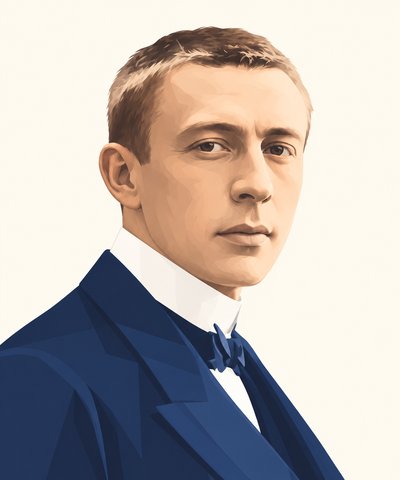
Sergei Rachmaninoff was born in 1873 on his family's country estate in the Novgorod region, south of St Petersburg. His mother came from a general's family and had brought several estates into the marriage. His father, a former officer, was a charming man who could not manage money. By the time Sergei was nine, every estate had been sold, and in 1882 the family moved to a small flat in St Petersburg.
His mother had taught him the piano since he was four, and at nine he entered the St Petersburg Conservatory on a scholarship. But he was lazy. He stayed away from his classes to go skating and to jump on and off the moving trams, and he failed his exams. His grandmother often took him to the great cathedrals of the city. At home he played the melodies he had heard there on the piano, from memory. His grandmother gave him a coin for that. The family did not want to waste his talent, so they asked his cousin Alexander Siloti, already a famous pianist, for advice. Siloti said that only one man could make the boy work: his own former teacher, Zverev, in Moscow.
So in 1885, at 12, Rachmaninoff moved into Zverev's house in Moscow. Zverev was the most expensive piano teacher in the city, and he took three boys into his home for nothing. They shared one bedroom and one piano, practised three hours each, and were not allowed to go home for the holidays.
On Sundays Zverev gave dinners for Moscow's actors, lawyers and musicians, and Tchaikovsky, 33 years older than the boy and the most famous composer in Russia, was often among the guests. Another pupil came on Sunday mornings: a small boy from the military school called Scriabin.
At 14 or 15 he took the harmony examination, and Tchaikovsky sat on the board. According to his own account, the top mark was a five with a plus, and Tchaikovsky added three more pluses to his, making it 5++++. Nobody had ever been given that mark, and the whole Conservatory talked about it.
At 16 he asked Zverev for a room and a piano of his own, because he wanted to compose and the music room was always full. Zverev had a terrible temper. He flew into a rage, screamed at him and threw things at him. For a month the two lived in the same house without a word. Then Zverev took him to the house of Rachmaninoff's aunt, the Satins, said that the two of them could not live together, and asked them to take the boy. The Satins took him in.
In 1892, at 19, he wrote his final examination piece, the opera Aleko, in less than three weeks, and the Conservatory gave him its Great Gold Medal, only the third in its history. Zverev also taught at the Conservatory and sat on the examination board. He had not spoken to Rachmaninoff for three years. After the examination he led him to a window in the corridor, embraced him, and gave him the gold watch from his own pocket. Rachmaninoff wore that watch for the rest of his life.
That autumn, short of money, he sold a short piano piece to a publisher for 40 roubles. It was the Prelude in C-sharp minor. Within a few years it was played all over the world, and when he was first invited to America, in 1909, he was told that every musician there knew him as the man who wrote the Prelude. The piece became a worldwide hit, but he never received another penny for it.
In 1893, at 20, Aleko was staged at the Bolshoi Theatre in Moscow, because Tchaikovsky had recommended it. That autumn the two met for the last time. A few weeks later Tchaikovsky died, and Rachmaninoff at once wrote a piano trio in his memory.
In 1897, at 23, his First Symphony was played in St Petersburg, and it was a disaster. He could not sit in the hall, and hid on the iron fire-escape stairs with his fingers in his ears. The composer Cui wrote that if there were a conservatory in hell, this symphony would win its first prize. Rachmaninoff locked the score away and never let it be played again. For three years he wrote almost nothing.
What helped was a doctor. Nikolai Dahl treated nervous illness by hypnosis. From January to April 1900 Rachmaninoff sat half asleep in an armchair in Dahl's study every day and heard the same words: "You will begin to write your concerto. You will work with great ease. The concerto will be excellent." By the summer, he said, new musical ideas were coming faster than he needed them. The Piano Concerto No. 2 was finished in 1901, when he was 28, and he dedicated it to Dahl. It became one of the most popular piano concertos ever written.
In 1902, at 29, he married his cousin Natalia Satina, the daughter of the family he had lived with since he was 16. The church did not allow first cousins to marry, and in the end permission had to come from the Tsar himself. In April he went to Ivanovka, the Satins' estate 500 kilometres south of Moscow, and wrote twelve songs, one a day, to pay for the honeymoon. One of them was Lilacs. Two daughters were born, in 1903 and 1907.
In the summer of 1906, at 33, at Ivanovka, he wrote fifteen songs, among them When Yesterday We Met and All Things Pass. That autumn he moved with his family to Dresden, in Germany, and lived there for three years, to compose in peace.
He often spent the summers at Ivanovka, and he loved his life there. In the 1917 revolution he lost the estate and almost all his money. In December 1917, at 44, he left Russia with his wife and his two daughters, aged 14 and 10. He never returned.
They took only a few clothes and the girls' schoolbooks. His closest friend, the singer Chaliapin, sent a loaf of white bread and some caviar for the journey. They crossed the border at night in a horse sledge. It was so full of people that his wife had to stand all the way. They reached Stockholm on Christmas Eve, and while the city celebrated, the family sat locked in a hotel room.
For most of 1918 the family moved from place to place in Scandinavia while he gave concerts. At 45 he decided to become a concert pianist, something he had never been. In November 1918 they landed in New York. Within a few years he was one of the finest pianists in the world. As soon as he had money he sent food parcels and money to Russia, to his mother, his wife's family, old friends and students. But he hardly composed any more. In the 25 years after he left Russia, he composed only six works.
In 1932, at 59, he bought land on Lake Lucerne in Switzerland, where he had spent a month of his honeymoon, and built a house. He called it Senar, from the first letters of Sergei and Natalia. He planted every bush and tree himself and drove his own motorboat on the lake. For the first time since leaving Russia, his wife said, he felt that he had a home, and his music came back.
In 1934 he wrote there the Rhapsody on a Theme of Paganini, whose slow 18th variation is known to people who have never heard his name. He left Senar in August 1939, a few days before the war, and never saw it again.
He was about 1.9 metres tall, with a long, lined face, cropped hair and huge hands. In public he was silent and serious, and strangers found him frightening. Among his own people he was a different man. Friends wrote that as soon as he was out of the public eye he began to smile and tease in a quiet voice. When his daughter tied big yellow ribbons to a guest's shoes under the table, he laughed until he cried, with a silent laugh of his own.
In January 1943, on tour, he fell ill, but he would not cancel his concerts. He said that he would rather die than sit in a wheelchair and do nothing. On 17 February 1943 he gave his last concert, in Knoxville, Tennessee. Soon afterwards doctors found a cancer that had spread through his body. His family hid it from him. He died at home in Beverly Hills on 28 March 1943, four days before his 70th birthday.
Rachmaninoff kept his face still and his feelings to himself. But his friends knew a kind and funny man who never got over the loss of his country. He was one of the greatest pianists of the 20th century, and his recordings are still played. As a composer he kept writing in the Romantic style while the world around him kept looking for new kinds of music. In 1939 he said that he felt like a ghost wandering in a world that had become foreign to him: he could not give up the old way of writing, and he could not learn the new. But his long, warm melodies are why the Prelude, the Second Concerto, the Rhapsody and the Vocalise are loved by people who know nothing else about classical music.
Lieder von Sergei Rachmaninoff singen
Diese Lieder sind in Singalong Solfege enthalten. Singen Sie sie in Solmisation mit Führungsstimme und Klavierbegleitung.
| Nr. | Schwierigkeit | Titel | Jahr | |
|---|---|---|---|---|
| Ex. 8-17 | ③ | Lilacs | 1902 | |
| Ex. 2-19 | ③ | When Yesterday We Met | 1906 | |
| Ex. 12-9 | ③ | All Things Pass | 1906 |