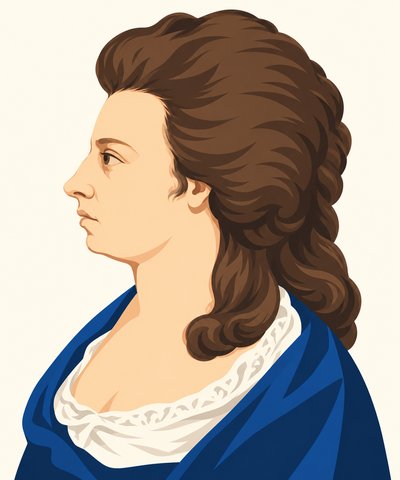
Maria Theresia von Paradis was born in Vienna in 1759. Her father was an official at the court of the Empress Maria Theresa. At about three or four she lost her sight. It is said that when she was about 11, the Empress heard her perform in a church. After that the Empress gave her a sum of money every year.
Paradis had an unusual memory. She could remember more than 60 concertos, and she played them without a mistake. She studied singing and composition with Antonio Salieri, a composer at the court, who was nine years older. Salieri later also taught Schubert and Liszt. When she was 14, she played an organ concerto by Salieri. At 16 she gave her first public concerts in Vienna, as a singer and as a pianist.
In August 1783, at 24, she left Vienna with her mother on a concert tour that lasted three years. In Salzburg they visited the family of Mozart, who was three years older than Paradis. During the tour a violinist joined her. He made a special board for her, so that she could write down music by touch.
In Paris in 1784 she played 14 times in public. A Paris newspaper wrote that you had to hear her yourself to imagine how clear, exact and lively her playing was. She also played for King Louis XVI and Queen Marie Antoinette, and the queen became one of her supporters. In Paris she played a piano concerto by Haydn. Haydn had probably written it for her. Mozart, too, is said to have written a concerto for her. In February 1785 his father wrote in a letter that Mozart had played a wonderful new concerto in Vienna, written “for Paradis, for Paris.” It is probably his Piano Concerto No. 18. It is said that Mozart encouraged her, and that he told her to trust herself more. Later on the tour, in Hamburg, she also met Carl Philipp Emanuel Bach, a son of Johann Sebastian Bach.
In Paris she also met a Frenchman, Valentin Haüy. He heard her play and was very impressed. She showed him the ways she used to read and write by touch. Haüy used her ideas when he planned books with raised letters for blind people. In 1785 he opened the first school for blind children, in Paris. Many years later Louis Braille studied at this school. Braille invented the raised dots that blind people all over the world use to read.
On the journey she wrote twelve songs. They were published in Leipzig in 1786, as Twelve Songs Set to Music on Her Journey. A rich lady liked them so much that she paid for the printing. Da eben seinen Lauf vollbracht (The Sun Has Just Set) is No. 10. Paradis herself modestly said that these songs were only the early work of a young woman.
In 1786 she came home to Vienna. After that she played less in public, but people still invited her to play in their homes. When someone asked her why she did not publish more music, she is said to have answered, “Would the men who judge music forgive me if I, as a woman, dared to compete with them?” She often held concerts in her home. It is said that Haydn once held a rehearsal of The Creation there, with Paradis at the piano. He is said to have told her that he had never enjoyed his own music so much.
In 1808, at 49, she opened a music school in her flat for girls and young women. Some of her pupils were blind, and some could see. She taught the piano, singing and music theory. For her blind pupils she used notes cut out of card, so that they could feel them. From 1809 her pupils gave concerts on Sundays, and the newspapers wrote about them. She never married. She went on teaching for the rest of her life. She died in her flat in Vienna in 1824, at 64. A music newspaper wrote that she left many pupils who were deeply sad at her death.
Paradis could not see, but she gave concerts all over Europe. What she showed Haüy in Paris helped him to start the first school for blind children. In Vienna she taught music to blind and sighted girls for the last 16 years of her life.
Lieder von Maria Theresia von Paradis singen
Diese Lieder sind in Singalong Solfege enthalten. Singen Sie sie in Solmisation mit Führungsstimme und Klavierbegleitung.
| Nr. | Schwierigkeit | Titel | Jahr | |
|---|---|---|---|---|
| Ex. 14-2 | ④ | Da eben seinen Lauf vollbracht (edited) | 1786 |