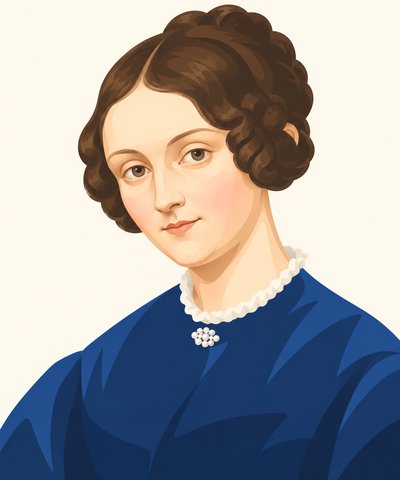
Johanna Kinkel was born in Bonn, the town where Beethoven was born, in 1810. Her name at birth was Johanna Mockel, and her father taught at the town’s grammar school. Her parents were musical, but they thought that music was only a hobby for a girl. When she asked for a good piano teacher and more time to practise, they said no. So at 12 she began to study old opera scores in secret, in the time she was supposed to spend on housework. She found a good teacher in the end: Franz Anton Ries, who had once been one of the young Beethoven’s teachers.
Her mother sent her to learn cooking in the kitchen of the best inn in Bonn. Johanna later wrote that she turned the recipes into verses and set them to music. Whenever she could, she slipped away to play the piano in the innkeeper’s family room. One day some guests from London heard her playing, and they wanted her to go to England to study. Her mother said no.
At 19 she became the leader of Ries’s singing club. For its carnival party she wrote her first published piece, a Bird Cantata. In it, five birds quarrel while they practise a song for their king, the eagle. She wrote both the words and the music. At 22 she married a bookseller from Cologne. The marriage was very unhappy, and after six months she went back to her parents.
In 1836, at 26, she met Mendelssohn in Frankfurt. He was a year older and already famous. The next time they met, she was playing a fugue by Bach before he came into the room. He stood outside the door and listened. Then he came in, praised her playing, and told her to go to Berlin to study. She took his advice, and for three years she studied the piano and composition in Berlin. In Berlin she sang in the choir at Fanny Hensel’s Sunday concerts. Fanny also asked her to play for the guests, and this brought her many pupils.
Her first songs were printed in Berlin. On the cover there was only her married name, with the letter “J.” in front of it. A critic in Schumann’s music journal praised their soft and tender feeling. He guessed that the “J.” stood for a girl’s name. Then Schumann himself asked her for a piece for his journal. She sent him her “wildest drinking song” for men’s choir. “If only I could see their faces when they sing it!” she wrote to a friend. Wasser und Wein (Water and Wine) is also a drinking song, and she dedicated the set to the same friend.
Back in Bonn she met the poet Gottfried Kinkel, who was five years younger. One evening a steamboat ran into their small boat on the Rhine. She could not swim, and Gottfried saved her. In 1843, at 32, she married him, and they had four children. She made her lessons fun. Her pupils wrote melodies over a bass line, and the best one won a prize. Then they all walked up a hill, drank coffee and played the winning tune on the church organ there. “A teacher must never bore anyone,” she wrote. “Perhaps the teacher, but never the pupil.”
In 1848 both Kinkels worked for a democratic Germany. Gottfried fought in the revolution, and he was captured and sentenced to life in prison. Johanna brought up the four children alone and earned the family’s money. In 1850 Gottfried’s former student, Carl Schurz, helped him escape. Schurz sent Johanna secret messages in invisible ink. Her eldest son later remembered watching his mother wash sheets of paper and dry them by the stove. The family escaped to London, where she earned their living by teaching the piano and singing. She also wrote a book of letters about teaching the piano, for mothers who taught their own children. She died in London in 1858, at 48. Many of her pupils walked behind her coffin.
Her family, her first husband and many critics thought that music was only a hobby for a woman. Johanna Kinkel made it her life’s work, as a composer, a choir leader and above all a teacher who made music fun.
Lieder von Johanna Kinkel singen
Diese Lieder sind in Singalong Solfege enthalten. Singen Sie sie in Solmisation mit Führungsstimme und Klavierbegleitung.
| Nr. | Schwierigkeit | Titel | Jahr | |
|---|---|---|---|---|
| Ex. 4-5 | ⑤ | Wasser und Wein | 1839 |